


How to Fix Facial Asymmetry: Your Guide to a Balanced Look
- Charis Aesthetics
- Jun 28, 2025
- 18 min read

Updated: Jun 29, 2025
Let’s be honest, perfect facial symmetry is incredibly rare. I’m talking unicorn-level rare. Almost everyone has some degree of asymmetry, and understanding where it comes from is the very first step toward knowing how to fix facial asymmetry.
Often, it's just part of the unique combination of features that makes you, you. But if it’s something that bothers you, it helps to know there are clear reasons behind it and, more importantly, effective ways to improve balance.
What Is Facial Asymmetry and Why Do We Have It?
Simply put, facial asymmetry just means the two halves of your face aren't perfect mirror images. Maybe one eye sits a tiny bit higher, a cheekbone seems more defined, or one side of your jawline feels softer than the other.
Before you lean into the mirror and start overanalysing, please know this is the norm, not the exception. In fact, studies have shown that complete, flawless facial symmetry is virtually non-existent in people.
The degree of asymmetry, however, can vary a lot—from tiny quirks you’d barely notice to more obvious imbalances. These differences come from all sorts of places. Some have been with you since birth, while others creep in over time. Getting to the bottom of these root causes is how we pinpoint the most effective solutions.
The Role of Genetics and Development
For many of us, the blueprint for our facial structure is written right into our DNA. It’s the same force that determines your eye colour and height, and it plays a huge part in the shape and alignment of your facial bones and muscles. If your parents have a slightly lopsided smile or one brow that sits higher, there’s a good chance you’ve inherited similar traits.
Developmental factors during childhood and adolescence also come into play. The way your teeth emerge, how your jaw grows, and the natural development of facial tissues can all lead to subtle—or sometimes not-so-subtle—imbalances. These kinds of asymmetries are completely natural and a fundamental part of who you are.
How Daily Habits Shape Your Face
Beyond your genes, your day-to-day habits have a surprisingly powerful impact on your facial structure over the years. We're often talking about subtle, repeated actions that you probably don’t even realise you're doing.
Think about these common habits:
Sleeping Position: Always sleeping on one side of your face puts prolonged pressure on the skin, muscles, and tissues. Over decades, this can contribute to a bit of volume loss or a slight shift on that side.
Chewing Patterns: Most of us have a favourite side for chewing. This can make the muscles on that side stronger and more developed, leaving the other side weaker. The result? A visible imbalance in the jaw and cheeks.
Posture: Slouching or constantly tilting your head to one side while on your computer or phone creates uneven tension in your neck and facial muscles. This can literally pull on your features and contribute to asymmetry.
Key Takeaway: Your lifestyle and habits do more than just affect your health; they physically sculpt your features over time. Becoming mindful of these small, repeated actions is one of the first and most powerful steps toward improving facial harmony.
The Natural Ageing Process
Ageing is another universal factor that throws symmetry off-kilter. As we get older, our faces naturally lose volume because of a decrease in fat, collagen, and elastin. This loss doesn't always happen evenly on both sides of the face.
One side might lose volume more quickly, leading to a flatter-looking cheek or a more hollowed appearance. Sun exposure can speed this up, too. If one side of your face has seen more sun over a lifetime (the driver's side is a classic example), the signs of ageing may show up there first.
Dental and Medical Influences
Finally, certain dental and medical conditions can be significant players. One of the most common causes is mandibular asymmetry, or an uneven jaw. It’s more widespread than you might think; research shows it affects a notable portion of people in the UK, with prevalence estimates ranging from 17.43% to as high as 72.95% in different studies.
For more severe cases, the UK's National Health Service (NHS) may even offer surgical correction if specific criteria are met. You can explore more about the importance of personalised treatment for mandibular asymmetry.
Other issues like an injury or trauma to the face, or conditions like Bell's Palsy (which causes temporary muscle weakness on one side), can also create asymmetry.
Understanding the full picture of why your face looks the way it does is what helps us figure out what can be done about it. The table below breaks down some of the most common factors I see in my clinic.
Common Factors Contributing to Facial Asymmetry
The journey to facial balance starts with understanding the "why." Here’s a breakdown of the primary influences that can lead to an uneven facial appearance, from your genes to your daily habits.
Cause Category | Specific Examples | How It Affects Your Face |
|---|---|---|
Genetics & Development | Inherited bone structure, congenital conditions, natural growth patterns during puberty. | This sets the fundamental 'blueprint' of your face. One side of the jaw may naturally be larger, or eye sockets may be set at slightly different heights. |
Lifestyle & Habits | Sleeping on one side, chewing predominantly on one side, poor posture (e.g., "tech neck"), smoking. | These repeated actions strengthen muscles on one side while weakening the other, leading to visible imbalances in the cheeks and jawline over time. |
Ageing Process | Uneven loss of fat, collagen, and elastin. Asymmetrical sun damage from driving or sitting near a window. | One side of the face may appear more hollowed or sag more than the other. Sun damage can cause more pronounced wrinkles and texture changes on one side. |
Dental Issues | Missing teeth, misaligned bite (malocclusion), temporomandibular joint (TMJ) disorders. | These issues can cause the jaw to shift or muscles to overcompensate, altering the alignment of the lower third of your face. |
Medical Factors | Facial injury or trauma, stroke, Bell's Palsy, torticollis (twisted neck), sinus issues. | These can directly damage nerves, muscles, or bones, or cause chronic inflammation that leads to noticeable asymmetry. |
Each of these factors tells part of the story. By identifying which ones apply to you, you can start exploring the most effective and targeted solutions, whether that's a simple lifestyle change or a professional aesthetic treatment.
At-Home Methods for Improving Facial Balance
If you’ve ever found yourself wondering how to fix facial asymmetry using techniques you can start today, the good news is there are several practical, non-invasive approaches. These at-home methods are all about improving muscle tone and making small lifestyle tweaks that, over time, can create a more balanced appearance.
It’s important to have realistic expectations. These methods are best for tackling minor imbalances caused by habits or muscle tension. They won’t change your bone structure, but they do empower you to take real steps toward enhancing your natural features with a bit of consistency and patience.
The Power of Facial Exercises and Yoga
Think of facial exercises as a targeted workout for your face. Just like you’d strengthen a weaker arm in the gym, you can work on the less dominant muscles in your face to improve their tone and create a subtle lift. Facial yoga takes this a step further, combining these exercises with massage-like movements to release tension and get the circulation flowing.
Here are a few targeted movements you can try at home:
The Jaw Balancer: Many of us unconsciously chew more on one side, which makes the muscles there stronger. To counter this, make a conscious effort to chew your food evenly on both sides. You can also do a gentle exercise: push your lower jaw forward slightly, hold for a few seconds, and relax. Repeating this helps balance out the jaw muscles.
The Cheek Lifter: If one cheek seems a bit flatter, try a "cheek lift." Smile widely without squinting your eyes, really focusing on lifting the cheek muscles. Hold this for 5-10 seconds, relax, and repeat several times. This helps strengthen and build up the muscles on the weaker side.
The Eyebrow Smoother: Does one eyebrow sit higher or furrow more? You can work on the muscles around it. Place your fingertips just above your brows and apply gentle pressure. Now, try to raise your eyebrows against the resistance of your fingers. This simple move can help release the chronic tension that might be pulling one brow up.
Consistency is your most important tool here. Weaving these small exercises into your daily routine—maybe while you're getting ready in the morning or winding down at night—is what leads to gradual, noticeable improvement.
Lifestyle Shifts for Better Facial Harmony
Beyond specific exercises, your day-to-day habits play a huge part in your facial symmetry. You might be surprised how much these small, repeated actions can influence your appearance over the years.
Making mindful adjustments can prevent asymmetry from getting worse and might even help correct it. Consider these simple but impactful changes.
Adjust Your Sleeping Position: Consistently sleeping on one side of your face puts constant pressure on the skin, muscles, and everything underneath. The best solution is to try sleeping on your back, which distributes pressure evenly. If that feels impossible, just make an effort to alternate which side you sleep on each night.
Improve Your Posture: Poor posture, especially the "tech neck" we get from staring down at our phones, creates uneven strain on our neck and facial muscles. This tension can literally pull down on one side of your face. Try to sit and stand with your shoulders back and your head held in a neutral position, keeping your ears aligned over your shoulders.
This simple infographic below breaks down the foundational steps for approaching facial asymmetry, from spotting it to planning your next move.
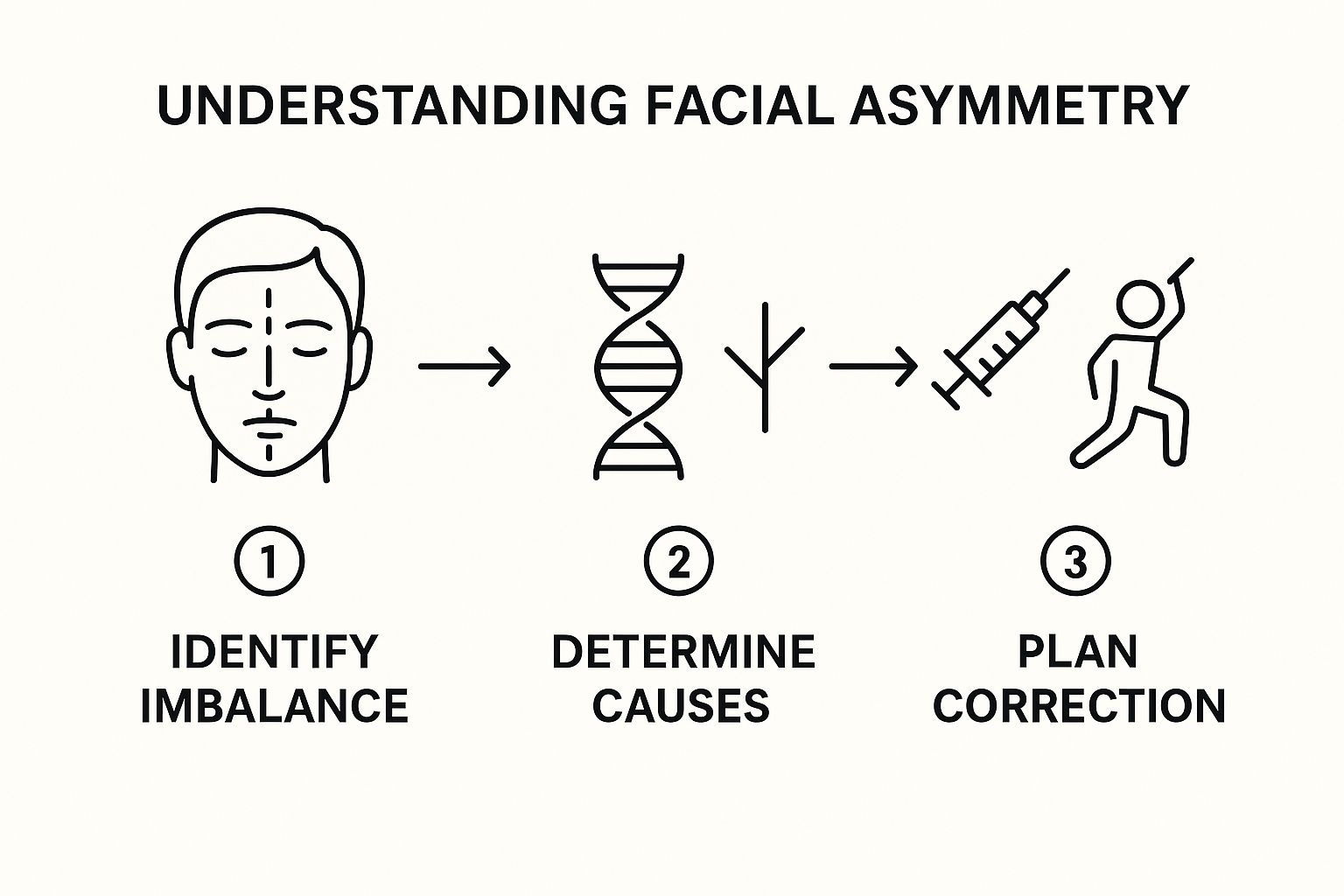
As the image shows, understanding what’s causing the imbalance is the first critical step before deciding on a solution, whether it's an at-home method or a professional treatment.
Combining At-Home Efforts with Professional Insight
While these at-home methods are a brilliant starting point for muscle-related asymmetry, they often work best when they complement other treatments. For imbalances caused by overactive muscles—like an uneven brow lift from a stronger forehead muscle—professional treatments can offer a more direct and effective solution.
For instance, you can learn more about how https://www.charis-aesthetics.co.uk/anti-wrinkle-injections are used to relax specific muscles and restore balance. Combining at-home toning exercises with professional muscle-relaxing treatments can create a powerful, synergistic effect for achieving real facial harmony.
Using Dermal Fillers and Botox for Facial Harmony
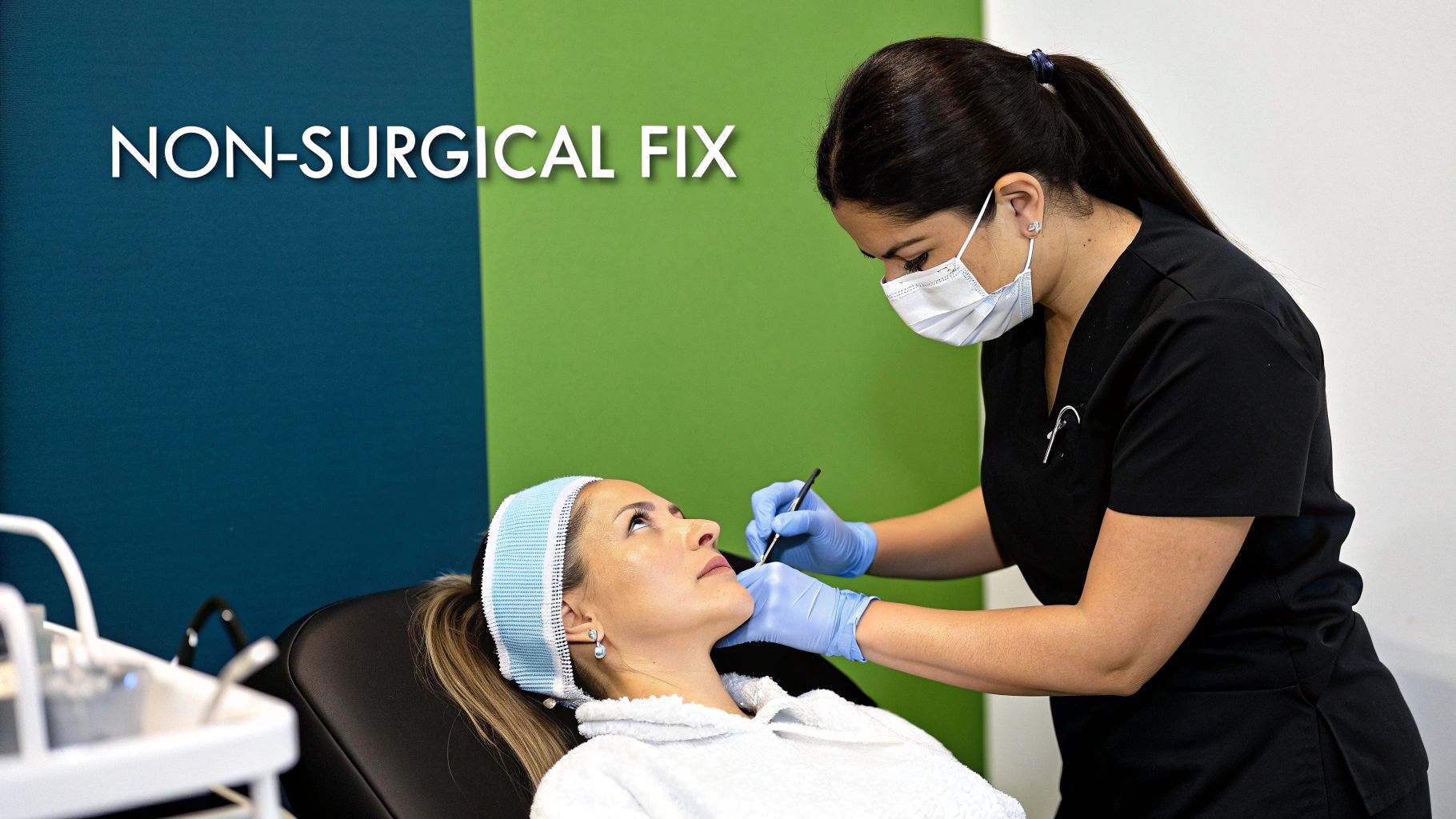
While at-home methods are a fantastic starting point for minor muscular imbalances, sometimes you need a more direct approach to see a significant change. This is where non-surgical aesthetic treatments, like dermal fillers and Botox, really come into their own. They represent a major step forward in our ability to correct facial asymmetry with precision and artistry, offering immediate improvements without the downtime of surgery.
These treatments are among the most popular options in UK aesthetic clinics for a reason. When handled by a skilled practitioner, they can subtly rebalance features, restore lost volume, and soften imbalances caused by overactive muscles. The goal is never to create an artificial or "frozen" look, but to enhance your natural structure for a more harmonious, refreshed appearance.
Strategically Adding Volume with Dermal Fillers
Dermal fillers are one of the most effective tools in our kit for tackling asymmetry caused by volume loss or an underlying structural imbalance. These are injectable gels, usually made from hyaluronic acid (a substance our skin produces naturally), which can be expertly placed to add subtle volume and definition right where it’s needed.
Think about it this way: if one cheekbone is naturally less prominent than the other, or one side of your jawline seems softer, a skilled injector can use a precise amount of filler to build up that area. It creates a more symmetrical and balanced profile. It’s a bit like being a sculptor, but the medium is your own unique facial structure.
Here’s how fillers can specifically help:
Balancing Cheeks: If ageing or genetics have left one cheek looking flatter, filler can restore that youthful contour and lift, bringing it into harmony with the other side.
Defining the Jawline: A weak or uneven jawline can be strengthened and defined. By adding filler along the mandible, we can create a sharper, more symmetrical lower face.
Correcting Chin Asymmetry: A chin that is slightly off-centre or less projected on one side can be balanced with a small amount of filler, improving the entire facial profile.
Evening out Temples: Hollowness in one temple, often due to age-related volume loss, can make the upper face look imbalanced. Dermal fillers can discreetly fill this area to restore a smoother, more symmetrical contour.
The real artistry lies in the "less is more" approach. The aim is to make such subtle adjustments that you simply look more balanced and rested, not like you’ve "had work done." A qualified practitioner will assess your face from all angles to determine the exact placement and amount needed for a natural result.
How Botulinum Toxin (Botox) Relaxes and Rebalances
While fillers add volume, Botulinum Toxin (commonly known as Botox) works by relaxing muscles. This is incredibly useful for asymmetry caused by one muscle being stronger or more active than its counterpart on the other side of your face. These overactive muscles can pull features out of alignment, and Botox temporarily quiets them down to restore balance.
A classic example is an uneven brow lift, where one eyebrow naturally sits higher because the muscle lifting it is stronger. By placing a tiny, precise amount of Botox into that stronger muscle, we can allow it to relax, letting the brow settle into a more symmetrical position.
Common scenarios where Botox is the ideal solution include:
Uneven Eyebrows: A few carefully placed injections can relax the muscle pulling one brow too high, creating a more even and serene expression.
A Gummy or Lopsided Smile: If one side of your upper lip pulls up more dramatically when you smile, Botox can relax that muscle for a more balanced look.
Jaw Clenching (Bruxism): Many people grind their teeth or clench their jaw more on one side, often while sleeping. This can lead to an overdeveloped masseter muscle, making one side of the jaw look larger and squarer. Botox can slim this muscle, not only improving symmetry but also relieving related tension headaches and jaw pain.
What to Expect During a Treatment Session
Your journey will always start with a thorough consultation. Honestly, this is the most important step. It's where you and your practitioner discuss your concerns, analyse your facial structure, and agree on a realistic treatment plan. They should explain exactly what they recommend and why.
The treatment itself is relatively quick. After the area is cleansed, the practitioner will use a very fine needle to inject the filler or Botox into the targeted areas. Most high-quality fillers already contain a local anaesthetic to minimise discomfort, and a topical numbing cream can also be applied beforehand.
Afterwards, you might see some mild redness, swelling, or bruising at the injection sites, but this usually settles down within a few days. One of the biggest upsides is the minimal downtime; you can typically get back to your normal routine straight away.
Longevity and Maintenance of Results
It’s important to know that these treatments aren't permanent, which many people actually see as a benefit. It allows for adjustments over time as your face continues to change naturally.
Here’s a general guide to how long you can expect the results to last:
Treatment | Typical Longevity | Key Factors Influencing Duration |
|---|---|---|
Botulinum Toxin (Botox) | 3-4 months | Your individual metabolism and the dosage used. |
Hyaluronic Acid Fillers | 6-18 months | The type of filler used (thinner fillers for lips last less time than thicker ones for cheeks), the area treated, and your body's metabolic rate. |
To maintain your beautifully balanced results, you’ll need to schedule follow-up treatments. Your practitioner will advise you on the best schedule for your specific needs. This approach allows for ongoing refinement and ensures your results always look fresh and natural.
Dermal fillers are also incredibly effective for balancing other features, such as the lips. You can see some great examples of how even subtle adjustments can create a more symmetrical smile by exploring some [lip filler before and after examples](https://www.charis-aesthetics.co.uk/post/6-lip-filler-before-and-after-examples-in-2025). This really shows the power of precision in achieving harmony.
When to Consider Medical and Surgical Options
While at-home methods and non-surgical aesthetic treatments can work wonders, sometimes facial asymmetry comes from deeper, structural issues. If the imbalance stems from your underlying bone, jaw, or how your teeth align, medical and surgical options are often the most effective—and permanent—solutions.
This isn’t about chasing an impossible ideal of perfection. It’s about tackling significant functional or structural imbalances that can affect not just your appearance but your quality of life. In the UK, these pathways can range from orthodontic work to more involved surgical procedures, and each is designed to address a very specific problem.
Deciding to go down this route is a big step. It means detailed consultations with specialists, getting a clear picture of the process, and having realistic expectations about recovery and results. Think of it as a journey to restore balance from the foundation up.
Orthodontic Treatments for Foundational Balance
Often, the real source of facial asymmetry is hidden in the way our teeth and jaws meet. An issue like a crossbite, where the upper and lower teeth don’t line up properly, can force the jaw to shift to one side. The result? A noticeable imbalance in the lower third of the face.
Orthodontic treatments are designed to correct these foundational problems.
Traditional Braces: By applying gentle, continuous pressure, braces guide teeth into their ideal positions. This doesn't just straighten your smile; it can resolve bite issues, improve jaw alignment, and subtly enhance facial symmetry.
Clear Aligners: For less complex cases, clear aligners offer a discreet alternative to straighten teeth and fix misalignments, which can also contribute to a more balanced look.
Fixing these dental issues often creates a positive ripple effect, improving the position of your lips, chin, and overall facial profile. It’s a real long-term investment in both your oral health and your facial harmony.
Surgical Solutions for Significant Asymmetry
When the asymmetry is caused by the actual size, shape, or position of your facial bones, surgery might be the best way forward. These procedures are highly specialised and aim to create lasting, structural change.
Rhinoplasty for Nasal Harmony
The nose sits right at the centre of the face, so if it’s crooked or asymmetrical, it can throw everything else off balance. A rhinoplasty, or "nose job," is a surgical procedure that reshapes the nasal bone and cartilage. An experienced surgeon can straighten a deviated septum, refine the tip, or adjust the bridge to create a look that’s more in harmony with your other features. The goal is always a natural-looking nose that fits your face perfectly.
Facial Implants for Structure and Volume
If asymmetry is caused by a lack of underlying bone structure on one side, facial implants offer a permanent fix. These are custom-made from biocompatible materials and can be placed to build up areas like the:
Cheeks: To add volume to a flatter cheek so it matches the other side.
Jawline: To sculpt a stronger, more defined, and symmetrical jaw.
Chin: To correct a chin that appears recessed or off-centre.
Unlike fillers, which are temporary, this procedure adds permanent volume and definition where it’s needed most.
Orthognathic (Jaw) Surgery
For major skeletal and dental misalignments, orthognathic surgery is the gold standard. This complex procedure involves surgically repositioning the upper jaw, lower jaw, or sometimes both. It's often combined with orthodontic work to correct severe underbites, overbites, or crossbites that cause significant facial asymmetry. While the recovery is a serious commitment, the results can be life-changing, improving everything from function (chewing and speaking) to overall facial balance.
The UK Context: NHS vs Private Care
Here in the UK, the route you take often boils down to the cause and severity of your asymmetry. The National Health Service (NHS) may cover procedures that are deemed medically necessary. For example, jaw surgery to fix a severe malocclusion that’s impacting your ability to eat or speak could be covered.
However, treatments seen as primarily cosmetic—like a rhinoplasty for purely aesthetic reasons or fillers to balance minor volume loss—typically aren't. For these, you’d need to go to a private clinic. It’s crucial to understand this distinction as you weigh up your options.
It's also worth highlighting the incredible work being done to prevent asymmetry in medical settings. For instance, over 25% of childhood cancers in the UK require radiotherapy to the head and neck, which can damage growing bones and cause facial asymmetry later on. Cutting-edge UK research is now focused on optimising how radiation is delivered to minimise this risk for young survivors. You can read about the research aimed at reducing facial asymmetry risk. Making treatments safer is just as vital as fixing existing issues.
Ultimately, deciding between at-home, non-surgical, and surgical options is a personal choice that needs careful thought and expert guidance. For those who do opt for injectable treatments like Botox to manage muscular asymmetry, it's smart to know how to get the most from your investment. You can check out our guide on how to make Botox last longer with expert tips from Lancashire for some practical advice.
Finding the Right UK Professional for Your Needs

When you're ready to tackle facial asymmetry, choosing the right person for the job is probably the single most important decision you'll make. Whether you're considering dermal fillers, orthodontic work, or even surgery, this isn’t a decision to rush. The UK has some incredible practitioners, but the key is knowing how to find them.
This isn't just about finding someone qualified to perform a procedure. It's about finding a genuine partner for your journey—someone who listens intently, understands your personal goals, and has both the technical skill and artistic vision to deliver natural-looking results. Your peace of mind is everything.
Your Vetting Checklist
Before you even think about booking a consultation, you need to do your homework. Any credible professional will be completely transparent about their qualifications and proud to show you their work. Think of it as your non-negotiable vetting process.
Here’s a practical checklist to help you find a trustworthy practitioner in the UK:
Check Their Qualifications and Registration: This is your first line of defence. For any medical procedure, ensure your surgeon or doctor is on the General Medical Council (GMC) register. If a nurse is performing an aesthetic treatment, they must be registered with the Nursing and Midwifery Council (NMC). This is the absolute minimum standard for safe practice.
Examine Their Portfolio: A picture is worth a thousand words. Scrutinise their before-and-after photos. Do they feature patients with concerns similar to yours? You're looking for natural, balanced results that showcase a high level of skill—not a cookie-cutter, "one-size-fits-all" look.
Read Genuine Patient Reviews: Don't just rely on the glowing testimonials on their website. Dig a little deeper. Independent platforms like Google Reviews or Trustpilot offer a much more balanced perspective on the entire patient experience, from the first phone call to the final follow-up.
This initial research is crucial for building a shortlist of professionals who tick all the boxes for safety and competence.
The Consultation Is Your Interview
Let's reframe the consultation. It's not just them assessing you; it's your chance to interview them. You're in the driving seat. This is where you get a feel for their expertise, their bedside manner, and whether you feel truly comfortable putting your trust in their hands. A good practitioner will welcome every question you have and give you clear, honest answers.
Come prepared with a list of questions. Here are a few essentials to get you started:
How many times have you performed this exact procedure for facial asymmetry?
What specific products or techniques are you recommending for me, and why?
What are the potential risks and side effects, and how do you handle them if they occur?
What does the aftercare involve, and who should I contact if I have a problem?
Remember, the goal of any treatment is improvement and balance, not impossible perfection. A responsible practitioner will manage your expectations from the start, explaining what is realistically achievable for your unique facial structure. If someone promises perfection or dismisses your concerns, take that as a major red flag.
For some people, asymmetry stems from medical conditions like facial palsy. In these cases, finding a true specialist is vital. A revealing survey by Facial Palsy UK found that only 25% of respondents had access to a specialist clinic at their hospital. This results in long waits and less-than-ideal care, highlighting just how critical it is to find someone with targeted expertise. You can learn more about the challenges patients face and the importance of specialised care on their site.
Ultimately, making an informed decision is all about feeling confident, safe, and completely aligned with your practitioner's vision. Taking your time to find the right professional will ensure your journey toward facial harmony is a positive and rewarding one.
Your Questions About Facial Asymmetry Answered
As you start looking into how to fix facial asymmetry, it’s completely natural for questions to bubble up. Getting to grips with the practical side of things—from costs to how long results last—is a huge part of making a decision you feel good about. Here are the answers to some of the most common queries we hear from our clients.
How Much Do Dermal Fillers for Facial Asymmetry Cost in the UK?
There’s no one-size-fits-all answer here, simply because every treatment is built around you. That said, as a general guide, you can expect the cost to be somewhere between £300 and £800 per syringe here in the UK.
So, what influences that final figure? A few things. The type of filler we use is a big factor, as different formulations are designed for different jobs and come at different price points. The amount of product needed is also key—balancing a slightly uneven jawline will naturally require less filler than sculpting and adding significant volume to a cheek. Finally, the clinic's location and the practitioner's level of experience will play a part in the overall cost.
Are Facial Exercises for Asymmetry Actually Effective?
Facial exercises can be a great tool, but it's important to be realistic about what they can achieve. If you have very minor imbalances caused by muscle tone, then yes, consistent practice can definitely help strengthen the weaker side and create a little more harmony.
However, they’re not a magic bullet. For more noticeable asymmetry that’s down to your bone structure or genetics, exercises won't be a substitute for professional treatment. It’s best to think of them as a supportive measure—fantastic for maintenance and subtle improvements, but not a standalone fix for every situation.
The honest truth is that perfect symmetry is not a realistic goal. The aim of any treatment, whether it’s an at-home exercise or a professional procedure, is to create better harmony and balance. Striving for mathematical perfection is a losing game, as it simply doesn't exist in nature.
How Long Do Non-Surgical Results Last?
This is a big consideration for most people. The great thing about non-surgical treatments is that the results aren't permanent, which allows for tweaks and adjustments as your face continues to change naturally over the years.
Here’s a rough timeline of what you can expect:
Botulinum Toxin (Botox): When we use it to relax muscles that are pulling one side of the face more than the other, the effects typically last for about 3 to 4 months. Your own metabolism can make this a little shorter or longer.
Dermal Fillers: The lifespan of hyaluronic acid fillers has a wider range. Depending on the thickness of the product, where it’s placed, and how quickly your body breaks it down, results can last anywhere from 6 to 18 months.
Is It Possible to Achieve Perfect Symmetry?
This might be the most important question of all, and the answer is a simple, honest no. No one has a perfectly symmetrical face—not even supermodels. Chasing that impossible ideal is a fast track to disappointment and can lead to results that look unnatural.
The real goal when addressing facial asymmetry is improvement, not perfection. A skilled practitioner isn't trying to make you look like a different person. They’re working to enhance your unique features, restore a sense of balance, and bring everything into a more harmonious alignment. The most beautiful outcomes are always the ones that respect your natural facial structure.
Ready to explore how personalised aesthetic treatments can enhance your natural balance and boost your confidence? At Charis Aesthetics, we combine medical expertise with an artistic eye to deliver subtle, beautiful results. Book your complimentary consultation today to start your journey.
Comments