


8 Types of Dermal Fillers: Your 2025 Guide to a Fresher Look
- Charis Aesthetics
- Jul 22, 2025
- 17 min read

Navigating the world of aesthetic treatments can feel overwhelming, but understanding the different types of dermal fillers is the first step toward making a confident, informed decision. More than just a simple wrinkle treatment, modern fillers are sophisticated tools used to restore lost volume, enhance facial contours, and rejuvenate your appearance in a way that feels authentically you. Making the right choice is crucial for achieving natural-looking, beautiful results, and that choice begins with knowledge.
This guide is designed to provide that clarity. We will break down the primary categories of dermal fillers available today, moving beyond marketing claims to explore the science behind each option. You will learn about their core composition, their specific use cases, how long you can expect the results to last, and the key pros and cons of each. This comprehensive overview is essential whether you are considering subtle lip enhancement, seeking to address volume loss in your cheeks, or exploring options for long-term collagen stimulation.
From the widely used Hyaluronic Acid (HA) fillers to advanced biostimulators like Poly-L-Lactic Acid (PLLA) and even autologous options like fat grafting, this article will serve as your definitive resource. We will cover the following key filler types in detail:
Hyaluronic Acid (HA) Fillers
Calcium Hydroxylapatite (CaHA)
Poly-L-Lactic Acid (PLLA)
Polymethylmethacrylate (PMMA)
Polydioxanone (PDO) Thread Fillers
Autologous Fat Transfer
Platelet-Rich Plasma (PRP) Combination
Medical-Grade Silicone Fillers
By understanding how these treatments work, you can better articulate your goals and collaborate with your aesthetic practitioner to create a personalised plan that aligns perfectly with your desired outcome.
1. Hyaluronic Acid (HA) Fillers: The Gold Standard in Reversible Rejuvenation
When exploring the different types of dermal fillers, Hyaluronic Acid (HA) fillers are undeniably the most prevalent and versatile option in aesthetic medicine. Their popularity stems from their remarkable safety profile and efficacy. Hyaluronic acid is a naturally occurring sugar molecule found in our own bodies, primarily within the skin and connective tissues, where it plays a crucial role in hydration and lubrication by binding to water.
As we age, our natural production of HA diminishes, contributing to volume loss, dehydration, and the formation of wrinkles. HA fillers, formulated as a smooth, injectable gel, work by replenishing this lost volume. This not only smooths out lines but also rehydrates the skin from within, restoring a youthful, supple appearance. Because the substance is native to the body, the risk of an allergic reaction is exceptionally low.
Common Applications and Expected Results
The versatility of HA fillers is a key reason for their gold-standard status. Different formulations, with varying particle sizes and cross-linking, are designed to address specific concerns throughout the face.
Lip Enhancement: For adding subtle volume, improving symmetry, and defining the vermillion border, softer products like Juvéderm Volbella or Restylane Kysse are ideal.
Mid-Face Contour: To restore volume to sunken cheeks or build a more defined facial structure, denser fillers such as Juvéderm Voluma or Restylane Lyft are used to provide lift and support.
Smoothing Lines: Fine to moderate lines, like nasolabial folds (smile lines) and marionette lines, can be effectively softened with flexible fillers like Belotero Balance or Restylane Refyne, which integrate smoothly into the skin.
This infographic summarises the key features that make HA fillers a leading choice.
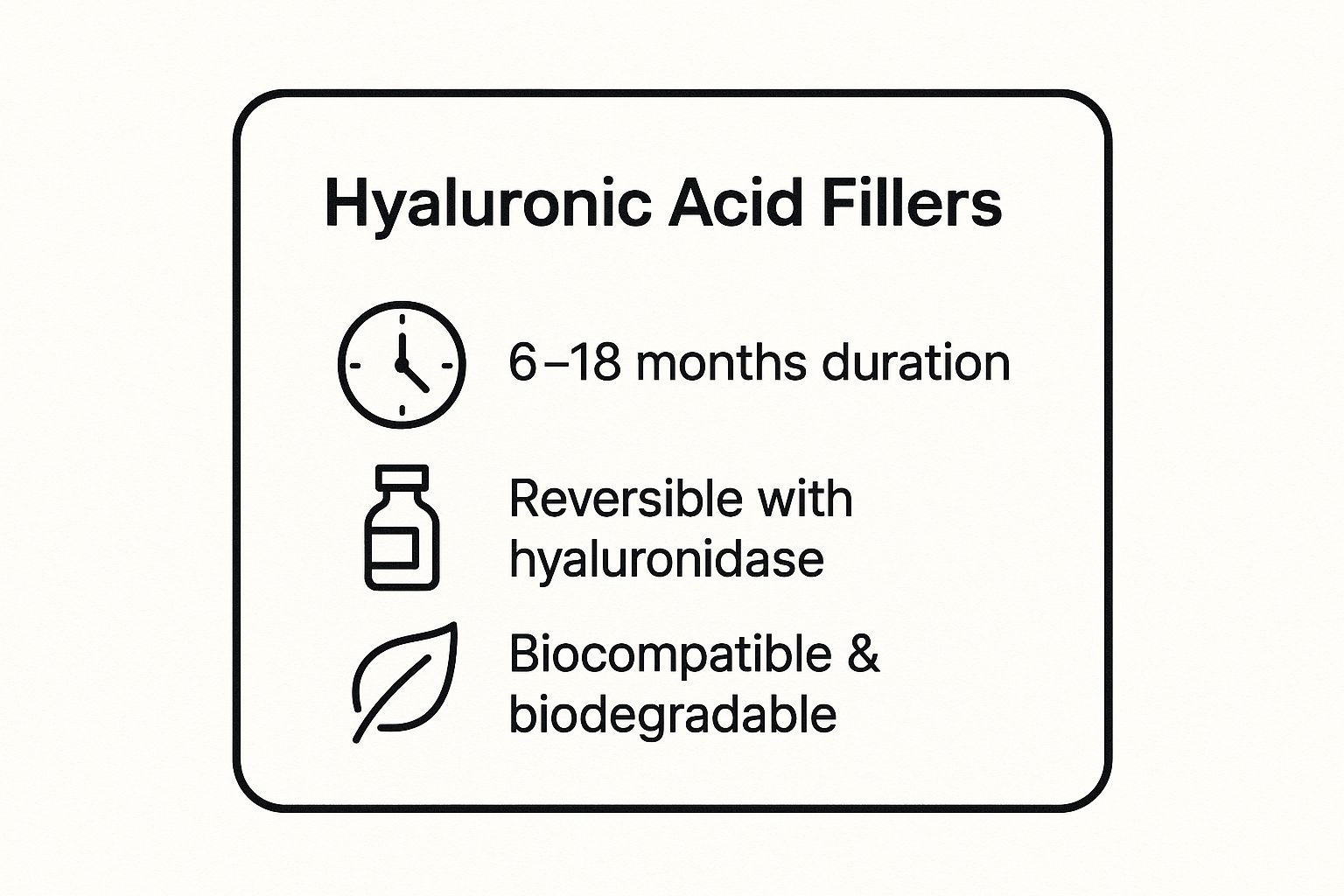
These core benefits - biocompatibility, reversibility, and a significant duration of effect - provide a unique combination of safety and performance for patients.
Key Considerations for HA Filler Treatment
Perhaps the most significant advantage of HA fillers is their reversibility. In the rare event of a complication or if a patient is unhappy with the outcome, an enzyme called hyaluronidase can be injected to dissolve the filler safely and efficiently. This provides an unparalleled level of control and peace of mind. While HA fillers are metabolised naturally by the body over time, this offers an immediate solution if needed. For those interested in HA for pure hydration rather than volume, you can explore skin booster treatments, which use a similar substance differently.
2. Calcium Hydroxylapatite (CaHA) Fillers: The Dual-Action Collagen Stimulator
Moving beyond HA, another of the key types of dermal fillers is Calcium Hydroxylapatite (CaHA). This unique compound offers a dual-action approach to facial rejuvenation, providing both immediate volume and long-term structural improvement. CaHA consists of tiny, smooth calcium microspheres suspended in an aqueous gel carrier. This substance is biocompatible, as calcium hydroxylapatite is a mineral naturally found in our bones and teeth.

When injected, the gel provides instant volume and lift to correct moderate to severe wrinkles and folds. Over the following weeks and months, the gel is absorbed by the body, leaving behind the calcium microspheres. These microspheres act as a scaffold, stimulating your body’s natural collagen production (a process known as neocollagenesis). This new collagen growth provides lasting structural support to the skin, improving its quality and firmness long after the initial filler has been metabolised. The most well-known CaHA filler is Radiesse, popularised by Merz Aesthetics.
Common Applications and Expected Results
Due to its firm consistency and collagen-stimulating properties, CaHA is ideal for deeper structural enhancement rather than for fine lines or delicate areas. It excels in areas requiring robust support and definition.
Jawline and Chin Definition: CaHA is highly effective for sculpting a more defined jawline, correcting jowls, and augmenting the chin for a stronger profile.
Cheek Enhancement: It provides significant lift and contour to the mid-face, restoring volume to sunken cheeks for a more youthful appearance.
Hand Rejuvenation: CaHA can be used to restore lost volume on the back of the hands, minimising the visibility of veins and tendons.
Non-Surgical Nose Reshaping: Its firmness makes it suitable for correcting minor bumps and asymmetries on the nasal bridge.
The initial volumising effects are visible immediately, but the full benefit unfolds over two to three months as new collagen develops, leading to results that can last for 12 to 18 months, or even longer in some patients.
Key Considerations for CaHA Filler Treatment
A primary advantage of CaHA is its longevity and its ability to act as a biostimulator, improving skin quality over time. However, unlike HA fillers, it is not immediately reversible. This makes the choice of a highly skilled and experienced practitioner absolutely critical to ensure precise placement and a natural-looking outcome.
It's best suited for patients with more significant volume loss, typically those over 35, who can benefit from its robust lifting capacity. To ensure smooth integration and prevent the formation of nodules, your practitioner may gently massage the treated area post-injection. Due to its thicker nature, it should not be used in areas with thin skin, such as the lips or the delicate under-eye region.
3. Poly-L-Lactic Acid (PLLA) Fillers: The Gradual Collagen Stimulator
Shifting from direct-volume fillers to bio-stimulators, Poly-L-Lactic Acid (PLLA) represents a different approach within the types of dermal fillers. Marketed most famously as Sculptra, PLLA is a biocompatible and biodegradable synthetic polymer that has been used safely in medical devices for decades. Unlike HA fillers that provide immediate plumping, PLLA works by stimulating your body’s own natural collagen production over time.
The PLLA microparticles are injected into the deep dermis, where they act as a scaffold. This process triggers a controlled inflammatory response that encourages fibroblasts to produce new, robust collagen. As the PLLA particles are gradually absorbed and metabolised by the body over several months, a new network of collagen is left behind, restoring underlying facial structure and volume for a remarkably natural and long-lasting result.

Common Applications and Expected Results
PLLA is not designed for fine lines or specific wrinkle filling; its strength lies in broad-scale volume restoration and structural support. The results appear gradually over a few months, making it an excellent choice for those who prefer a subtle, non-abrupt enhancement.
Global Facial Volumisation: Ideal for treating widespread volume loss across the mid-face, temples, and jawline, restoring youthful contours.
Temple Hollowing: It effectively rebuilds the structure in hollow temples, a common sign of ageing that other fillers may not address as effectively.
Body Contouring: The "Sculptra butt lift" is a popular non-surgical procedure that uses PLLA to add subtle volume and improve the shape of the buttocks.
Correcting Lipoatrophy: PLLA is medically approved to treat facial fat loss (lipoatrophy) associated with certain medical conditions.
Key Considerations for PLLA Filler Treatment
Success with PLLA requires patience and adherence to a specific treatment plan, as it is a multi-session process. The final outcome is not seen for several months after the last session, but the results can last for two years or more, making it one of the longest-lasting injectable treatments available.
A critical component of the treatment is post-procedure massage. Patients must follow the "5-5-5 rule": massage the treated areas for five minutes, five times a day, for five days. This ensures the PLLA particles are evenly distributed, preventing the formation of nodules and promoting uniform collagen growth. Unlike HA fillers, PLLA is not reversible, so choosing an experienced practitioner who understands the unique properties of this product is paramount.
4. Polymethylmethacrylate (PMMA) Fillers: The Permanent Volume Solution
Among the various types of dermal fillers, Polymethylmethacrylate (PMMA) fillers stand out for their permanence. PMMA is a biocompatible, synthetic substance that has been used in medical implants for decades. In dermal fillers, it consists of microscopic beads, or microspheres, suspended in a smooth, gel-like carrier, which is typically composed of bovine collagen.
The mechanism is twofold. Upon injection, the collagen gel provides immediate volume and lift, smoothing the treated area instantly. Over the next few months, this collagen carrier is naturally absorbed by the body. As it dissipates, the PMMA microspheres remain in place, acting as a scaffold that encourages your body to produce its own natural collagen to encapsulate them. This process creates a durable, long-term support structure within the skin.
Common Applications and Expected Results
Due to their permanent nature, PMMA fillers are reserved for specific, deep-set structural concerns and are not suitable for areas with thin skin or significant movement, such as the lips or around the eyes.
Deep Wrinkle Correction: They are highly effective for correcting deep nasolabial folds (smile lines) and other significant facial creases that require robust structural support.
Acne Scar Treatment: PMMA is an excellent choice for filling pitted, atrophic acne scars, providing a permanent solution to lift the indentations and create a smoother skin texture. Bellafill is the primary brand approved for this indication.
Restoring Facial Volume: It can be used to address significant volume loss associated with ageing or conditions like HIV-associated facial lipoatrophy, restoring contours to the cheeks and temples.
Key Considerations for PMMA Filler Treatment
The defining characteristic of PMMA fillers is their permanence, which is both a significant benefit and a crucial consideration. Unlike HA fillers, the results cannot be easily reversed, making the choice of practitioner paramount. A skin test is required before treatment to ensure you do not have an allergy to the bovine collagen carrier.
Because the final outcome develops over several months as your own collagen grows, a conservative approach is essential. It is often recommended to start with a smaller amount and build upon the results if necessary. Patients considering PMMA should have stable aesthetic goals and may benefit from trying a temporary filler first to confirm they are happy with the potential final look before committing to a permanent change.
5. Polydioxanone (PDO) Thread Fillers: The Dual-Action Lift and Volumiser
While not a traditional injectable gel, Polydioxanone (PDO) thread fillers represent a unique and innovative category within the broader field of non-surgical rejuvenation, making them a key consideration when discussing types of dermal fillers. PDO is a biocompatible and fully absorbable polymer that has been used safely in medical sutures for decades. In aesthetics, these fine threads are strategically inserted into the subdermal layer of the skin to provide an immediate mechanical lift while also stimulating long-term collagen production.
The treatment works on two levels. First, the placement of the threads creates a supportive scaffold under the skin, physically lifting and tightening sagging tissues. Second, as the body’s natural healing response is triggered, it begins to produce new collagen around the threads. This process, known as neocollagenesis, builds a stronger, firmer skin structure from within. The threads themselves dissolve naturally over 6 to 8 months, but the revitalising effects of the new collagen can last much longer.
Common Applications and Expected Results
PDO threads come in various forms, including smooth (mono) threads for skin revitalisation, screw threads for targeted volume, and barbed (cogs) for significant lifting. This allows practitioners to customise treatments for specific patient needs.
Mid-Face and Jowl Lift: Barbed threads, such as Nova PDO threads or Aptos threads, are expertly used to lift sagging skin in the cheeks and jawline, creating a more defined and youthful contour.
Brow Lift: Strategically placed threads can elevate drooping eyebrows, opening up the eye area for a refreshed and less tired appearance.
Neck and Décolletage Tightening: Smoother threads can be used to create a "mesh" that firms up crepey skin on the neck and chest, improving texture and reducing laxity.
The dual benefit of an instant lift combined with progressive, natural-looking skin rejuvenation makes PDO threads a powerful tool in aesthetic medicine.
Key Considerations for PDO Thread Filler Treatment
A crucial factor for success with PDO threads is the practitioner’s skill. The technique requires a deep understanding of facial anatomy to ensure the threads are placed correctly for optimal lift and safety. While the procedure is minimally invasive, it is more technique-dependent than standard filler injections. Unlike HA fillers, PDO threads are not instantly reversible, so choosing a highly experienced and reputable provider is paramount. The results are gradual and natural, with the full benefit of collagen stimulation becoming apparent over the months following treatment.
6. Autologous Fat Transfer (Fat Grafting): The Body's Own Natural Filler
Among the different types of dermal fillers, Autologous Fat Transfer, also known as fat grafting, stands out as a uniquely natural and long-lasting approach. This procedure involves a two-step process where a patient’s own fat is harvested from one area of the body, purified, and then strategically reinjected into another area that requires volume enhancement. The fat is typically taken from areas with ample reserves, such as the abdomen, thighs, or buttocks, using a gentle liposuction technique.
The core principle behind fat grafting is its complete biocompatibility. Since the "filler" is the patient's own tissue, the risk of allergic reactions or rejection is virtually eliminated. This method not only restores volume but also leverages the regenerative properties of adipose-derived stem cells present in the harvested fat, which can improve the texture and quality of the overlying skin. This makes it an excellent option for those seeking significant, natural-looking results with a permanent potential.
Common Applications and Expected Results
Fat transfer is exceptionally versatile, capable of addressing volume loss on both a small and large scale. Its applications range from subtle facial rejuvenation to more substantial body contouring.
Facial Rejuvenation: Fat grafting is highly effective for restoring age-related volume loss in the cheeks, temples, and under-eye area. It can also be used to soften deep nasolabial folds and marionette lines for a comprehensive and harmonious result.
Body Contouring: Famous procedures like the Brazilian Butt Lift (BBL) rely on fat grafting to enhance shape and projection. It is also a popular choice for natural breast augmentation and can be used to rejuvenate the appearance of ageing hands.
Scar Revision: The regenerative qualities of fat can help improve the appearance of depressed or atrophic scars by filling the deficit and enhancing skin quality.
It is important to understand that not all of the transferred fat will survive. On average, practitioners expect a 50-70% survival rate, meaning some of the initial volume will diminish as the body reabsorbs a portion of the fat cells. The cells that do survive establish a new blood supply and become a permanent part of the local tissue.
Key Considerations for Fat Transfer Treatment
Choosing fat grafting is a more involved commitment compared to off-the-shelf fillers. The procedure is considered minor surgery, requiring local anaesthesia and sometimes sedation. It also involves a longer recovery period, with swelling and bruising common in both the donor and recipient sites. However, the reward is a result that can last for many years, far outliving synthetic fillers.
For this procedure, selecting a board-certified plastic surgeon with extensive experience in fat grafting techniques, pioneered by figures like Dr. Sydney Coleman, is paramount to ensure safety and optimal cell survival. Patients should also maintain a stable weight post-procedure, as significant weight fluctuations can alter the results. It is also important to differentiate this volume-adding procedure from treatments designed for fat reduction. For those interested in targeted fat removal, you can explore fat dissolving injections, which serve the opposite purpose.
7. Platelet-Rich Plasma (PRP) with Fillers: A Regenerative Enhancement
Among the various types of dermal fillers, Platelet-Rich Plasma (PRP) represents a cutting-edge, autologous approach to rejuvenation. Rather than being a filler in the traditional sense, PRP is a concentration of platelets and growth factors derived from the patient's own blood. This bio-stimulating substance works by kickstarting the body's natural healing and regenerative processes, leading to the creation of new collagen, improved blood supply, and repaired tissues.
The procedure involves a simple blood draw, after which the blood is spun in a centrifuge to separate the platelets, creating a golden, plasma-rich serum. This PRP can be injected on its own to improve skin quality or, more commonly, used in combination with other dermal fillers. When paired with a filler like Hyaluronic Acid, PRP acts as a biological booster, enhancing the filler's volumising effects and simultaneously improving the overlying skin's texture, tone, and vitality for a truly comprehensive, natural-looking result.
Common Applications and Expected Results
PRP's regenerative power makes it a versatile tool for enhancing aesthetic outcomes, particularly when combined with other treatments or used to target specific cellular-level concerns.
Under-Eye Rejuvenation: For dark circles and crepey skin under the eyes, a combination of a soft HA filler and PRP (often called a 'vampire tear trough' treatment) can both fill hollows and improve skin quality.
Full-Face Revitalisation: The famous 'vampire facial' combines microneedling with a topical application of PRP. This drives the growth factors deep into the skin to stimulate profound collagen production, reducing fine lines and improving texture.
Enhanced Filler Longevity: When mixed with HA fillers for treating areas like the nasolabial folds, PRP may help prolong the filler's effects and provides ongoing skin health benefits long after the filler has metabolised.
Key Considerations for PRP Treatment
The primary advantage of PRP is its autologous nature; because it uses your own biological material, the risk of allergic reaction or rejection is virtually non-existent. It is a treatment that heals and regenerates from within, offering improvements that go beyond simple volume replacement. The focus is on long-term skin health and natural enhancement, rather than just filling a space.
For those specifically interested in the skin revitalisation benefits, you can discover more about the power of vampire facials, which harness PRP for a radiant complexion. To ensure optimal results, patients are advised to avoid blood-thinning medications before the procedure and should anticipate that a series of treatments may be required to achieve their desired outcome.
8. Silicone-Based Fillers (Medical Grade): A Permanent, Controversial Solution
Among the various types of dermal fillers, liquid injectable silicone represents a permanent, yet highly controversial, option. Medical-grade silicone oil is a synthetic polymer that, unlike temporary fillers, is not metabolised or absorbed by the body. Once injected, it provides a permanent volume enhancement by stimulating the body to form a capsule of collagen around the microdroplets, which then integrates with the tissue.
This method requires extreme precision and an advanced "microdroplet" technique, where tiny amounts of silicone are injected over multiple sessions. This gradual approach is crucial to avoid overfilling and minimise the risk of complications. Due to its permanence and potential for severe adverse reactions if performed incorrectly, it is one of the least common filler types and is often reserved for very specific medical applications by a handful of highly specialised practitioners.
Common Applications and Expected Results
Silicone fillers are not used for general cosmetic enhancements like fine lines or lip plumping. Their use is typically restricted to reconstructive purposes or severe volume loss where other fillers may be unsuitable or financially impractical over the long term.
HIV-Associated Facial Lipoatrophy: Silicone can be highly effective in correcting the severe facial wasting and sunken cheeks that can occur as a side effect of certain antiretroviral therapies.
Correction of Severe Asymmetry: For significant congenital or post-traumatic facial asymmetry, silicone can provide a lasting and stable correction.
Post-Surgical Volume Restoration: It can be used to fill defects left after tumour removal or other reconstructive surgeries.
Treatment of Depressed Scars: Deep, atrophic scars, such as those from severe acne, can be permanently raised and smoothed with meticulous silicone injections.
The goal is to achieve a natural-feeling and permanent restoration of volume, which is possible when administered by an expert using the correct technique.
Key Considerations for Silicone Filler Treatment
The defining characteristic of silicone is its permanence, which is both its primary benefit and its greatest risk. Unlike HA fillers, there is no "reversal agent"; removal is difficult, often requiring surgical excision, and may not be completely successful. This makes the choice of practitioner absolutely critical. Patients must understand that they are committing to a permanent change with potential long-term risks, including inflammation, migration, and the formation of granulomas (hard lumps).
Given the risks, it is imperative to exhaust all other safer, temporary options first. Anyone considering this treatment must conduct thorough research, verify the practitioner's extensive experience with this specific material, and ensure only pure, medical-grade silicone oil is used. This is not a treatment to be taken lightly and is considered off-label for most cosmetic uses in the UK and many other countries.
8 Types of Dermal Fillers Comparison
Filler Type | Implementation Complexity 🔄 | Resource Requirements ⚡ | Expected Outcomes ⭐📊 | Ideal Use Cases 💡 | Key Advantages 💡 |
|---|---|---|---|---|---|
Hyaluronic Acid (HA) Fillers | Moderate; reversible, injector skill important | Moderate; requires trained injector and follow-up | Immediate, natural-looking, lasts 6-18 months ⭐ | Lips, cheeks, nasolabial folds, under-eye | Reversible, minimal downtime, stimulates collagen |
Calcium Hydroxylapatite (CaHA) | Moderate-high; deep injection skill needed | Moderate to high; thicker product, longer lasting | Immediate volume, collagen stimulation, lasts 12-18 months ⭐⭐ | Deep volume loss: cheeks, jawline, hands | Longer-lasting than HA, cost-effective, collagen stimulation |
Poly-L-Lactic Acid (PLLA) | High; multiple sessions, specialized technique | High; multiple treatments and time investment | Gradual, long-lasting (2-3 years), natural collagen growth ⭐⭐ | Large volume loss, overall facial restoration | Very long-lasting, improves skin quality, natural collagen boost |
Polymethylmethacrylate (PMMA) | Very high; permanent, skilled injector required | High; permanent filler, requires expertise | Semi-permanent to permanent structural support ⭐⭐⭐ | Acne scars, deep folds, severe loss | Longest-lasting, cost-effective long-term, minimal maintenance |
Polydioxanone (PDO) Thread Fillers | Moderate; minimally invasive, technique-sensitive | Moderate; thread insertion skill and equipment | Immediate lift, collagen stimulation, lasts 12-18 months ⭐ | Facial lifting, neck tightening, jawline | Immediate lift, minimally invasive, minimal downtime |
Autologous Fat Transfer | High; surgical procedure, harvesting & grafting | High; requires OR access, skilled plastic surgeon | Potentially permanent volume, natural tissue integration ⭐⭐ | Large volume restoration: buttocks, face | Uses patient's own tissue, natural feel, dual benefit (fat removal) |
Platelet-Rich Plasma (PRP) + Fillers | Moderate; blood draw plus filler injection | Moderate; blood processing, multiple sessions | Gradual skin quality improvement, mild volume, lasts 6-12 months ⭐ | Skin quality, under-eye, combined treatments | Natural healing enhancement, minimal complications |
Silicone-Based Fillers (Medical Grade) | Very high; permanent, micro-droplet technique | High; limited qualified injectors, multiple sessions | Permanent volume, natural feel when precise ⭐⭐⭐ | Medical facial wasting, severe asymmetry (medical use only) | Permanent results, cost-effective long-term (medical only) |
Making Your Choice: Partnering with an Expert for Personalised Results
Navigating the diverse world of dermal fillers can feel complex, but this guide has equipped you with a foundational understanding of your options. We have explored the most common and effective types of dermal fillers, from the adaptable and hydrating properties of Hyaluronic Acid (HA) fillers to the powerful, collagen-stimulating effects of Calcium Hydroxylapatite (CaHA) and Poly-L-Lactic Acid (PLLA). You now understand the distinction between these and more permanent solutions like PMMA, as well as innovative approaches like PDO thread fillers and the regenerative power of combining PRP with traditional fillers.
The key takeaway is that there is no single "best" filler. Instead, the ideal choice is entirely dependent on your individual anatomy, your specific aesthetic goals, the area being treated, and your desired longevity. A filler that creates beautiful, sharp definition in the jawline might be entirely unsuitable for the delicate tear trough area. Similarly, a product designed for subtle hydration will not achieve the structural lift required for a non-surgical rhinoplasty.
Key Insights to Guide Your Decision
Understanding the material science behind each filler is crucial. Your journey should be a collaborative process, where your knowledge empowers you to have a more meaningful conversation with your practitioner.
Here are the most important takeaways from our exploration of dermal filler types:
Reversibility vs. Longevity: Hyaluronic Acid fillers offer the significant advantage of being reversible with hyaluronidase. This provides an essential safety net and peace of mind, especially for first-time patients. Biostimulators like PLLA and CaHA, while longer-lasting, are not reversible and work by stimulating your body’s own collagen, a process that unfolds over several months.
Structure vs. Softness: The viscosity and cohesivity of a filler determine its function. Thicker, more robust fillers (like certain HA products or CaHA) are ideal for building structure in the cheeks, chin, and jawline. Softer, more flexible fillers are used for dynamic areas like the lips and for smoothing fine lines.
The Importance of a Personalised Treatment Plan: A one-size-fits-all approach has no place in aesthetic medicine. An expert practitioner will often use a combination of different fillers and techniques in a single session. They might use a firm filler to lift the cheek and a softer one to fill the nasolabial folds, creating a harmonious and natural-looking result. This multi-faceted approach is key to achieving sophisticated outcomes.
The Practitioner: Your Most Important Choice
While understanding the types of dermal fillers is your first step, the single most critical decision you will make is choosing your practitioner. The safety, effectiveness, and artistry of your results are not determined by the syringe, but by the skill and expertise of the person holding it.
An experienced, medically qualified practitioner brings more than just technical skill. They possess an in-depth understanding of facial anatomy, a refined aesthetic eye, and the ability to foresee how a treatment will settle and evolve over time. They are your partner in achieving results that enhance, not alter, your natural beauty.
Choosing a qualified injector, particularly one with a medical background, ensures your treatment is performed in a safe, sterile environment. They are equipped to manage any potential complications and are committed to a patient-first ethos. They will conduct a thorough consultation, listen to your concerns, manage your expectations, and develop a bespoke treatment plan designed just for you. This partnership is the cornerstone of a successful and satisfying aesthetic journey.
Ready to take the next step with a team that prioritises your safety and natural-looking results? At Charis Aesthetics in Rossendale, our medically-led experts specialise in creating personalised treatment plans using a comprehensive range of premium dermal fillers. We invite you to book a consultation to discover how we can help you achieve your aesthetic goals with confidence.
Comments