


Under Eye Fillers Wrinkles A Realistic Guide
- Charis Aesthetics
- Aug 18, 2025
- 17 min read

Yes, absolutely. When it comes to tackling certain types of under-eye wrinkles and that tell-tale hollowness, under-eye fillers are a genuinely effective treatment. These are typically injectable gels made from hyaluronic acid, designed to carefully restore lost volume, which in turn smooths the skin and softens the shadows that make fine lines look so much worse.
Is Filler the Right Move for Your Under-Eye Wrinkles?

If you’re fed up with concealers that just sink into fine lines or expensive creams that promise the world but don't deliver, under-eye filler has probably crossed your mind. The goal here isn't to completely erase every single line, but to get to the root cause of many under-eye issues: volume loss.
As the years go by, the natural fat pads under our eyes begin to shrink. This creates a hollowed-out area many of us know as the "tear trough."
This hollowing is what casts those stubborn shadows that often get mistaken for dark circles. It also causes the very delicate skin in that area to crease, which is how those wrinkles form. Under-eye fillers work by strategically placing a smooth, hyaluronic acid (HA) gel right into that trough. It’s a clever approach, as HA is a substance our bodies already make, famous for its incredible ability to attract and hold onto moisture.
How Fillers Actually Rejuvenate the Under-Eye Area
Picture the skin under your eyes as a fine silk sheet draped over a supportive frame. When that frame—the underlying fat and bone—starts to diminish, the sheet naturally sags and wrinkles. Fillers are all about rebuilding that internal support.
The injected gel essentially plumps up the hollows from within. This lifts the skin, creating a smoother surface and dramatically reducing the appearance of static wrinkles—those are the lines you see even when your face is completely relaxed.
This treatment works particularly well for:
Softening fine lines that are a direct result of volume loss.
Minimising that hollow, tired look in the tear trough.
Reducing shadows that create the illusion of permanent dark circles.
It's no surprise this has become a go-to treatment in aesthetic medicine here in the UK. Data from the EYELIGHT study revealed that out of 958 initial dermal filler treatments given to 136 people, a staggering 35.3% were performed in the tear trough area. It just goes to show how many people are choosing this specific, targeted treatment to feel better about their under-eye area. You can discover more insights from the study about dermal filler practices.
For a quick overview, here's a snapshot of what to expect from under-eye fillers.
Under Eye Fillers At a Glance
Aspect | What It Means for You |
|---|---|
Treatment Time | Typically 15-30 minutes. It's often called a "lunchtime" procedure. |
Pain Level | Minimal discomfort. Most fillers contain a local anaesthetic. |
Downtime | Very little. You might see some swelling or bruising for a few days. |
Results | You'll see an immediate improvement, with the full effect visible in about 2 weeks. |
Longevity | Results usually last from 9-12 months, depending on the filler and your metabolism. |
Cost | Varies by location and practitioner, but expect to invest in an expert. |
This table gives you the basics, but the real key to a great result lies in the hands of your practitioner.
Setting Realistic Expectations
It’s so important to remember that under-eye filler is a medical procedure that demands a huge amount of skill and artistry. It’s definitely not a one-size-fits-all fix. A truly qualified practitioner will take the time to assess your unique facial anatomy, the quality of your skin, and what's actually causing your wrinkles before they even think about suggesting a treatment plan.
The goal of a skilled injector is not to make you look different, but to restore a more rested and refreshed version of yourself. The best results are subtle, natural, and harmonious with your overall facial features.
A successful outcome hangs entirely on the practitioner's technique and their choice of filler. A product that’s too thick or is placed incorrectly can easily lead to unwanted puffiness or lumps. This is precisely why choosing an experienced, medically qualified professional isn't just a recommendation—it's non-negotiable for getting a safe and beautiful result.
Are You a Good Candidate For Tear Trough Fillers?

Before you even book a consultation for under-eye fillers for wrinkles, it’s so important to understand who this treatment really works for. Let me be clear: not every under-eye shadow or line is a job for filler. The very best results come from matching the right person with the right solution, and a skilled practitioner isn’t just looking at the wrinkles—they're assessing the entire structure of your under-eye area.
The first thing we need to figure out is the root cause of your concern. Is it genuine volume loss creating a hollow, or is something else going on? This distinction is absolutely key.
Volume Loss Versus Skin Laxity
The ideal candidate for tear trough fillers is someone with noticeable hollowing under the eyes. This is usually caused by a loss of fat and bone support as we age, creating a shadow that makes the thin skin on top crease and wrinkle. Think of it like a deflated cushion; the filler’s job is simply to gently re-inflate it from underneath.
However, if your main issue is significant skin laxity—meaning loose, crepey skin without a distinct hollow—filler might not be the answer. In fact, adding volume beneath very thin, loose skin can sometimes create puffiness or a slightly unnatural look. It's not a risk worth taking.
Let’s look at two completely different scenarios:
Scenario A: A 32-year-old has always had a bit of genetic hollowness under her eyes, giving her faint dark circles that make her look tired. Her skin quality is fantastic, with good elasticity. She is a prime candidate because filler will directly address the volume deficit causing that shadow and the fine lines that come with it.
Scenario B: A 58-year-old has more prominent under-eye bags (sometimes called festoons) and very thin, sun-damaged skin that has lost its firmness. In her case, adding filler could actually worsen the appearance of the bags. She would likely get a much better result from skin-tightening treatments or even a surgical consultation.
Key Factors for Candidacy
Beyond what’s causing the wrinkles, a good practitioner will evaluate several other factors to see if you’ll get the beautiful, natural result you’re hoping for.
A successful outcome is about so much more than the injection itself. Making sure you’re on the right path for aesthetic treatments before you even step into a clinic sets you up for the best possible experience.
Here’s what we look for:
Good Skin Quality: Your skin needs to have decent thickness and elasticity. This helps it support the filler and drape smoothly over the newly added volume.
Mild to Moderate Hollowing: The treatment is most effective for those with a clear, but not excessively deep, tear trough.
Realistic Expectations: This is a big one. It's vital to understand that the goal is improvement, not perfection. We aim to make you look refreshed and less tired, not to completely erase every single line as if it were never there.
A thorough consultation is non-negotiable. A responsible practitioner will carefully examine your facial anatomy, discuss your medical history, and manage your expectations to ensure the treatment is both safe and appropriate for your goals.
Who Should Avoid Under Eye Fillers
While it’s a fantastic solution for many, this treatment simply isn’t suitable for everyone. Certain conditions can increase the risk of complications or just lead to disappointing results.
You might not be a good candidate if you have:
Active Skin Infections: Any infections near the treatment area, like active acne or cold sores, must be completely healed first.
Certain Medical Conditions: People with autoimmune disorders, bleeding disorders, or severe allergies may not be suitable.
Prominent Under-Eye Bags: If your main concern is large "bags" caused by fat pushing forward (herniation) rather than hollowing, filler can sometimes make them look more noticeable.
Pregnancy or Breastfeeding: As a precaution, we never perform cosmetic injectable treatments on patients who are pregnant or breastfeeding.
Ultimately, doing your own research is a great first step, but only a professional consultation with a medically qualified aesthetic practitioner can give you a definitive answer. They have the expertise to properly diagnose the cause of your under-eye concerns and confirm if tear trough filler is the safest and most effective choice for you.
What Really Happens During a Filler Treatment?
Walking into a clinic for an aesthetic treatment can feel a bit daunting, especially if it’s your first time. Knowing exactly what goes on during an appointment for under eye fillers for wrinkles can make all the difference, helping you feel relaxed and prepared. Let's break down the whole journey, from that first chat to the moment you see your refreshed reflection.
This isn’t just about a quick injection; it's a careful, artistic procedure designed for safety and to get the best possible aesthetic result for you.
The All-Important Consultation
Every treatment journey starts with a proper, in-depth consultation. Honestly, this is the most critical part of the whole process because it lays the groundwork for everything else. A qualified UK practitioner will never, ever rush this.
First, they’ll go through your medical history in detail. This means covering any allergies, previous cosmetic work you've had, and any medications you’re on—especially things like aspirin or ibuprofen, which can make bruising more likely. Being completely open here is non-negotiable for your safety.
Next, you'll chat about your goals. What is it about your under-eye area that bothers you? Is it the hollows, the shadows, or the fine lines? A great practitioner really listens, helps manage your expectations, and explains what can realistically be achieved. They’ll then take a close look at your facial anatomy, checking your skin quality, bone structure, and what’s actually causing the wrinkles to make sure you're a good candidate.
You should walk away from any good consultation with total clarity. That means understanding the filler being recommended, the procedure itself, the potential risks, the aftercare, and the final cost. If you ever feel pressured or unsure, don't move forward.
Preparing for the Injection
Once you and your practitioner have agreed on a treatment plan, the procedure can get underway. The first step is all about preparing the area to make sure it’s clean and you're comfortable.
Your practitioner will:
Thoroughly cleanse your face, paying special attention to the under-eye area. This removes any makeup, oils, or bacteria to minimise any risk of infection.
Apply a topical numbing cream. This is usually left on for about 20-30 minutes and contains something like lidocaine to make the injections as comfortable as possible. Many modern fillers also have a little local anaesthetic mixed in, which helps even more.
While the cream is working its magic, your practitioner will get the sterile filler syringes ready. It's a great time to ask any last-minute questions that pop into your head.
The Injection Technique Itself
When your skin is nice and numb, the practitioner will start the injections. This is where their skill and artistic eye really come into play. They’ll typically use one of two tools to place the filler: a very fine needle or a blunt-tipped microcannula.
For the delicate under-eye area, a cannula is often the preferred choice. Its blunt tip is much less likely to pierce blood vessels, which dramatically reduces the risk of bruising and swelling. The practitioner makes a tiny entry point with a needle near the cheek and then gently guides the cannula under the skin to deposit the filler precisely where it's needed.
The filler is placed in tiny, strategic amounts, often deep down onto the bone to lift the tissue from underneath. Your practitioner will inject a little, pause, and check the result as they go. They might gently mould or massage the filler with their fingertips to make sure it settles smoothly, creating a seamless transition from your cheek to your under-eye. The entire injection process for both eyes is surprisingly quick, usually taking only 15 to 30 minutes.
To give you an idea of the different fillers available, this visual explains the durability of some common types.
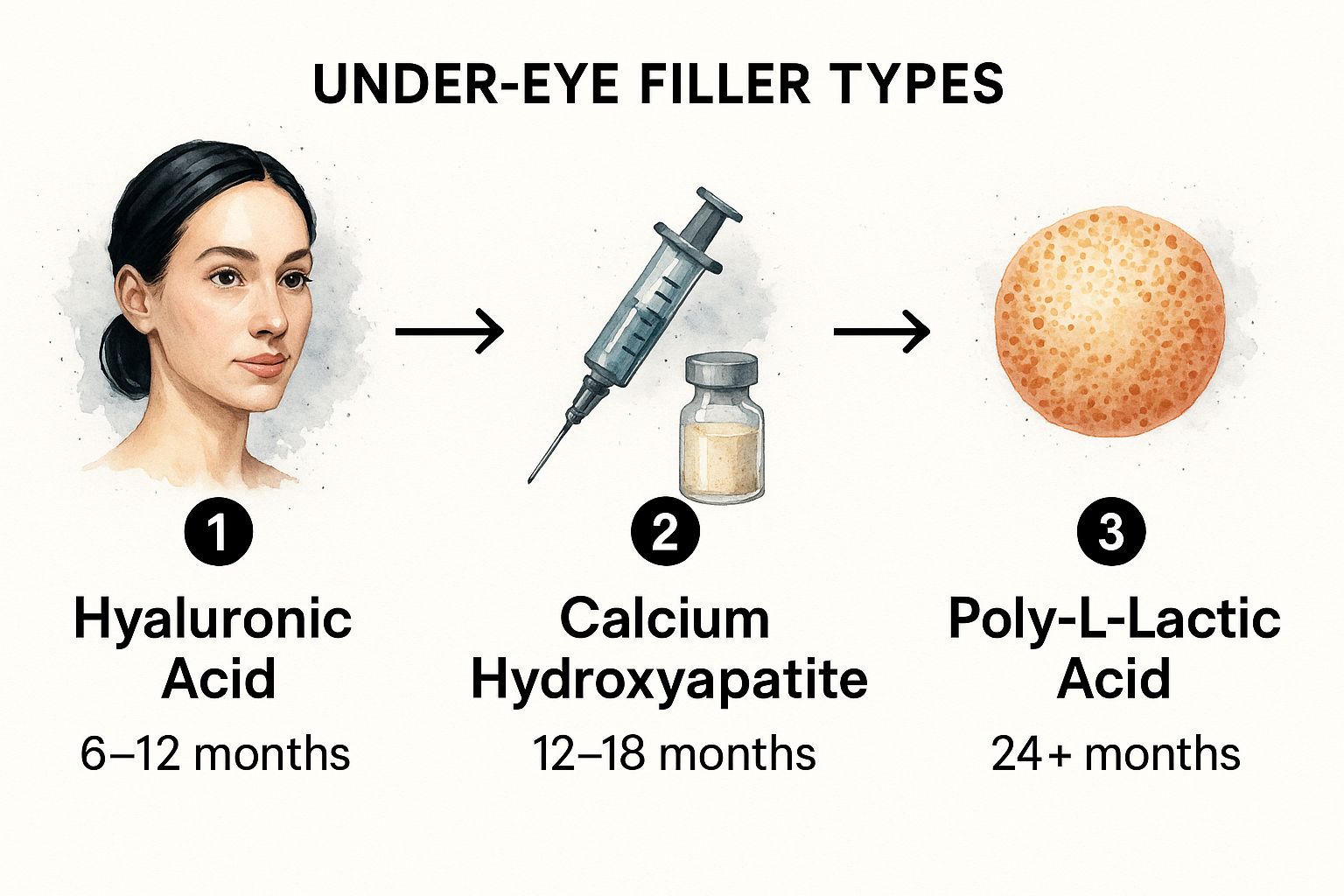
As you can see, Hyaluronic Acid is a very popular choice because it feels natural and can be reversed, but other options work by stimulating your own collagen for longer-lasting results.
You’ll see a difference right away. The hollows will look softer, and any dark shadows will be much less noticeable. If you want to dive deeper into how this procedure is tailored to each person, you can find more detail about our specific approach to tear trough filler treatments and why it's so effective.
Once the injections are done, your practitioner will give you detailed aftercare instructions to make sure everything heals beautifully and your results last as long as possible.
Of course. Here is the rewritten section, crafted to sound like an experienced human expert while following all your instructions.
Navigating the Risks and Potential Side Effects
While under eye fillers for wrinkles can create some truly beautiful, refreshing results, we need to have an honest chat about the potential risks. Like any medical procedure, it’s not without its possible downsides, and understanding them is the best way to feel confident in your decision.
The good news? When you’re in the hands of a skilled, medically qualified practitioner, these risks drop significantly. Most of what you’ll experience is temporary, mild, and an entirely normal part of the healing process.
The Usual Suspects: Common and Temporary Side Effects
Straight after your treatment, and for a few days afterwards, it’s completely normal to see some minor side effects. This is just your body’s natural response to the injections, so there’s typically no need to worry.
Here’s what you can generally expect:
Mild Swelling and Puffiness: The under-eye area is incredibly delicate and prone to a bit of swelling. It's usually most noticeable the morning after your treatment and should start to settle down within 48 to 72 hours.
Bruising: Even with the most careful technique, a small bruise can pop up. A tiny blood vessel might get nicked during the injection. It's nothing a bit of concealer can't hide, and it'll fade over a week or so.
Redness and Tenderness: The injection sites might look a little red and feel tender to the touch for a day or two. Think of it as a standard inflammatory response that sorts itself out quickly.
This is exactly why I always tell my clients to schedule their treatment at least two weeks before any big event. It just gives your body plenty of time to heal so you can look and feel your absolute best.
It's so important to know the difference between normal healing and a genuine complication. Minor swelling that gets a little better each day is fine. Swelling that gets worse or feels hard is not. Keep that line of communication open with your practitioner.
Looking at Less Common Complications
Beyond the usual temporary stuff, there are a few less common but more significant complications you should be aware of. A highly experienced injector knows exactly how to avoid these, but being informed is a crucial part of patient safety.
The Tyndall Effect This happens when hyaluronic acid filler is placed too superficially—that is, too close to the skin's surface. The result is a faint bluish shadow under the eye, which you might notice more in certain lights. While it's not dangerous, it can be an aesthetic annoyance. The fix, thankfully, is straightforward: an injection of hyaluronidase to dissolve the misplaced filler.
Lumps and Nodules Occasionally, small lumps or bumps can form under the skin. This might happen if the filler isn't massaged and integrated properly, or if the wrong type of filler was chosen for such a delicate area. Most tiny lumps settle on their own within a few weeks, but any persistent or noticeable ones can also be dissolved with hyaluronidase.
The Most Serious Risk: Vascular Occlusion
Now for the most critical, albeit extremely rare, complication: vascular occlusion. This is when filler is accidentally injected into a blood vessel, blocking the blood flow to the tissue nearby. If it isn't spotted and treated immediately, it can lead to serious problems like skin necrosis (tissue death) and, in the worst-case scenario, issues with vision.
This is precisely why your choice of practitioner is non-negotiable. An expert has an intimate knowledge of facial anatomy—they know the vascular map of the face like the back of their hand. They'll use safer techniques, like a blunt-tipped cannula instead of a sharp needle, to dramatically reduce this risk. They are also trained to spot the early signs—things like immediate, sharp pain or a blotchy skin pattern—and have emergency protocols ready to dissolve the filler and restore blood flow in an instant.
The aesthetic community in the UK is heavily focused on making treatments even safer. For instance, practitioners are exploring new ways to manage complex issues, like the PHAREE technique for persistent swelling, which blends hyaluronidase, microneedling, and tiny amounts of filler. Many skilled injectors also use preperiosteal injection methods, placing filler deep onto the bone to avoid compressing lymphatic vessels. This is a clever way to limit swelling from the get-go. These careful techniques just go to show how vital practitioner skill is for getting safe, natural-looking results. You can read more about the latest aesthetic trends and technologies in the UK.
Aftercare Tips For Long-Lasting, Natural Results
The success of your treatment with under-eye fillers for wrinkles doesn’t end when you leave the clinic—in many ways, it's just beginning. What you do in the hours, days, and weeks that follow is crucial for achieving that smooth, natural-looking result and making it last.
Think of the filler as a delicate sculpture that needs a little time to settle and integrate perfectly with your skin. Your aftercare routine is all about protecting that investment and giving the area the best possible chance to heal beautifully.
The First 48 Hours: Your Immediate Action Plan
The initial 48 hours are easily the most critical. This is when you want to manage any swelling and make sure the filler stays exactly where it was so expertly placed. The goal is simple: be gentle and avoid anything that could ramp up blood flow to your face, which can worsen bruising or swelling.
For the first day or two, make these simple rules your priority:
Avoid Strenuous Exercise: Anything that gets your heart rate up, from a spin class to heavy lifting, needs to be put on hold. A gentle walk is perfectly fine, but intense activity increases blood pressure and can lead to more noticeable swelling.
Skip the Alcohol: It’s best to avoid alcoholic drinks for at least 24 hours. Alcohol is a vasodilator, meaning it widens blood vessels, which can easily contribute to extra puffiness and bruising under the eyes.
Keep It Make-Up Free: Give your skin a break from makeup for the first 24 hours. The tiny injection sites need to close up and heal, and applying products can introduce bacteria, which increases the small risk of infection.
Following these steps gives your under-eye area the calm environment it needs to start the healing process on the right foot.
Managing Swelling and Promoting Healing
A little bit of swelling is completely normal and to be expected. The good news is, you can take practical steps to minimise it and feel more comfortable as your results start to settle.
One of the best tools in your arsenal is a gentle cold compress. Try applying a clean, soft cloth-wrapped ice pack to the area for about 10 minutes every hour or so during that first day. The key is to be very careful not to apply firm pressure; just let it rest lightly on the skin.
Your sleeping position also plays a surprisingly important role. For the first couple of nights, try to sleep on your back with your head slightly elevated on an extra pillow. This simple trick uses gravity to help drain fluid away from your face, reducing that morning-after puffiness.
Another vital tip is to avoid touching, rubbing, or massaging the treated area unless your practitioner has specifically told you to. The filler needs to remain undisturbed while it settles into its final position.
Long-Term Strategies to Protect Your Results
Once you're past the initial healing phase, the focus shifts to long-term maintenance. How you look after your skin and your overall health will have a direct impact on how long your beautiful results last—which is typically between 12 to 18 months.
To get the most out of your treatment, try to work these habits into your daily life:
Commit to Sun Protection: The sun is the number one enemy of both your skin and your filler. UV rays break down hyaluronic acid and collagen. Wearing a high-SPF, broad-spectrum sunscreen and sunglasses every single day is non-negotiable.
Hydrate from the Inside Out: Hyaluronic acid fillers work by attracting and holding onto water. Staying well-hydrated by drinking plenty of water helps the filler do its job properly, keeping the under-eye area looking plump and smooth.
Adopt a Supportive Skincare Routine: Use a gentle, hydrating eye cream to support the delicate skin in that area. Ingredients like peptides, ceramides, and antioxidants can help maintain skin health and perfectly complement the effects of your filler.
By following this roadmap, you can feel confident you’re doing everything you can to support your treatment. For more detailed guidance tailored to your specific needs, you can learn about our dedicated approach to aftercare for under-eye treatments and how we support our clients on their journey. Consistent care is the real secret to enjoying that refreshed, well-rested look for many months to come.
UK Costs and the "Less is More" Approach
Let's talk about the elephant in the room: the cost of under-eye fillers. When you’re considering any cosmetic treatment, the financial side is a big part of the equation. In the UK, the price you see isn’t arbitrary—it’s a direct reflection of the expertise, quality, and safety you're getting.
For a tear trough treatment, you can expect to pay anywhere from £350 to over £700 for a session. That’s quite a range, and it boils down to a few key things. An experienced medical practitioner with a clinic in a prime spot like London or Manchester will naturally have a different price point than someone newer to the field in a smaller town. The product itself matters, too. Premium hyaluronic acid fillers specifically designed for the delicate under-eye area simply cost more, but they’re worth it for their safety and results.
What's Included in the Price?
So, what are you actually paying for when you book a treatment? It's so much more than just the liquid in the syringe.
Your Practitioner's Expertise: This is the big one. You're investing in years of anatomical training, a deep understanding of facial structures, and the skill to deliver beautiful results while avoiding complications.
Clinic Standards and Location: A high-end clinic with top-of-the-line equipment and Care Quality Commission (CQC) registration in a major city has higher overheads, which is reflected in their pricing.
The Filler Itself: Reputable practitioners use premium, TGA-approved fillers. They cost more, but they have a much better track record for safety and achieving a smooth, natural finish.
Your Follow-Up Care: Good clinics don’t just send you on your way. The price often includes a follow-up appointment to check on your results and make any tiny adjustments needed.
Think of it less as a cost and more as an investment in your safety and the final outcome. A price that seems too good to be true usually involves cutting corners you really don't want cut, especially when it's your face.
The Big Shift Towards a Natural Look
Beyond the numbers, there’s a massive cultural shift happening in the UK aesthetics world. Gone are the days of the "overfilled," obviously "done" look. Today, subtlety is king. People want to look like the best version of themselves—rested, refreshed, and rejuvenated, not fundamentally different.
The data backs this up. We've actually seen a 26-31% drop in the overall demand for dermal filler procedures recently. It's not because people have stopped wanting treatments; it's because the focus has shifted. The new goal is to use less product more skilfully to create natural enhancements, particularly for tricky areas like under-eye wrinkles. This client-driven demand for a more understated look is a huge force in the UK's £2.4 billion cosmetic market. You can dive deeper into the latest cosmetic surgery industry statistics to see how things are changing.
Honestly, this trend is fantastic news for everyone. It means the best practitioners are focused on honouring and restoring your unique features, not stamping out a generic, cookie-cutter look. Understanding this helps you set the right expectations and find a provider whose artistic style aligns with this modern, "less is more" philosophy.
Common Questions About Under Eye Fillers

We get asked about this treatment all the time, so we’ve put together answers to the most common queries to give you that final bit of clarity.
How Painful Is the Under Eye Filler Procedure?
This is probably the number one question, and the answer is reassuring: most people find it very manageable. We always start by applying a strong topical numbing cream to make sure the area is desensitised.
On top of that, many of the advanced hyaluronic acid fillers we use actually contain lidocaine, a local anaesthetic. This means the area gets numbed from the inside as we work. You might feel a slight pinch or a bit of pressure, but genuine pain is rare. Any tenderness afterwards is usually mild and gone within a day.
When Will I See the Final Results from My Filler Treatment?
You’ll definitely notice a difference straight away, which is one of the most satisfying parts of the treatment. However, the final, settled result takes a little longer to reveal itself.
Give it about two to four weeks. This buffer allows any minor swelling or bruising to completely subside and lets the filler fully integrate with your skin’s tissue. That’s when you’ll see that smooth, refreshed, and completely natural finish.
A key reason hyaluronic acid fillers are the gold standard for this area is their reversibility. If for any reason you’re not happy with the result or an unlikely complication occurs, your practitioner can inject an enzyme called hyaluronidase. It safely dissolves the filler, typically within 24 to 48 hours, returning your under-eye area to how it was before.
This built-in safety net provides incredible peace of mind, making it the responsible choice for treating such a delicate part of the face.
At Charis Aesthetics, we combine medical expertise with an artistic touch to deliver subtle, natural-looking results. Book your consultation today to discover how we can help you look and feel your best.
Comments