


What Is Marionette Lines? UK Guide to Causes & Treatments
- Charis Aesthetics
- Aug 14, 2025
- 14 min read

We’ve all seen them, those vertical lines that run from the corners of the mouth down towards the chin. They’re often called marionette lines, and the name is quite fitting—they can resemble the distinct jaw lines on a string puppet.
While they’re a completely natural part of how our faces change over time, many people feel these lines create a permanent downturned, sad, or tired look, even when they’re feeling their absolute best.
What Exactly Are Marionette Lines?
A great way to understand this is to picture your skin as a well-supported tent. In your youth, the tent poles (your collagen and elastin) are strong, and there's plenty of padding (facial fat) underneath, keeping the canvas (your skin) smooth and taut. But as we get older, this internal support system naturally weakens. The poles become less sturdy, the padding thins out, and the canvas starts to sag and fold.
Marionette lines are one of the most common outcomes of this process. In the UK, these creases often start to appear in our 40s, as the natural production of collagen and elastin slows down. This decline causes facial fat to shift downwards and the underlying muscles to lose their support, which lets the skin droop and form those tell-tale lines. For a more detailed look at the science, the experts at the London Lip Clinic offer a great explanation.
To give you a quick reference, here’s a simple breakdown of what we're talking about.
Marionette Lines At a Glance
Characteristic | Description |
|---|---|
Location | Vertical lines running from the corners of the mouth to the chin. |
Appearance | Creates a downturned or "sad" mouth look. |
Primary Cause | Loss of collagen, elastin, and facial fat due to ageing. |
Typical Onset | Often becomes noticeable from a person's 40s onwards. |
Understanding these basics is the first step toward figuring out how to manage them effectively.
Why They Affect Your Expression
The biggest issue most people have with marionette lines is how they alter their resting facial expression. By pulling the corners of the mouth downwards, they can give off an unintentional look of sadness or exhaustion. It's no wonder they're sometimes called "sad mouth lines."
It’s important to remember that these lines aren't a sign of poor health; they're just a predictable part of our ageing journey. However, how prominent they become can certainly be influenced by other factors:
Genetics: Your family’s facial structure and skin type play a huge part.
Lifestyle: Things like heavy sun exposure and smoking can speed up the process.
Volume Loss: The natural thinning of fat pads in the cheeks and lower face removes that crucial underlying support.
Once you recognise what these lines are and why they form, you're in a much better position to explore the different ways to soften their appearance and restore a more neutral, rested look to your face.
Why Do Marionette Lines Appear?
Knowing what marionette lines are is one thing, but understanding why they form is like getting a peek behind the curtain at the complex processes happening just beneath your skin. It’s not a single moment or flaw that causes them. Instead, think of it as a gradual, predictable architectural shift in your facial structure over time.
At the very heart of this change are two crucial proteins: collagen and elastin. You can imagine these as your skin's internal scaffolding. Collagen is like the steel beams, providing strength and structure, while elastin acts as the flexible joints, allowing everything to move and snap back into place. When we're young, this scaffolding is dense and strong, keeping our skin firm and resilient.
But as we get older, our bodies naturally slow down the production of both. In fact, starting from our mid-20s, we lose about 1% of our collagen every single year. This slow weakening of the internal framework means the skin can't bounce back like it used to, which eventually leads to sagging and folding.
The Role of Facial Volume Loss
Another huge piece of the puzzle is the loss and shifting of facial fat. Our faces are cushioned by distinct pockets of fat, often called facial fat pads, which create the soft, youthful contours we associate with a younger face. With time, these pads start to shrink and descend, pulled down by gravity as their supportive ligaments weaken.
When the fat pads in your cheeks (the malar fat pads) lose volume and begin to droop, it sets off a chain reaction. This downward shift puts pressure on the skin of your lower face, directly contributing to deeper folds like nasolabial folds and, of course, marionette lines. It’s a bit like a pillow losing its stuffing—the outer fabric inevitably wrinkles and collapses inwards.
Key Insight: Marionette lines are rarely just a skin-deep issue. They are often a direct result of volume loss higher up in the face. This is why the most effective treatments often focus on restoring support in the cheeks to gently lift the lower face.
This infographic gives a great visual breakdown of the primary factors that all play a part in creating these lines.
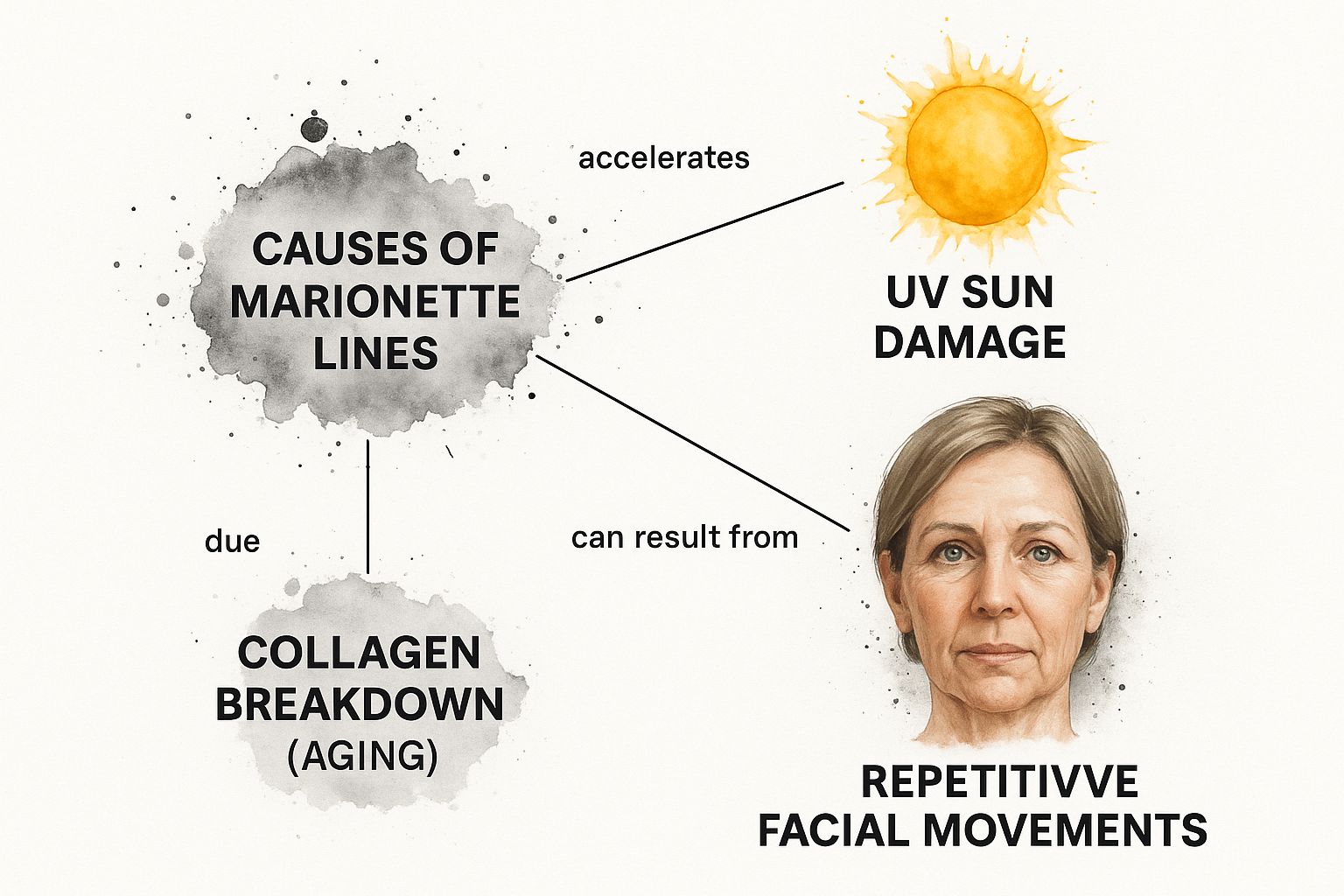
As you can see, it’s the combination of what’s happening inside our bodies and the external world around us that ultimately determines how prominent these lines become.
Are You Genetically Predisposed?
Finally, we can't ignore genetics. Just as we inherit our eye colour or height from our parents, we also inherit traits related to our facial anatomy and how our skin ages. It’s just part of our unique makeup.
Some of us are simply born with a facial structure or muscle arrangement that makes us more likely to develop marionette lines earlier or more deeply. Key genetic factors include:
Bone Structure: A softer, less defined chin or jawline might offer less structural support for the surrounding soft tissues.
Skin Type: You might have inherited skin that is naturally thinner or has a lower baseline level of collagen to begin with.
Facial Muscles: Overactivity in the depressor anguli oris (DAO) muscle, which pulls the corners of your mouth downwards, can also be an inherited trait.
So, when it comes right down to it, marionette lines almost always appear due to a trio of factors working together: the natural breakdown of your skin's structural proteins, the gravitational pull on shrinking facial fat, and your own unique genetic blueprint.
Lifestyle Habits That Deepen Marionette Lines
While genetics and the natural passing of time certainly lay the groundwork for marionette lines, our daily habits have a huge say in how quickly and deeply they appear. It's a bit like this: your genes might load the gun, but it's often your lifestyle that pulls the trigger, putting your skin’s ageing timeline on fast-forward.
Getting to grips with these external factors is key. When you understand how certain choices affect your skin's underlying structure, you can start making proactive changes to protect your complexion and slow down the formation of those stubborn creases.
The Impact of Sun Exposure
Unprotected sun exposure is, hands down, the biggest outside culprit for premature skin ageing. We call this process photoageing. The sun’s ultraviolet (UV) radiation acts like a demolition crew on your skin’s support network. UVA rays are particularly damaging, as they travel deep into the dermis where your precious collagen and elastin fibres live, and they actively break them down.
This relentless damage weakens your skin’s internal scaffolding far more quickly than natural ageing ever could. The result? A serious loss of firmness and elasticity, which allows the skin to sag and fold, carving out deeper and more obvious marionette lines.
Smoking and Skin Elasticity
Smoking is another major accelerator of facial ageing. The nicotine in cigarettes makes your blood vessels constrict, drastically cutting off the flow of oxygen and essential nutrients to your skin cells. This effectively starves the skin of everything it needs to repair itself and build new, healthy collagen.
On top of that, the thousands of other chemicals in tobacco smoke unleash free radicals that attack and obliterate the collagen and elastin you already have. This double attack massively reduces skin elasticity, leaving it far more susceptible to sagging and the deep-set wrinkles that form around the mouth.
Key Takeaway: Both sun exposure and smoking directly dismantle the proteins that keep your skin firm and bouncy. Making sun protection a non-negotiable daily habit and quitting smoking are two of the most powerful things you can do for your skin's future.
How Weight Changes and Diet Play a Role
Dramatic swings in your weight can also influence the fullness of your face and, in turn, the severity of marionette lines. When you lose a lot of weight quickly, you often lose volume from the fat pads in your face that provide that soft, underlying support. This can leave the skin looking a bit loose and deflated, making any existing lines look much more prominent.
Beyond weight, a few other daily habits add to the problem, often more subtly:
Poor Diet: A diet packed with sugar and processed foods can trigger a process called glycation. This is where sugar molecules latch onto your collagen and elastin, turning them stiff, brittle, and ineffective.
Dehydration: When your skin doesn't have enough water, it loses its plumpness and resilience. This can make fine lines and creases look much more obvious than they really are.
Sleeping Position: If you consistently sleep on your side or stomach, you’re pressing your face into a pillow for hours every night. Over time, this compression can contribute to "sleep wrinkles" that can eventually become permanent.
UK Professional Treatments for Smoothing Marionette Lines
When your at-home skincare and lifestyle tweaks just aren't cutting it for those deeper marionette lines, it might be time to explore professional aesthetic treatments. These options are powerful, effective, and designed to tackle the root cause—volume loss—to lift the skin and smooth out those stubborn creases. The goal is never to change how you look, but simply to restore a more rested, neutral expression.
Leading the charge against marionette lines are hyaluronic acid (HA) dermal fillers. The best way to think of them is as a strategic replacement for the natural padding your face has lost over time.
Hyaluronic acid is a sugar molecule your body already produces to keep your skin plump and hydrated. When a skilled practitioner injects an HA filler like Juvederm® or Restylane® into precise areas around the mouth and chin, it acts like a tiny, internal cushion. It physically lifts the sagging skin, essentially rebuilding the support structure from within and smoothing the fold on the surface.
Dermal Fillers: The Gold Standard Treatment
There's a good reason dermal fillers are considered the primary treatment for marionette lines. Here in the UK, using fillers like Juvederm® and Restylane® for this concern is an incredibly common and effective procedure. Costs typically start from around £275 per syringe, with any further syringes needed for deeper lines costing about £200 each. It's a minimally invasive treatment that usually takes just 30 to 60 minutes, and the uplifting results can last anywhere from 6 to 12 months before you might want a top-up.
The process is highly targeted, allowing a practitioner to add volume exactly where it’s needed to support the corners of the mouth and soften their downturned appearance.
Key Insight: The best filler treatments are always subtle. The aim isn't to look "done," but to soften the shadow and lift the corners of the mouth, restoring a fresher and more positive look. A great injector focuses on creating a completely natural-looking result.
While fillers directly tackle lost volume, it's worth knowing they work very differently from other injectables. If you're curious about how various treatments compare, you might find our complete expert guide to anti-wrinkle injections helpful, as they focus on relaxing muscles rather than adding volume.
Exploring Other Advanced Treatment Options
Beyond fillers, other technologies can brilliantly improve skin texture and firmness. These can either complement the effects of injectables or work as excellent standalone treatments for less severe lines. Their main job is to kickstart your body’s own collagen-making machinery.
Here are a few other powerful options you might find at clinics like Charis Aesthetics:
Morpheus8 (Microneedling with Radiofrequency): This clever treatment combines two actions. First, tiny needles create micro-channels in the skin. Then, radiofrequency (RF) heat is delivered through those needles deep into the skin's layers. This combination triggers a powerful healing response, ramping up collagen and elastin production to tighten and firm the skin from the inside out.
Laser Resurfacing: This procedure uses focused beams of light to gently remove the outer, damaged layers of skin. As your skin heals, it reveals a much smoother, tighter surface with less noticeable wrinkles.
Chemical Peels: A specialised chemical solution is applied to the skin, which causes it to exfoliate and eventually peel away. The new, regenerated skin that comes through is typically smoother, brighter, and more even in tone.
Figuring out the right path forward really depends on the severity of your lines, your skin type, and what you hope to achieve. A thorough, honest consultation with a qualified practitioner is always the essential first step. It's the only way to build a personalised plan that will deliver the beautiful, natural results you’re looking for.
How Experts Grade Marionette Line Severity
Think of it like getting your eyes tested. The optician doesn’t just ask if things look “a bit blurry”—they use specific charts and lenses to get a precise measurement. In aesthetics, we use clinically validated grading scales to do the same for facial lines, moving beyond vague descriptions and into proper scientific analysis.
The Marionette Line Severity Scale
One of the most trusted methods is a photonumeric grading scale. It sounds technical, but it’s quite simple. These tools use a set of standardised photos showing different degrees of line severity, usually on a straightforward point system. This gives us a consistent benchmark for every single client.
For example, the 5-point Marionette Line Severity Scale is a clinically recognised tool that helps practitioners classify lines from completely absent to very severe. Research has even confirmed just how reliable it is, meaning different clinicians will almost always give the same score when looking at the same face.
This methodical approach is better for everyone involved:
Personalised Treatment: It helps us figure out the exact type and amount of dermal filler needed.
Clear Expectations: You and your practitioner are on the same page from the very beginning.
Trackable Progress: It allows us to objectively measure and show you the improvement after your treatment.
Key Takeaway: Using a validated scale takes all the guesswork out of the equation. It turns the consultation into a precise diagnostic step, building a foundation of trust and making sure the final result is both effective and beautifully natural.
This level of precision is vital for all aesthetic procedures. Dynamic wrinkles caused by muscle movement, for instance, need a completely different approach. If you’re curious about how various treatments work, you might find our guide to anti-wrinkle injections in the UK helpful.
Your At-Home Skincare and Prevention Plan
While professional treatments can work wonders on existing marionette lines, what you do every day at home is your first and best line of defence. Think of it as the foundational work for healthy skin. By protecting it from daily damage and feeding it the right ingredients, you can seriously slow down how quickly these creases form and even enhance the results of any clinical procedures you have.
Your single most powerful tool in this fight? A broad-spectrum sunscreen, applied every single day. No excuses. Unprotected sun exposure is the number one cause of premature ageing, chipping away at the collagen that keeps your skin firm and bouncy. Making an SPF of 30 or higher a non-negotiable part of your morning routine is the smartest investment you can make for your skin’s future.
Building Your Anti-Ageing Arsenal
Beyond sun protection, a few key active ingredients are proven to fortify the skin. You don’t need a complicated ten-step routine; incorporating just a handful of well-chosen products can make a genuine difference in maintaining your skin's structure and resilience.
The goal is to use ingredients that either protect the collagen you already have or kickstart new production.
Retinoids (like Retinol): These are the undisputed gold standard in anti-ageing. They work by speeding up skin cell turnover and firing up collagen production, which over time, helps to firm up the skin and smooth its texture.
Vitamin C: Think of this potent antioxidant as a personal bodyguard for your skin cells. It neutralises the free radical damage caused by everyday aggressors like pollution and UV rays, all while playing a crucial part in synthesising new collagen.
Hyaluronic Acid: While it won’t erase deep-set lines on its own, this hydration powerhouse is fantastic for a quick fix. It works by drawing moisture into the skin, instantly plumping up the surface and making fine lines look much less obvious.
To get a full picture of the most effective strategies out there, from at-home care to clinical treatments, have a look at our complete guide to UK anti-ageing treatments that actually work.
To help you navigate the skincare aisles, here’s a quick breakdown of the hero ingredients you should be looking for to help manage the signs of ageing around the mouth.
Key Skincare Ingredients for Preventing Marionette Lines
Ingredient | Primary Benefit | How It Works |
|---|---|---|
Retinoids | Collagen Production & Cell Turnover | Communicates with skin cells to behave in a younger, healthier way, speeding up renewal and boosting structural protein. |
Vitamin C | Antioxidant Protection | Neutralises environmental damage before it can degrade collagen and helps stabilise the collagen you have. |
Peptides | Skin Firming & Repair | Act as messengers, signalling to your skin to produce more collagen and elastin, leading to firmer, bouncier skin. |
Hyaluronic Acid | Intense Hydration & Plumping | A humectant that can hold up to 1,000 times its weight in water, drawing moisture into the skin for an instant plumping effect. |
These ingredients work best when used consistently as part of a daily routine, creating a strong foundation for healthy, resilient skin.
The Power of Facial Massage
Never underestimate the power of your own hands. Simple facial massage techniques can be a brilliant addition to your daily plan. While it’s not a magic cure, regular massage helps release pent-up tension in your facial muscles—especially in the depressor anguli oris (DAO) muscles, which are notorious for pulling down the corners of your mouth.
Pro Tip: As you apply your serums or moisturisers, use gentle, upward sweeping motions around your mouth and along the jawline. This not only helps your products sink in better but also boosts circulation and can help counteract that constant downward pull of gravity.
This proactive, multi-pronged approach—combining daily protection, targeted ingredients, and supportive massage—puts you back in control of your skin's health, helping you keep a smoother, more youthful look for longer.
Right, let's wrap things up by tackling some of the questions that almost always come up when people start thinking about how to handle marionette lines. Getting clear, straightforward answers can make all the difference.
At What Age Do Marionette Lines Typically Appear?
It's a mixed bag and really depends on your genetics and lifestyle, but generally, marionette lines start making an appearance in a person’s 40s. This is often the decade when the slowdown in collagen and elastin production, paired with facial fat loss, becomes more visible.
That said, it’s not a hard-and-fast rule. For some people, especially those with a genetic tendency or who’ve had a lot of sun exposure over the years, those lines can start to show up in their 30s.
Can Skincare Alone Get Rid of Marionette Lines?
Skincare is absolutely your first line of defence, but on its own, it can't erase deep, established marionette lines. Think of it this way: ingredients like retinol and Vitamin C are fantastic for encouraging collagen and protecting your skin. They can definitely soften very fine lines and slow down the clock on new ones forming.
But once a line is properly etched in because of significant volume loss underneath, no cream or serum can physically lift the skin back up. Skincare is your essential daily maintenance, while professional treatments are the structural support that addresses the root cause.
Key Reminder: Your most powerful at-home tool is a good, broad-spectrum SPF 30+. Using it every single day won't reverse existing lines, but it's crucial for stopping them from getting deeper.
Are Dermal Filler Treatments for Marionette Lines Painful?
Most of our clients find the treatment very manageable and report only minimal discomfort. There are a couple of reasons for this:
Numbing Cream: First, we apply a topical anaesthetic cream to the area, which numbs the surface of the skin.
Lidocaine: The high-quality dermal fillers we use, including those from the Juvederm® range, come pre-mixed with a local anaesthetic called lidocaine.
This two-pronged approach ensures you're as comfortable as possible. You might feel a tiny pinch or a bit of pressure as the filler is placed, but it's generally a very well-tolerated procedure.
Ready to see how a treatment plan designed just for you could restore a softer, more rested look? At Charis Aesthetics, we blend medical expertise with an artistic eye to achieve beautiful, natural-looking results.
Book your no-obligation consultation today and have a chat with an expert practitioner about your goals. We’d love to help.
Comments