


See Stunning Non Surgical Rhinoplasty Before and After Results
- Charis Aesthetics
- Jul 5, 2025
- 13 min read

Updated: Jul 9, 2025
Considering a change to your nose but hesitant about surgery? The non-surgical rhinoplasty, often called the 'liquid nose job', offers a remarkable alternative, delivering significant aesthetic improvements with minimal downtime. This procedure uses precisely placed dermal fillers, typically hyaluronic acid, to reshape, contour, and refine the nose in a matter of minutes. It's a powerful tool for addressing common concerns like dorsal humps, drooping tips, and asymmetry without a single incision.
This visual guide is designed to showcase the transformative potential of this treatment. We will move beyond simple pictures and delve into a strategic analysis of real-life non surgical rhinoplasty before and after case studies. You will see firsthand how specific techniques are applied to achieve distinct patient goals, from subtle refinements to more noticeable structural enhancements.
By examining these examples, you will gain a deeper understanding of:
What is realistically achievable with dermal fillers for nose reshaping.
The strategic placement of filler required to correct different concerns.
Actionable insights to help you articulate your own aesthetic goals during a consultation.
We will analyse cases covering dorsal hump camouflage, nasal tip lifting, asymmetry correction, and more, providing a clear, practical look at the results you can expect. Let’s explore the possibilities.
1. Case 1: Erasing the Dorsal Hump for a Smoother Profile
One of the most common reasons clients seek a non-surgical rhinoplasty is to address a dorsal hump, which is a bump or prominence on the bridge of the nose. This feature can make the nose appear larger or more hooked from a profile view. A liquid nose job offers a remarkably effective and immediate solution by strategically adding dermal filler to camouflage the hump, creating the illusion of a perfectly straight nasal bridge.
The procedure itself is a masterful application of anatomy and artistry. By injecting a hyaluronic acid-based filler just above and sometimes below the hump, an experienced practitioner can build up the surrounding areas. This clever technique effectively fills in the "dip" above the bump, smoothing out the transition from the top of the nose to the tip and making the entire profile appear straighter and more refined.
Strategic Analysis: The "Liquid Camouflage" Technique
The success of this treatment hinges on precise placement and volume control. The goal isn't to remove the hump but to cleverly disguise it by augmenting the areas around it. This is a perfect example of how adding volume can, counterintuitively, make the nose appear smaller and more balanced within the facial structure.
Key Insight: The procedure demonstrates the principle of "addition by subtraction". By adding filler to the nasal bridge (radix) and sometimes the tip, the prominence of the dorsal hump is subtracted from the overall visual impression, resulting in a sleeker profile.
The non surgical rhinoplasty before and after transformation for this concern is often dramatic. Patients are frequently amazed at how such a minor addition of filler can produce such a significant aesthetic improvement without any of the risks, downtime, or permanence associated with a surgical procedure.
Actionable Takeaways for Patients
Consultation is Crucial: Discuss your goals with a qualified practitioner. They will assess if your specific dorsal hump is a good candidate for this camouflage technique.
Understand the Product: Ask about the type of dermal filler being used. A thicker, more robust hyaluronic acid filler is typically required to provide the structure needed for reshaping the nasal bridge.
Manage Expectations: This treatment is temporary, typically lasting 12 to 18 months. It masterfully camouflages a hump but does not physically remove it.
Review Portfolios: Always look at your practitioner's non surgical rhinoplasty before and after photos, specifically for cases involving dorsal humps, to ensure their aesthetic style aligns with your desired outcome.
2. Nasal Tip Refinement and Lifting
A drooping or poorly defined nasal tip can significantly impact facial harmony, making the nose appear longer or less elegant. Non-surgical rhinoplasty offers a sophisticated solution for this concern, using dermal fillers to lift, define, and refine the tip without any incisions. This technique is ideal for individuals with mild tip ptosis (drooping) or those who desire a more sculpted and upturned appearance.
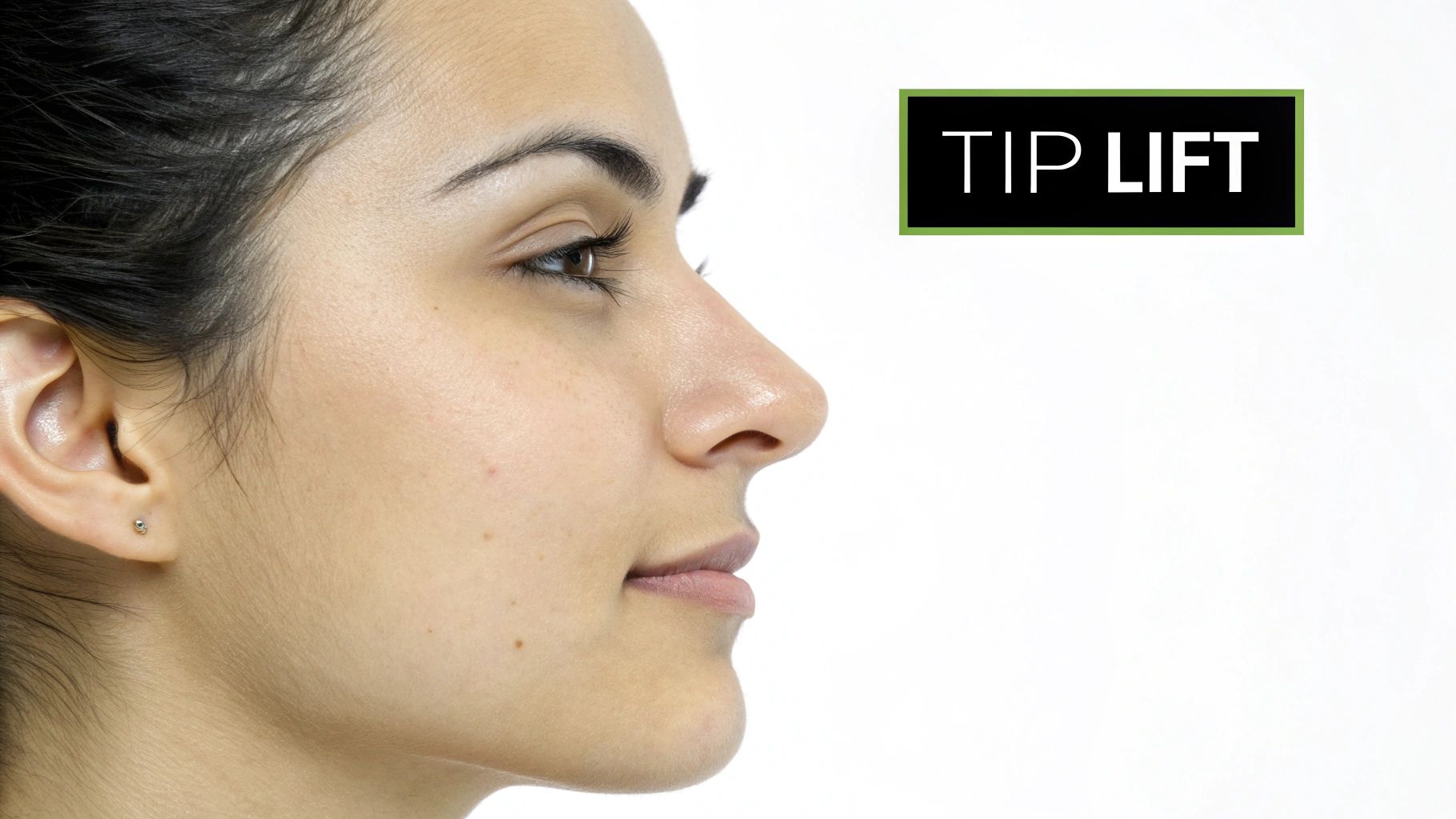
The procedure involves the precise injection of a hyaluronic acid filler into key structural points. By adding a small amount of filler to the base of the nose (anterior nasal spine) and along the columella (the tissue separating the nostrils), a practitioner can create a supportive "scaffold". This support counteracts the downward pull of muscles, providing an immediate lift and enhancing the tip's projection and rotation for a more refined profile.
Strategic Analysis: The "Structural Support" Technique
The success of this treatment relies on an expert understanding of nasal anatomy, particularly the interplay between cartilage and muscle. The goal is to provide structural reinforcement from below, creating a subtle yet impactful lift. It’s a method of architectural enhancement, using filler not just as a volumiser but as a support column.
Key Insight: The procedure works on the principle of "vector lift". By placing filler at the nasal base, the practitioner creates an upward force vector, physically elevating the nasal tip. This changes the tip's angle and rotation, making it appear perkier and more defined from both front and side views.
The non surgical rhinoplasty before and after photos for tip refinement showcase a remarkable change in the nose's overall character. Patients often feel their entire face looks more lifted and balanced, achieved through a procedure that takes only a few minutes and involves minimal discomfort or downtime.
Actionable Takeaways for Patients
Prioritise Expertise: Select a practitioner with extensive experience in nasal tip anatomy. Improper placement can widen the tip or fail to achieve a lift, so this is not a procedure for a novice.
Discuss Realistic Goals: A liquid nose job can provide a subtle, beautiful lift. However, it cannot achieve the dramatic rotation possible with surgery. Have an open conversation about what is realistically achievable.
Understand Filler Choice: A firmer, more structural hyaluronic acid filler is necessary to provide adequate support and lift for the nasal tip. Ask your clinician what product they plan to use and why.
Review Tip-Specific Results: When looking at a practitioner's non surgical rhinoplasty before and after portfolio, pay close attention to cases focused on tip lifting to ensure their results match your aesthetic preferences.
3. Nostril Asymmetry Correction for a Balanced Frontal View
While profile enhancements are common, achieving facial harmony from a frontal view is equally important. Nostril asymmetry, where one nostril appears different in size, shape, or position compared to the other, can disrupt this balance. A non-surgical rhinoplasty offers a highly precise method to correct these minor irregularities using tiny, strategically placed amounts of dermal filler.
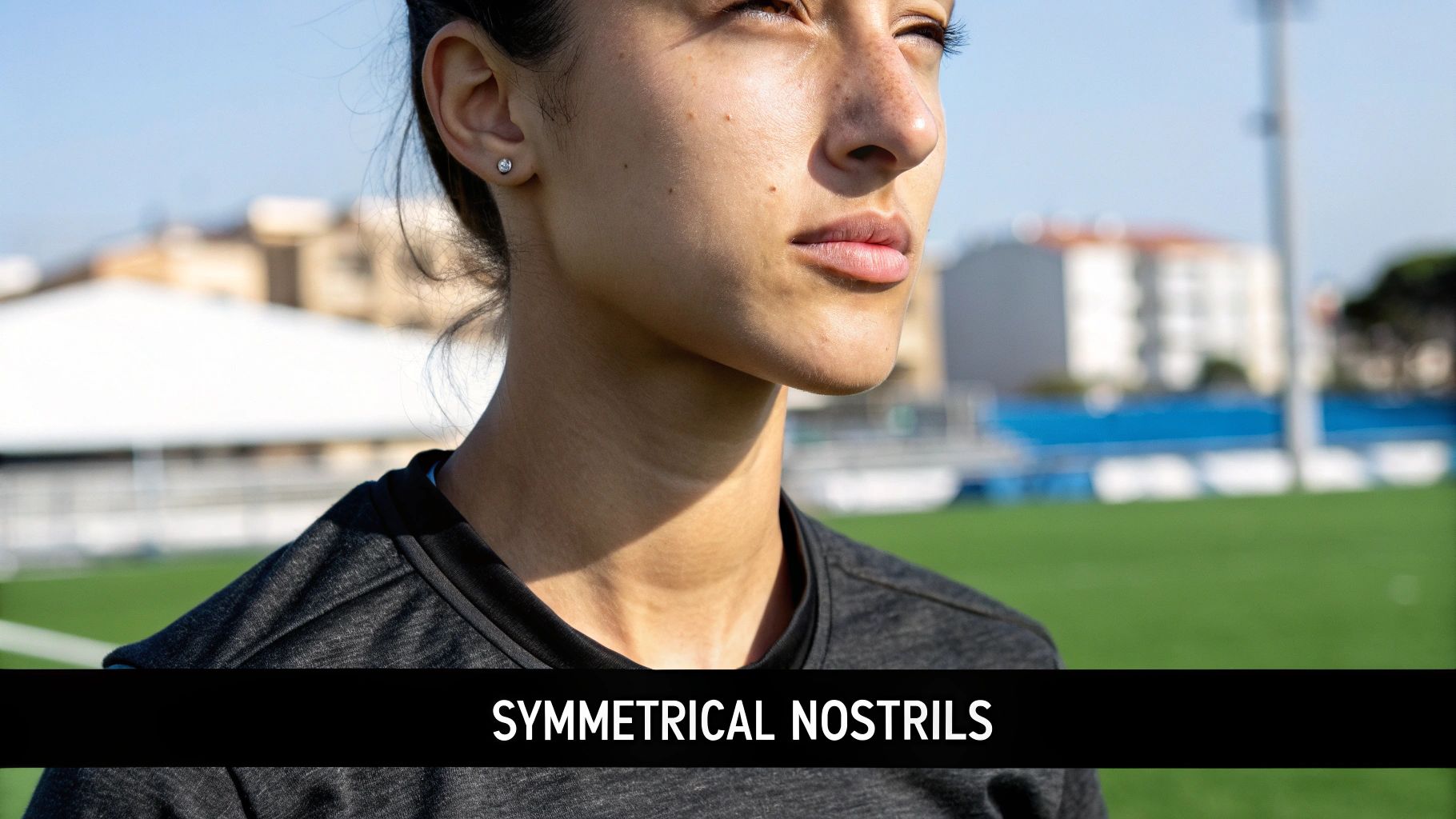
This advanced technique involves injecting filler into the nostril rim (the ala) or the columella (the tissue between the nostrils) to build structure and create a more uniform appearance. It can be used to address congenital asymmetry, refine the results of a previous surgical rhinoplasty, or correct subtle irregularities caused by minor trauma. The procedure demands an injector with a deep understanding of nasal anatomy and an exceptional eye for detail.
Strategic Analysis: The "Micro-Droplet" Technique
The key to correcting nostril asymmetry is precision over volume. The "micro-droplet" technique involves depositing minuscule amounts of filler to subtly reshape the nostril cartilage and surrounding soft tissue. This is not about adding bulk; it is about providing structural support where it's lacking to achieve a more symmetrical and harmonious look from the front.
Key Insight: This procedure highlights the principle of targeted augmentation. By adding minute amounts of filler to one side, a practitioner can create the illusion of lifting a drooping nostril or rounding out a flattened one, thereby balancing it with the other side for a more pleasing aesthetic. This is a powerful tool for fixing facial asymmetry.
The non surgical rhinoplasty before and after photos for this treatment showcase a subtle yet impactful change. While the difference might seem small, the overall improvement in facial balance can be significant, boosting a patient's confidence in their frontal appearance.
Actionable Takeaways for Patients
Seek an Expert: This is not a standard filler treatment. Choose an injector with extensive experience specifically in non-surgical rhinoplasty and nostril refinement, as popularised by experts like Dr. Jason Emer.
Photo Analysis is Key: A thorough consultation should involve photography and analysis to pinpoint the exact nature of the asymmetry and plan the precise injection points.
Less is More: Understand that the goal is subtle correction. The best results come from a conservative approach, and it's always possible to add more in a follow-up session if needed.
Confirm Suitability: Not all nostril asymmetry can be corrected with filler. Your practitioner will determine if your specific concern is related to soft tissue or cartilage that can be influenced by filler placement.
4. Wide Nose Bridge Narrowing Illusion
A common aesthetic concern is a nasal bridge that appears overly wide from a frontal view. While surgery is the only way to physically alter the nasal bones, a non-surgical rhinoplasty can create a powerful optical illusion of a narrower, more defined bridge. This advanced technique relies on the strategic placement of filler to manipulate how light reflects off the nose, essentially contouring it from within.

The procedure involves injecting a fine line of dermal filler precisely down the centreline of the nasal bridge. By building up this central column, the practitioner creates a more prominent, defined dorsal line. This new, sharper line catches the light, drawing the eye inward and creating shadows along the sides of the nose. This play of light and shadow makes the entire bridge appear slimmer and more sculpted without physically narrowing it. It's a favourite technique for those seeking subtle refinement, including in some ethnic rhinoplasty cases where the goal is definition rather than drastic change.
Strategic Analysis: The "Light-Reflecting Contour" Technique
This method is less about adding volume and more about creating definition. The injector acts as a sculptor, using the filler as a tool to build a central 'keel' that becomes the nose's primary light-reflecting point. This redirects attention to the centre, away from the wider nasal bones on either side.
Key Insight: The treatment leverages the principles of cosmetic contouring. Just as makeup uses highlighter to bring features forward, a precise line of filler acts as a permanent highlighter, making the bridge appear more projected and therefore narrower from a frontal perspective.
The non surgical rhinoplasty before and after results for this specific concern are subtle yet impactful. Patients often report that their nose looks more elegant and refined, and their overall facial features appear more harmonious. It's an excellent choice for individuals who are generally happy with their profile but desire more definition from the front.
Actionable Takeaways for Patients
Seek an Artistic Injector: This technique is highly dependent on artistry. Look for a practitioner with a strong portfolio showcasing their ability to create contour and definition, not just add volume.
Discuss Ethnic Considerations: If seeking ethnic nose refinement, ensure your practitioner understands your specific goals to enhance, not erase, your unique features.
Consider a Gradual Approach: Building the bridge definition over two sessions can sometimes yield a more natural and precise result, allowing the filler to settle perfectly.
Review Frontal Views: When looking at a practitioner's non surgical rhinoplasty before and after photos, pay close attention to the frontal shots for wide bridge cases to assess their skill with this specific illusion.
5. Post-Surgical Rhinoplasty Touch-Up
Surgical rhinoplasty is a definitive procedure, but the healing process can sometimes leave behind minor imperfections. A non-surgical rhinoplasty is an exceptional tool for addressing subtle asymmetries, small bumps, or minor depressions that may appear months after surgery, once swelling has fully subsided. This approach allows for fine-tuning the surgical result without the need for a second, often complex, revision operation.
Instead of undergoing another surgical procedure, patients can opt for precisely placed dermal fillers to correct these small irregularities. An expert injector can use a hyaluronic acid filler to fill a slight concavity on the nasal bridge, smooth out a tiny residual bump, or correct a minimal asymmetry at the tip. This provides a highly controlled, immediate, and non-invasive solution to perfect the final outcome of a previous surgery.
Strategic Analysis: The "Refinement and Polish" Technique
This application is all about precision and subtlety. It is not intended for major corrections but rather for the final polish that elevates a good surgical result to an excellent one. The injector must work with a deep understanding of the post-surgical anatomy, as scar tissue and altered blood supply can make the procedure more complex than on a non-operated nose.
Key Insight: The success of a post-surgical touch-up relies on patience and precision. It addresses the small percentage of imperfections that can arise during the natural healing process, offering a low-risk method to achieve the patient's desired level of refinement without committing to revision surgery.
The non surgical rhinoplasty before and after images for these cases highlight minute but impactful changes. What might appear as a tiny shadow or slight unevenness in the "before" photo is completely resolved in the "after", leading to a more harmonious and polished final appearance. This showcases the procedure's value as a complementary, rather than competing, treatment to surgical rhinoplasty.
Actionable Takeaways for Patients
Patience is Paramount: You must wait at least 12 months after your surgical rhinoplasty before considering a liquid touch-up. This ensures all swelling has resolved and the final surgical result is stable.
Consult Your Surgeon First: Always discuss your concerns with your original rhinoplasty surgeon. They can advise if a non-surgical approach is appropriate or if there are other considerations.
Seek an Expert Injector: Choose a practitioner with extensive experience in performing non-surgical rhinoplasty, especially on post-surgical patients. Ask to see their non surgical rhinoplasty before and after portfolio for similar refinement cases.
Discuss Long-Term Goals: Be clear about whether you are seeking a temporary fix or might consider a surgical revision in the future. This will influence the treatment plan.
6. Ethnic Nose Enhancement and Contouring
A non-surgical rhinoplasty offers a uniquely sensitive approach for individuals seeking to enhance their nose while honouring their ethnic heritage. Rather than aiming for a standardised "ideal", this specialised technique focuses on subtle refinements that respect and preserve cultural identity. Common goals include adding height to a lower nasal bridge, providing more definition to the nasal tip, or subtly narrowing the appearance of the nostrils, all while maintaining the natural character of the nose.
The procedure requires an injector with a deep understanding of diverse facial anatomies and cultural beauty standards. Using a precise application of dermal filler, the practitioner can augment the bridge to create a more defined profile, or carefully sculpt the tip to give it a more refined shape without altering its fundamental structure. This approach is about enhancement, not erasure, ensuring the results are harmonious with the individual's overall facial features.
Strategic Analysis: The "Heritage-Conscious" Enhancement
The success of an ethnic non-surgical rhinoplasty is rooted in cultural awareness and anatomical precision. The objective is to make subtle improvements that align with the patient's aesthetic goals without compromising their ethnic identity. For instance, building up the bridge on an East Asian or African nose requires a different technique and filler density than refining the tip on a Middle Eastern nose.
Key Insight: This procedure is a powerful example of aesthetic artistry meeting cultural sensitivity. The focus shifts from creating one type of nose to celebrating and enhancing many, proving that cosmetic treatments can and should be inclusive and personalised to an individual's unique background.
The non surgical rhinoplasty before and after results for ethnic enhancements are often profoundly affirming for patients. They see a version of themselves that feels more balanced and refined, yet entirely authentic. It showcases how minor adjustments can boost confidence while celebrating the features that define their heritage. For a deeper understanding of how these bespoke treatments are performed, you can learn more about ethnic nose enhancement at Charis Aesthetics.
Actionable Takeaways for Patients
Choose a Culturally Aware Injector: Seek a practitioner who demonstrates experience and sensitivity in treating a diverse range of ethnicities. Their portfolio should reflect this expertise.
Discuss Heritage Preservation: Be explicit in your consultation about your desire to enhance, not erase, your ethnic features. A good practitioner will embrace this goal.
Review Ethnic-Specific Portfolios: Ask to see non surgical rhinoplasty before and after photos of patients with a similar background to your own to ensure their results align with your vision.
Manage Expectations: Understand that filler can add volume to build bridges and define tips, but it cannot physically narrow cartilage or bone. Discuss what is realistically achievable.
Non-Surgical Rhinoplasty: 6 Before & After Cases
Technique | 🔄 Implementation Complexity | ⚡ Resource Requirements | 📊 Expected Outcomes | 💡 Ideal Use Cases | ⭐ Key Advantages |
|---|---|---|---|---|---|
Dorsal Hump Reduction with Hyaluronic Acid Fillers | Low (15-30 min, simple injections) | Moderate (Hyaluronic acid fillers, skilled injector) | Immediate illusion of straighter nose bridge; lasts 12-18 months | Mild to moderate dorsal humps, preview surgical results | Quick procedure; reversible; natural look |
Nasal Tip Refinement and Lifting | Moderate (targeted tip and columella injections) | Moderate (Filler, experienced injector) | Improved tip projection and rotation; lasts 10-15 months | Mild tip drooping, weak tip projection | Non-surgical tip enhancement; quick recovery |
Nostril Asymmetry Correction | High (precision micro-injections) | Low to moderate (small filler amount, expert injector) | Subtle, precise nostril symmetry; lasts 12-15 months | Minor congenital or trauma-related asymmetries | Highly precise; minimal product needed |
Wide Nose Bridge Narrowing Illusion | High (complex artistic contouring) | Moderate to high (varied filler densities, artistic skill) | Creates optical narrowing effect; lasts 12-18 months | Moderately wide nasal bridges; ethnic refinement | Customizable; reversible; enhances balance |
Post-Surgical Rhinoplasty Touch-Up | Low to moderate (targeted corrections) | Moderate (filler, experienced injector) | Smooths minor surgical irregularities; lasts 12-18 months | Post-surgical bumps, asymmetries | Avoids revision surgery; immediate improvement |
Ethnic Nose Enhancement and Contouring | Moderate (culturally sensitive techniques) | Moderate (specialized knowledge, tailored fillers) | Subtle enhancements maintaining ethnic identity; lasts 10-15 months | Ethnic-specific nasal features needing refinement | Respects cultural identity; avoids over-westernization |
Your Next Steps Towards a Refined Profile
Throughout this exploration of non-surgical rhinoplasty before and after transformations, a clear picture emerges: this innovative procedure offers a remarkable, bespoke solution for a variety of aesthetic nasal concerns. We've journeyed through diverse case studies, from subtly camouflaging a dorsal hump to meticulously refining a drooping nasal tip, and have seen how hyaluronic acid fillers can achieve significant, yet natural-looking, enhancements without a single incision.
The power of this treatment lies in its precision and artistry. As demonstrated in the examples, success is not just about injecting filler; it's about a deep understanding of facial anatomy, proportions, and the specific properties of the dermal filler used. Each case, whether correcting minor asymmetry or creating the illusion of a narrower bridge, underscores the importance of a personalised approach tailored to the individual's unique goals and facial structure.
Key Insights and Actionable Takeaways
Mastering the concepts we've discussed empowers you to make an informed decision about your own aesthetic journey. Let's synthesise the most crucial takeaways:
Communication is Paramount: Your final outcome is directly linked to how effectively you communicate your goals. Use photographs, be specific about what you'd like to change, and have an open dialogue with your practitioner. As we saw in the post-surgical touch-up example, precise communication leads to precise results.
Artistry Over Volume: The most impressive non surgical rhinoplasty before and after results are not achieved with large volumes of filler. They are realised through strategic, micro-droplet placement. The goal is to create light and shadow, refine angles, and build structure, not just to add size.
It’s a Procedure of Millimetres: Tiny adjustments can create dramatic improvements in your overall facial harmony. Whether lifting the tip or straightening the bridge, small, targeted injections make all the difference. This precision is what makes the procedure so effective and the results so natural.
Manage Your Expectations: While transformative, a non-surgical rhinoplasty has its limitations. It cannot reduce the size of your nose. Understanding what is realistically achievable is the first step towards being truly satisfied with your results.
Moving Forward with Confidence
Embarking on any aesthetic treatment requires careful consideration and research. Your next step is to consolidate your understanding and prepare for a productive consultation. Review the non surgical rhinoplasty before and after images that resonate most with you. Analyse not just the result, but the subtle changes that led to it. Was it the lift in the tip? The smoothing of the bridge? Identifying these specifics will be invaluable.
Ultimately, choosing a non-surgical rhinoplasty is a decision to invest in a version of yourself that feels more balanced and confident. The immediate results, minimal downtime, and reversible nature of the treatment provide a safe and accessible pathway to refining your profile. By arming yourself with the knowledge from these detailed case studies, you are no longer just a passive observer but an educated and empowered participant in your own aesthetic story.
Ready to explore what a non-surgical rhinoplasty could do for you? At Charis Aesthetics, our practitioner-led clinic in Lancashire specialises in creating beautiful, natural-looking results tailored to your unique facial anatomy. Schedule your consultation with us to see how we can help you achieve your aesthetic goals with artistry and precision. Charis Aesthetics
Comments