


Liquid Rhinoplasty Aftercare Your Complete Guide
- Charis Aesthetics
- Jul 17, 2025
- 11 min read

Your liquid rhinoplasty aftercare begins the moment you leave the clinic. For the first 48-72 hours, it's absolutely crucial to avoid touching or putting any pressure on your nose. You'll also need to skip strenuous exercise and sleep with your head propped up. This minimises swelling and makes sure the filler settles exactly where it should.
What to Expect in Your First 72 Hours
The first three days after your non-surgical rhinoplasty are easily the most important for your recovery and the final look you'll achieve. It's completely normal to see a bit of minor swelling, some redness, and feel a little tenderness around the injection sites. Just think of this as your body's natural reaction; it's all temporary and should start to settle down within a couple of days.
Your main job during this time is to protect the filler while it integrates with your nasal tissue. The hyaluronic acid is still quite malleable, which means it can be moved or misshapen by any outside pressure.
The Initial 24 Hours
On the very first day, the rule is simple: do not touch your nose. I know it’s tempting, but you have to resist the urge to poke, press, or massage the area, even if you think you feel a slight bump or unevenness. This is almost always just a bit of swelling. It's also a good idea to avoid wearing glasses if they rest on the bridge of your nose—switch over to contact lenses for a day or two if you can.
This visual guide breaks down the simple but essential steps for a smooth start to your recovery.
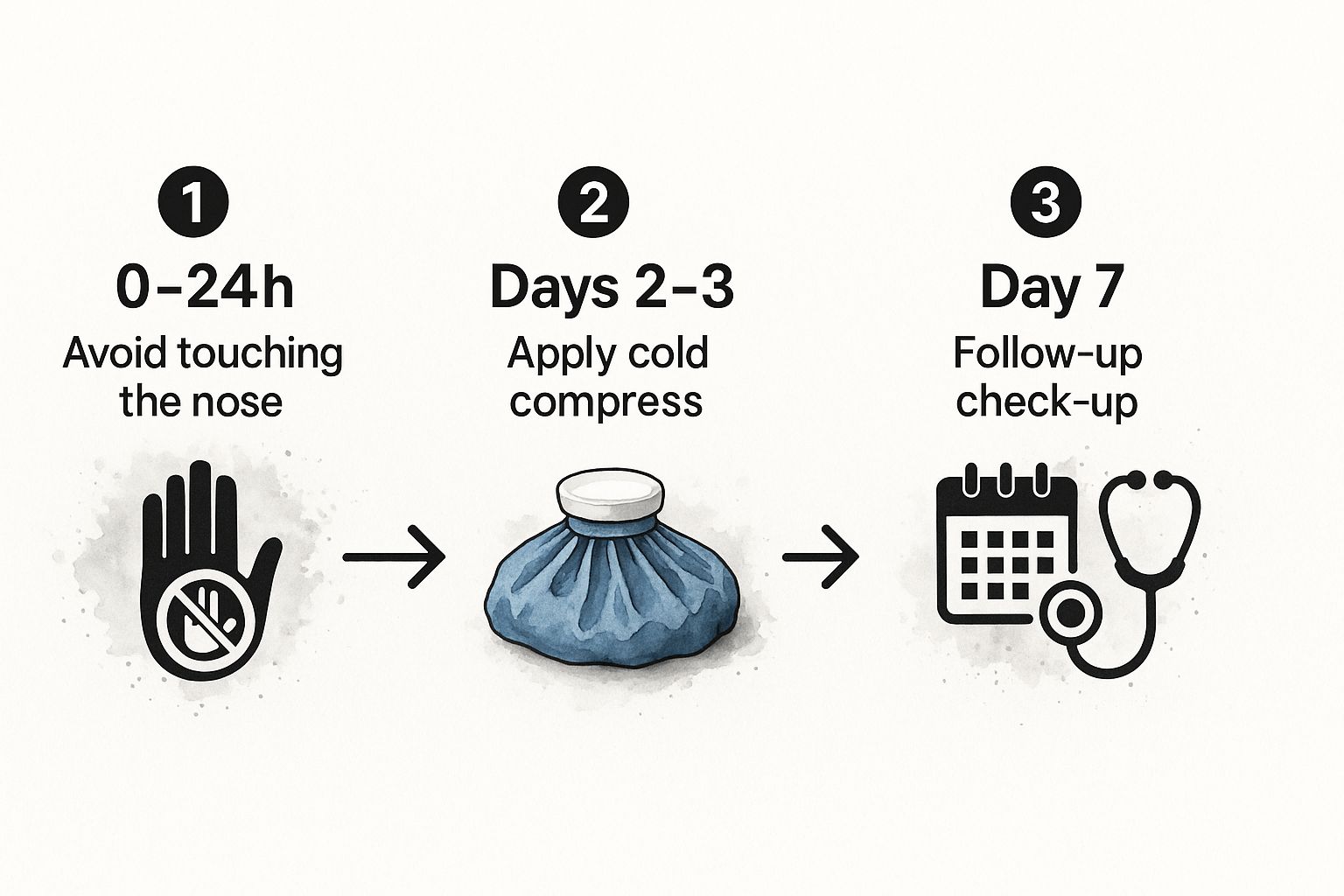
As you can see, your aftercare is mostly about protecting the treated area, managing any swelling, and making sure you attend your follow-up appointment. It’s a straightforward process.
Immediate Aftercare Do's and Don'ts (First 48 Hours)
To make things even clearer, here’s a quick-glance guide to what you should and shouldn't do in the first two days after your procedure. Following these simple rules is the best way to ensure your results look fantastic.
Action | Do | Don't |
|---|---|---|
Touching | Hands off! Leave the area completely alone. | Don't poke, press, or massage the nose. |
Sleeping | Sleep on your back with your head elevated on pillows. | Don't sleep on your front or side. |
Exercise | Stick to gentle walking only. | Don't do any strenuous exercise, gym workouts, or heavy lifting. |
Heat & Sun | Avoid direct sun exposure. | Don't go in saunas, steam rooms, or take very hot showers. |
Eyewear | Wear contact lenses if possible. | Don't wear heavy glasses that rest on the nose. |
Swelling | Apply a gentle cold compress around the nose, not on it. | Don't apply ice or anything frozen directly to the treated area. |
Sticking to this table is your best bet for a complication-free recovery.
Days Two and Three
As you get into the second and third day, you can start to gently apply a cold compress to the areas around your nose—never directly on the filler itself. This can really help with any lingering swelling. And, of course, keep sleeping on your back with your head propped up on an extra pillow or two.
This careful approach is so important for getting the best possible outcome. With non-surgical aesthetic procedures growing so popular in the UK and sessions costing anywhere from £500 to £1,500, protecting your investment is just common sense. Proper aftercare not only helps your results last but also seriously reduces any risks. If you're interested in the data, you can read the full market research from Grand View Research.
Key Takeaway: The first 72 hours are less about active recovery and more about passive protection. By simply leaving your nose alone and taking a few easy steps to manage swelling, you’re doing the most important work to ensure a beautiful, lasting result.
Minimising Swelling and Bruising Like a Pro

A little bit of swelling and maybe some minor bruising are completely normal after a liquid nose job. But just because they're expected doesn't mean you have to sit back and wait for them to disappear. With a few proactive steps, you can take control, speed up your recovery, and keep any downtime to an absolute minimum.
For the first 24-48 hours, think of a gentle cold compress as your new best friend. The key is how you use it. Grab a small ice pack or even a bag of frozen peas, wrap it in a clean, soft cloth, and apply it to the areas around your nose—think your cheeks or forehead. Don't press it directly onto the nose itself. This is crucial because you want to avoid putting any pressure on the freshly placed filler, which could affect your final, beautiful result. A good routine is 10-15 minutes on, several times a day.
Lifestyle Tweaks for a Smoother Recovery
Beyond the cold compress, a few simple changes to your routine can make a huge difference in how quickly the swelling subsides. It mainly comes down to how you sleep and what you eat.
Elevate Your Head: This is a non-negotiable for the first two or three nights. Prop your head up with an extra pillow while you sleep. It’s a simple trick that uses gravity to help drain fluid away from your face, and you'll definitely notice less puffiness in the morning.
Watch Your Diet: We all know that salty foods and alcohol can make us feel bloated, and it's the same for post-treatment swelling. For a few days, try to steer clear of salty takeaways, processed meals, and that evening glass of wine. Your body will thank you for it.
Consider Arnica: Many of our clients swear by over-the-counter arnica cream or tablets. It's a herbal supplement that's well-known for its potential to help reduce bruising and inflammation.
It's reassuring to know you're in safe hands. A huge UK study looking at 5,000 non-surgical rhinoplasties confirmed that when performed by experienced clinicians, the procedure has very low rates of complications. You can read through the findings from this in-depth liquid rhinoplasty study yourself to get a better sense of its strong safety record.
Key Takeaway: You're not just a passenger in your recovery; you're the driver. By combining gentle cold compresses, sleeping with your head elevated, and making smart food choices, you have a powerful toolkit to minimise swelling and help the filler settle perfectly.
These principles of gentle, protective aftercare are a common thread across many aesthetic treatments. For example, if you're curious about other ways to rejuvenate your skin, you might find our guide on chemical peel aftercare useful, as it also highlights the importance of protecting your skin post-procedure.
Protecting Your Investment for the Long Term

Great aftercare for a liquid rhinoplasty goes far beyond the first week. To get the absolute most out of your treatment, which can last anywhere from 9 to 18 months, you’ll want to protect your results for the entire lifespan of the filler. It’s all about creating the right environment for that filler to stay exactly where it was placed, keeping your new nasal contours crisp and defined.
The biggest factor here is avoiding unnecessary pressure on your nose. The hyaluronic acid filler is firm, but it’s still mouldable, especially in those initial weeks. This just means being mindful of anything that could physically alter its shape.
Avoiding Pressure and Protecting the Filler
Take a moment to think about your daily habits. Do you wear heavy glasses or sunglasses? The constant pressure sitting on your nasal bridge can, over time, create a permanent dent in the filler. It’s a good idea to avoid heavy eyewear for at least two to four weeks. If you can't go without glasses, a clever trick is to tape them to your forehead to lift them off your nose slightly, or simply switch to contact lenses for a little while.
Your sleeping position matters more than you might think, too.
Avoid Face-Down Sleeping: Consistently sleeping on your front can slowly but surely flatten or displace the filler over time. It’s best to try sleeping on your back.
Be Careful with Contact Sports: Any activity with a high risk of impact to the face, like football or martial arts, should be approached with caution. A direct knock could significantly alter your results.
Key Insight: Protecting your filler is an ongoing commitment. Simple adjustments, like choosing lighter glasses or being mindful of your sleeping position, are crucial for preventing filler migration and preserving the shape you love.
Skincare and Sun Protection
Your skincare routine also plays a part. For the first couple of weeks, stick to gentle, non-abrasive cleansers on and around the treated area. You’ll want to avoid harsh exfoliants, scrubs, and potent retinoids directly on the nose, as they can cause irritation while the tissue is still settling.
Finally, sun protection is non-negotiable. UV exposure is known to accelerate the breakdown of hyaluronic acid—the very substance your filler is made of. Diligent, daily use of a high-SPF, broad-spectrum sunscreen will not only protect your skin but also help prolong the life of your filler. This is the key to getting the most value from your investment and maintaining those stunning non-surgical rhinoplasty before and after results you worked to achieve.
Getting Back to Normal: Exercise and Daily Routines

One of the biggest draws of a liquid rhinoplasty is just how quickly you can get back to your life. But it's important to remember that "minimal downtime" isn't the same as no downtime. To protect your results and ensure the filler settles perfectly, you need to ease back into your routine with a little care.
For the first 24 to 48 hours, you'll need to press pause on any strenuous workouts. This means no high-intensity interval training (HIIT), heavy weightlifting, running, or even hot yoga. Any activity that gets your heart racing and blood pressure up can worsen swelling and bruising, which might interfere with your final outcome.
Don't worry, you don't have to be completely sedentary. A gentle walk is perfectly fine and can actually help with circulation. Just think of it as a temporary break, not a full stop.
Be Mindful of Heat, Pressure, and Travel
It’s not just about avoiding the gym. Certain environments and activities can also cause extra swelling, so you'll want to be mindful of these for a couple of days.
Skip the Heat: Stay out of saunas, steam rooms, and very hot showers for the first two days. Intense heat dilates blood vessels, and that’s the last thing you want when you’re trying to minimise swelling.
Flying: If you can, it’s best to wait at least 48 hours before taking a flight. The shifts in cabin pressure can sometimes increase swelling and make you feel more uncomfortable.
Taking these small precautions is vital for getting the beautiful, subtle results you want. This treatment is part of a fast-growing global market, valued at over USD 815 million in 2024. As its popularity skyrockets here in the UK, understanding the right aftercare has never been more important for ensuring your safety and satisfaction. You can learn more about the non-surgical rhinoplasty market growth to see just how in-demand this procedure has become.
Expert Tip: The best advice I can give is to simply listen to your body. If an activity makes your face feel flushed, hot, or pressured, it’s a clear sign to stop and rest. Most people feel ready to return to their normal exercise routine after about 48 hours, but if you have any doubts, always get in touch with your practitioner.
Knowing the Red Flags and When to Call Your Clinic
While liquid rhinoplasty is very safe when done by an experienced medical pro, the best thing you can do for yourself is to be an informed patient. A huge part of your aftercare is knowing the difference between what’s totally normal and what warrants an urgent call to the clinic.
You can absolutely expect some minor swelling, a bit of redness, and maybe a few small, temporary bumps. That’s all just part of the process. What isn't normal, however, are symptoms that could point to a vascular occlusion—a rare but serious complication where filler blocks a blood vessel. These signs should never be ignored.
Understanding the Warning Signs
If you experience any of the following, you need to get in touch with your practitioner immediately. Don't wait around to see if things get better on their own.
Severe or Worsening Pain: I'm not talking about mild tenderness. This is a deep, throbbing pain that feels much worse than you’d expect from a few small injections.
Skin Discolouration: Keep a close eye on the colour of your skin. If it looks unusually pale, white, or develops a bluish, dusky tint, that’s a major red flag.
A Mottled Skin Pattern: This can look like a blotchy, lace-like, or bruised pattern on the skin (livedo reticularis) that seems to spread out from where you had the injections.
Changes in Vision: Any blurriness, double vision, or loss of sight is a critical emergency and requires immediate attention.
Critical Takeaway: When it comes to complications, time is everything. If you notice any severe pain or strange skin discolouration after your treatment, contact your practitioner or seek emergency medical help straight away.
Knowing what to look for is a vital part of your liquid rhinoplasty aftercare. It gives you the power to act quickly and protect your health. For a more detailed look at potential issues, our guide on nose fillers side effects and key risks is essential reading.
At the end of the day, trust your instincts. It’s always, always better to make the call and find out everything is fine than to stay quiet and ignore a potential problem.
Of course. Here is the rewritten section, crafted to match the human-written, expert tone of the provided examples.
Common Questions After Your Treatment
Even with the best preparation in the world, it’s completely normal for a few questions to pop up once you get home. Getting your aftercare right is all about knowing what to expect and how to handle the small, practical details.
We’ve gathered some of the most common queries we hear from our clients to give you total peace of mind as you heal.
When Can I Wear My Glasses or Sunglasses?
This is probably the question we get asked most often, and it’s a crucial one. You’ll need to avoid wearing any glasses that rest directly on the bridge of your nose for at least one to two weeks.
The constant, focused pressure—even from the lightest frames—can easily leave a dent in the freshly placed filler. This can unfortunately compromise the beautiful, smooth result we worked to achieve. If you absolutely must wear glasses, try switching to contact lenses for a short while. Another clever trick is to use a tiny piece of tape to gently lift your glasses and secure them to your forehead, so they float just above your nose.
Can I Get a Facial After My Treatment?
It’s best to let your skin rest and allow the filler to settle in properly. We strongly advise waiting at least two weeks, though four is even better, before booking any other facial treatments. This includes everything from facials and microdermabrasion to chemical peels and even facial waxing.
Why the wait? These procedures often involve pressure, deep massage, or active ingredients that can interfere with how the filler integrates with your nasal tissue. It's always a good idea to let your aesthetician know about your recent liquid rhinoplasty before they start any other treatment.
What If I Notice Small Bumps on My Nose?
First of all, don’t panic. It's very common to find a few small, localised bumps in the first week or so. In almost all cases, these are just tiny pockets of swelling around the injection sites, and they will resolve on their own as everything settles.
The golden rule here is do not try to fix them yourself. Resist the urge to press, massage, or smooth out any bumps you feel. Doing so can easily move the filler out of place and undo our work. If, however, a bump becomes painful, seems to be getting bigger, or you notice any skin discolouration, you must get in touch with your practitioner straight away.
Is It Safe to Fly After a Liquid Rhinoplasty?
While it’s not strictly dangerous, most experienced practitioners recommend waiting at least 24-48 hours before you fly. This is mainly for your own comfort. The changes in cabin air pressure can sometimes increase swelling slightly, making the treated area feel more tender than it otherwise would.
If your schedule allows for it, booking your flight for a few days after your procedure is a simple way to make your journey much more comfortable.
At Charis Aesthetics, we believe that outstanding results are a partnership between our expertise and your diligent aftercare. If you have any other questions or are ready to discuss your aesthetic goals in a safe, luxurious setting, we invite you to book a consultation. Explore your options at https://www.charis-aesthetics.co.uk.
Comments