
How does cheek filler work?
Cheek filler restores midface support by placing hyaluronic acid on and around the cheekbone, lasting twelve to eighteen months because the tissue there moves far less than the lips.
- When you see it
- immediately, settled at 2 to 4 weeks
- How it feels
- mild — topical anaesthetic, and the product contains lidocaine
- Sessions
- one, assessed as part of the midface rather than in isolation
What dermal filler actually is
Hyaluronic acid — the same molecule your skin already makes and holds a great deal of. In its natural state it is a loose chain that the body breaks down within a day or two, which would be useless as a treatment. So the gel used in filler is cross-linked: the chains are bonded to each other, which turns a fluid into a soft solid that holds a shape and resists being broken down for months rather than hours.
How tightly it is cross-linked, and how the gel is made, is what separates one filler from another. A firmer, more cohesive gel holds structure and is what you want along a jaw or under a cheek. A softer, more fluid gel spreads and integrates and is what you want in a lip. Using the wrong one in the wrong place is a more common cause of a poor result than using too much.
It also draws water to itself, which is why a lip looks fuller at day three than the amount injected would suggest, and why the final result is a settled result rather than the one you see in the mirror on the way out.
How it works once it is in
Filler works by occupying space in a particular tissue plane, and the plane matters as much as the volume. Deep filler placed on bone provides structure — it lifts what sits above it and changes the shape of a face from underneath. Superficial filler placed in the dermis smooths a line directly. The same product in the same amount does completely different things at those two depths.
That is the whole reason a full-face assessment is not a sales tactic. A fold at the mouth is often a midface problem: the tissue above has descended and gathered, and the fold is where it lands. Filling the fold itself treats the pile of tissue rather than the reason it piled up, which is why over-treated nasolabial folds look heavy rather than smooth.
It is placed either with a needle, which is precise and takes a direct path, or with a cannula — a blunt tube introduced through one entry point that pushes vessels aside rather than piercing them. Neither is universally safer; the choice is made by area, by plane and by what is being corrected.
From there it simply sits there and does its job, while your own hyaluronidase breaks it down gradually over months. There is no point at which it stops working and has to be replaced — it fades.
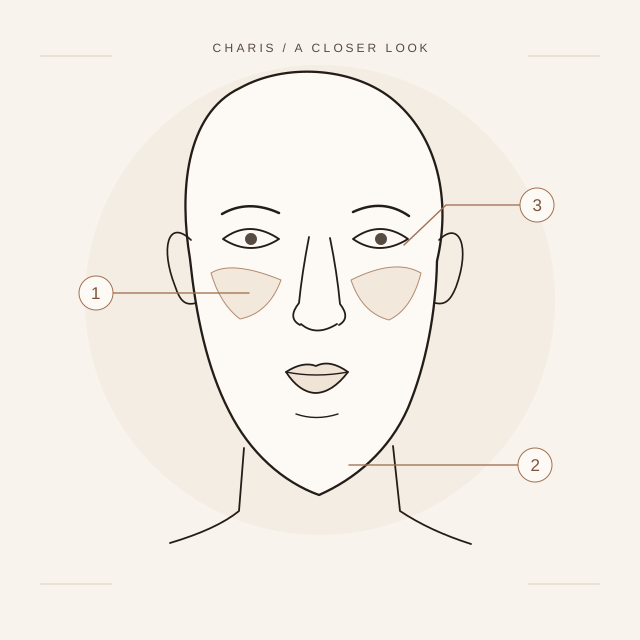
A closer look
A whole-face assessment
Cheeks
The midface contributes to facial contour and proportion.
Chin and jaw
The lower face is considered from the front and in profile.
Skin
Skin quality is assessed alongside shape and support.
Simplified illustration, not a diagnosis, treatment map or prediction of your result.
What it cannot do
It cannot lift loose skin. Filler placed into laxity adds weight to something already descending, and the result is heavier rather than tighter. If skin quality and laxity are the problem, the honest answer is that filler is the wrong category.
It cannot move bone, so a skeletal asymmetry is softened rather than corrected. It cannot improve skin texture, pigmentation or fine crepey lines — those need something that changes the skin itself.
And it cannot be made to look natural past a certain quantity. Tissue accommodates a finite amount before it stops holding shape and starts holding pressure, and pressure is what moves product to where it was not put. That limit is individual, it is assessed rather than calculated, and it is the reason the answer is sometimes no.
Sources and further reading
- NHS — Dermal fillers
- British Association of Dermatologists — patient information
- Joint Council for Cosmetic Practitioners
- Aesthetic Complications Expert Group
This page is general information, not personal medical advice. Every treatment needs an individual assessment, and what is right for someone else may not be right for you.
Common questions
- What is cheek filler?
- Cheek filler restores midface support by placing hyaluronic acid on and around the cheekbone, lasting twelve to eighteen months because the tissue there moves far less than the lips.
- How does cheek filler work?
- Filler works by occupying space in a particular tissue plane, and the plane matters as much as the volume. Deep filler placed on bone provides structure — it lifts what sits above it and changes the shape of a face from underneath. Superficial filler placed in the dermis smooths a line directly. The same product in the same amount does completely different things at those two depths.
- How long does cheek filler take to work?
- Immediately, settled at 2 to 4 weeks. Judging it before then is judging an incomplete result.
- Does cheek filler hurt?
- mild — topical anaesthetic, and the product contains lidocaine You are told what to expect before anything starts, and you can stop at any point.
- What can cheek filler not do?
- It cannot lift loose skin. Filler placed into laxity adds weight to something already descending, and the result is heavier rather than tighter. If skin quality and laxity are the problem, the honest answer is that filler is the wrong category.
Get in touch
Book a consultation
Consultations are £30, and that comes off the cost of your treatment if you go ahead. No pressure to book anything on the day — if you are not sure whether you want treatment at all, that is still a good reason to come and talk.