
Microneedling in Rossendale
Controlled micro-injury that prompts the skin to remodel — used for texture, scarring, pore size and overall quality.
In short
Microneedling makes controlled micro-injuries in the skin to trigger collagen production, treating texture, scarring and fine lines over a course of three to four sessions four weeks apart, with results building for up to six months.
- How long it lasts
- results build for up to 6 months and are held with maintenance
- When you see it
- glow within a week, remodelling over 8 to 24 weeks
- Downtime
- redness like mild sunburn for 24 to 48 hours
- Does it hurt
- topical anaesthetic is used; most describe pressure and heat rather than pain
- Sessions
- 3 to 4, four weeks apart
Microneedling creates thousands of controlled micro-channels in the skin. The skin's response to that controlled injury is to remodel: laying down new collagen and elastin, and improving texture, tone and firmness over the weeks that follow. It is one of the most versatile treatments available and one of the most commonly done badly.
What it treats
Texture and roughness, enlarged pores, acne scarring, fine lines, and general dullness. It can be used across the face, and on the neck and décolletage.
Depth is the variable that matters. The same device set at the wrong depth for your skin either does nothing or does too much, which is why this is not a treatment to choose on price alone.
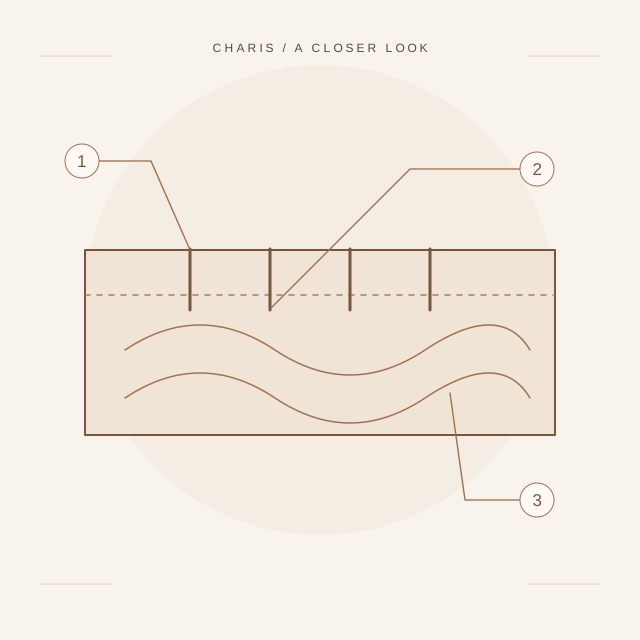
A closer look
What microneedling acts on
Controlled channels
A clinical device creates small punctures in the skin.
Healing response
The treatment uses the skin’s response to controlled injury.
Gradual change
Changes in appearance develop over time rather than at the instant of treatment.
Not to scale; no device setting, depth or home-treatment technique is shown.
Course and results
Most concerns need a course — commonly three to six sessions spaced four weeks apart — with maintenance afterwards. Scarring generally needs more sessions than texture.
It combines well with skin boosters and polynucleotides, and can be paired with dermaplaning.
You will be given written aftercare before you leave, and a direct number to reach me on if anything concerns you afterwards. Reviews are offered at two weeks so we can assess the result together and adjust if needed.
Downtime
Expect redness similar to mild sunburn for 24 to 48 hours, sometimes with light flaking a few days later. Sun protection afterwards is not optional — it is part of the treatment working.
What the whole course involves, start to finish
| Stage | What happens | When |
|---|---|---|
| Assessment | Skin type, history, current products, and what has been tried. Depth and intensity are set from this | Before the first session |
| Session | The treatment itself | 20–45 minutes |
| Straight afterwards | Redness and tightness, like moderate sun exposure | 0–24 hours |
| Shedding | Flaking or peeling, depending on depth. How much you shed is not how well it worked | Day 2–7 |
| The glow, then the gap | Skin looks better for a few days, then appears to stop changing | Week 1–4 |
| The actual result | Collagen remodelling becomes visible: texture, tone, softened scarring | From 4 weeks, building to 12 |
| Next session | Spaced so the previous round has finished remodelling | 4–6 weeks apart |
The stretch between the glow fading and the collagen result appearing is the part people find hardest, because nothing appears to be happening. That is the remodelling phase, and it is the treatment working.
How the plan is decided
Depth is chosen for the area and the skin, not for the appointment
The skin over the forehead and around the eyes is markedly thinner than the skin of the cheek, so treating the whole face at one setting either under-treats one or over-treats the other. A practitioner adjusting as they work across the face is doing the job properly.
Deeper is not better. Past the point that triggers a repair response, extra depth buys downtime and risk rather than collagen.
Skin tone changes the plan, and should be raised before you ask
Post-inflammatory pigmentation — healing darker than the surrounding skin — is meaningfully more likely in richer skin tones. That is a reason for priming the skin, a gentler depth and staged treatment, not a reason to avoid resurfacing. A practitioner who does not raise it before treating deeper skin is not assessing the risk that matters most.
What you do between sessions decides most of the outcome
Daily sun protection and a consistent routine matter more to the final result than any single appointment. Freshly resurfaced skin is temporarily far more reactive to ultraviolet light, and a course without daily protection is money spent undoing itself.
Sources and further reading
- NHS — Dermal fillers
- British Association of Dermatologists — patient information
- Joint Council for Cosmetic Practitioners
- Aesthetic Complications Expert Group
This page is general information, not personal medical advice. Every treatment needs an individual assessment, and what is right for someone else may not be right for you.
Results
Microneedling — Ashleigh’s patients
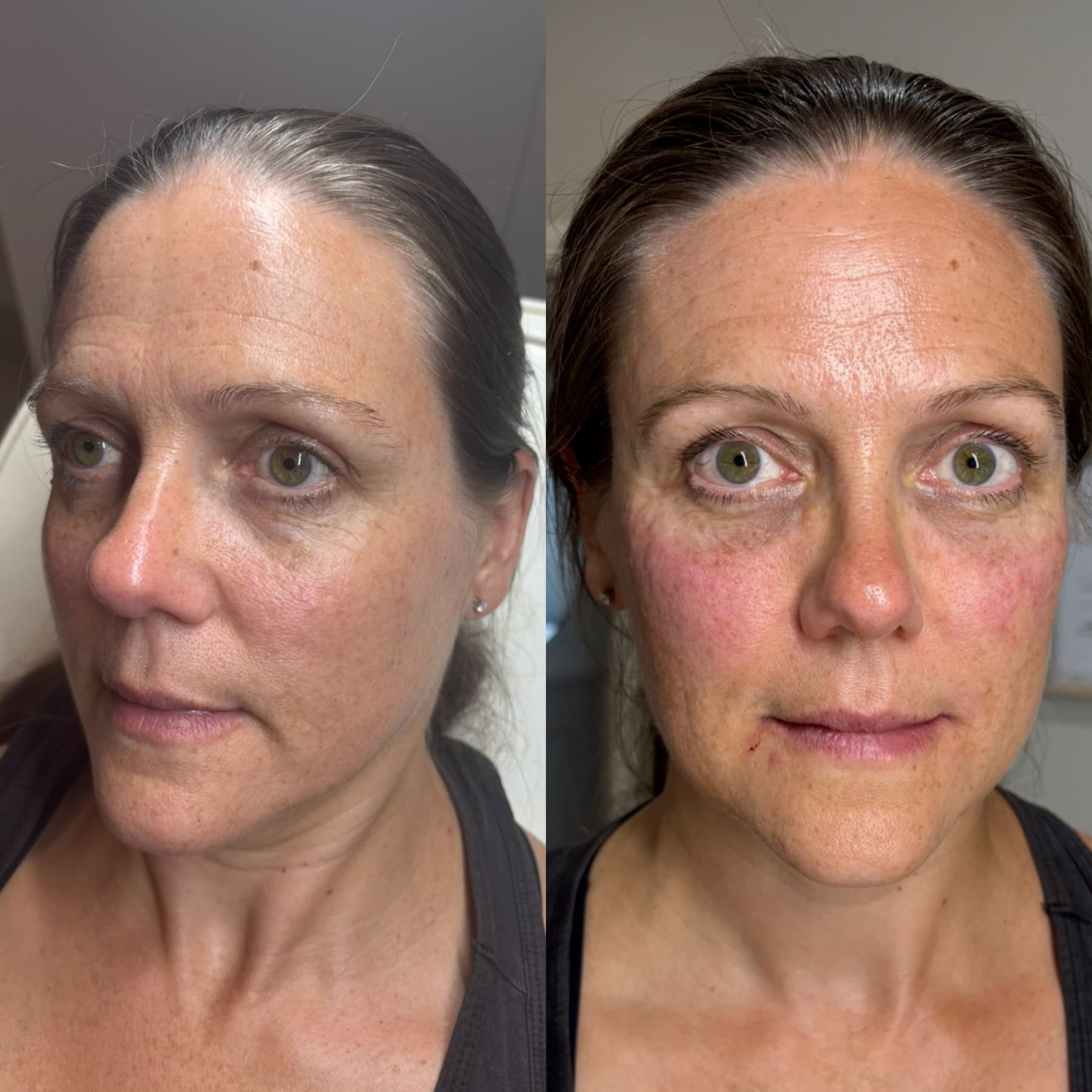
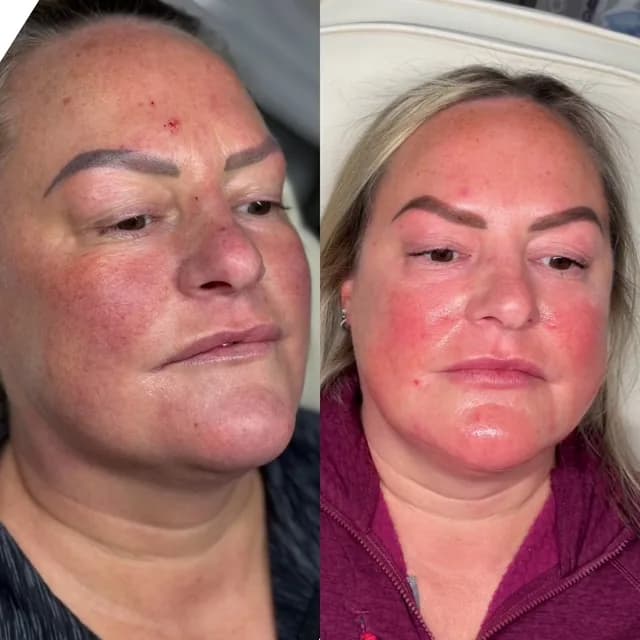
Individual results vary. Shared with patient consent.
Common questions
Microneedling — what people ask
- Does microneedling hurt?
- Topical numbing is applied first and most people describe it as tolerable rather than painful. Sensitivity varies by area — the forehead and upper lip are usually the most sensitive.
- How many sessions do I need?
- Three to six for most concerns, spaced about four weeks apart. Acne scarring typically needs the higher end of that range and sometimes more.
- Can I have it if I have active acne?
- Not over active, inflamed lesions — it risks spreading bacteria. We would treat the acne first, then address the scarring afterwards.
- Is microneedling safe?
- Yes, when the depth is chosen for your skin rather than applied as one setting to everybody. The real risks are pigmentation change in darker skin types, and infection if the skin is not kept clean for the first day or two. Home rollers are the genuinely risky version, because they cannot reach the depth that does the work but can breach the barrier and drag the skin.
- What is radiofrequency microneedling?
- The same channels made by needles, with heat added — insulated needles deliver radiofrequency energy at a set depth, so the tissue around each needle tip is heated as well as pierced. The intended gain is more collagen contraction and a firming effect standard microneedling does not produce. The trade-offs are cost, more downtime, and more to go wrong if the settings do not suit the skin in front of the machine. It is not simply a better version: for texture and scarring the evidence for standard microneedling is solid and the risk is lower.
- Does microneedling tighten skin?
- Only modestly, and less than most marketing implies. It stimulates new collagen, which improves firmness and quality over months — but it does not lift or tighten loose skin in the way a device or a surgical procedure does. If genuine laxity is what bothers you, microneedling will disappoint you, and being told that before you book a course is worth more than the course.
- Is microneedling bad for your skin long term?
- There is no evidence that appropriately spaced treatment damages skin over time — the mechanism is the skin's own repair response, which is finite and self-limiting. Treating too often is the mistake worth avoiding, because it interrupts remodelling that has not finished rather than adding to it.
- Can I have microneedling while pregnant or breastfeeding?
- It depends on the treatment. Microneedling is not offered during pregnancy. Superficial treatment is often fine, but pregnancy changes how skin behaves and pigments, so it is a conversation rather than a yes or no — tell me at booking and we will work out what is sensible.
Travelling to Charis
The clinic is in Stacksteads, Bacup, with patients travelling in for microneedling from Rawtenstall, Haslingden, Ramsbottom, Burnley, Rochdale, Bury, Accrington and across the Rossendale valley.
Areas we coverYou may also be looking at
A resurfacing treatment that accelerates cell turnover — used for pigmentation, congestion, texture and dullness.
A thorough facial: double cleanse, exfoliation, dermaplaning where your skin needs it, then a soothing moisturiser finished with SPF 50.
Regenerative injectable treatment that works on skin quality — hydration, elasticity and firmness — rather than adding volume.
Read before you book
Skin
Chemical peel aftercare and recovery
What to expect day by day, what to use, and the one mistake that undoes the treatment.
Skin
Treating pigmentation on the face
Sun damage, post-inflammatory marks and melasma look similar and are treated differently — how to tell them apart, what actually works, and what makes each of them worse.
Skin
Melasma: what it is and how it is managed
A chronic, hormonally driven pigmentation condition — managed rather than cured, and very easily made worse by the wrong treatment.
Skin
Improving skin texture
Roughness, visible pores and an uneven surface — what causes them, what genuinely improves them, and what no treatment can change.
Skin
Treating acne scarring
Which scars respond to which treatment, why the acne has to be settled first, and what a realistic improvement looks like.
Skin
Why skin looks dull, and what actually helps
Dullness is a light problem before it is a skin problem. What causes it, what fixes it quickly, and what fixes it properly.
Get in touch
Book a consultation
Consultations are £30, and that comes off the cost of your treatment if you go ahead. No pressure to book anything on the day — if you are not sure whether you want treatment at all, that is still a good reason to come and talk.