
How does Teoxane BabyGLOW work?
Teoxane BabyGLOW is a bio-remodelling treatment that spreads hyaluronic acid through the tissue to firm and hydrate an area, given as two sessions four weeks apart with results showing at four to six weeks.
- When you see it
- 4 to 6 weeks
- How it feels
- mild — a small number of fixed injection points
- Sessions
- 2, four weeks apart
What regenerative treatment actually is
A category that does not fill anything. Where filler occupies space, these treatments give the skin either instructions or materials, and then wait for your own cells to do the work. That difference is the reason the results appear over weeks rather than on the day, and the reason they are given as a course rather than as an appointment.
The category covers several genuinely different things. Polynucleotides are fragments of purified DNA that act as a signal to the fibroblasts — the cells that make collagen and elastin — to behave more like younger ones. Amino acid injectables supply the raw materials the skin needs to rebuild its matrix. Bio-remodelling uses a very high concentration of uncross-linked hyaluronic acid that spreads through the tissue rather than staying put, hydrating and stimulating as it goes. Platelet-rich plasma concentrates the growth factors from your own blood. Exosomes are signalling vesicles.
They are frequently sold as interchangeable and they are not. Which one suits you depends on whether your skin needs signalling, materials, hydration or all three — which is an assessment question rather than a menu question.
| Type | What it supplies | Best suited to |
|---|---|---|
| Polynucleotides | A signal. Purified DNA fragments that prompt fibroblasts to behave more like younger ones. | Thin, delicate or damaged skin. The strongest option under the eyes. |
| Amino acid injectables | Materials. The building blocks the skin uses to rebuild its matrix. | Skin that has thinned and lost density — around the eyes, mouth and neck. |
| Bio-remodelling | Hydration plus stimulation. Uncross-linked hyaluronic acid that disperses through the tissue. | Skin that has lost firmness and bounce across a whole area. |
| Platelet-rich plasma | Growth factors concentrated from your own blood. | General rejuvenation, and early-stage hair thinning. |
| Exosomes | Signalling vesicles. | Scalp and skin, where the evidence is newer and still developing. |
How it works over the following weeks
The common mechanism is fibroblast stimulation. Fibroblasts sit in the dermis and produce collagen, elastin and hyaluronic acid; with age they become fewer and lazier, and the matrix they maintain thins and loses its spring. Every treatment in this category is trying to get those cells working again, by one route or another.
Because you are waiting on cell behaviour rather than on a product, the timeline is biological. Little is visible at two weeks. Change is usually apparent from four to six weeks, continues developing for two to three months after the final session, and the improvement is in quality — firmness, hydration, how light sits on the skin — rather than in shape.
This is also why a course exists. A single session produces a signal; repeated sessions produce a sustained one, and sustained signalling is what changes the tissue. Stopping after one is the commonest reason someone concludes the category does not work.
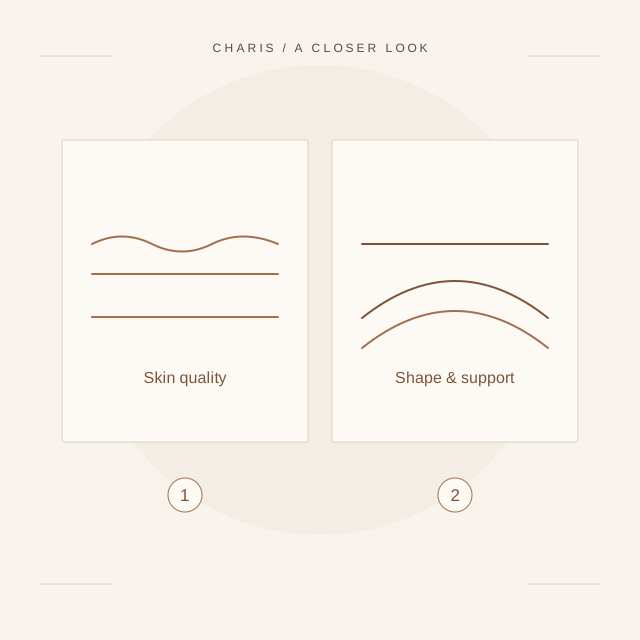
A closer look
Skin quality and facial contour are different questions
Skin quality
Texture, hydration and fine surface lines are skin-quality concerns.
Shape
Volume and contour concern the shape and support of the face.
Often both
These can coexist. Assessment is needed to decide whether any treatment would help.
Conceptual categories, not injection depths. A home lifting or pinch test cannot establish suitability.
What it cannot do
It will not restore volume. If the problem is a flat midface or a heavy jowl, no amount of regenerative treatment will address it, and a clinic selling you a course for that is selling you the wrong thing.
It will not produce a change anyone else notices in a week. The people who are happiest with this category are the ones who understood the timeline before they started; the people who are disappointed are almost always the ones who were sold it as an event.
And it does not suspend ageing. It improves the condition of the tissue you have, from a baseline that continues to move. Maintenance is part of the treatment rather than an upsell.
Sources and further reading
- NHS — Dermal fillers
- British Association of Dermatologists — patient information
- Joint Council for Cosmetic Practitioners
- Aesthetic Complications Expert Group
This page is general information, not personal medical advice. Every treatment needs an individual assessment, and what is right for someone else may not be right for you.
Common questions
- What is Teoxane BabyGLOW?
- Teoxane BabyGLOW is a bio-remodelling treatment that spreads hyaluronic acid through the tissue to firm and hydrate an area, given as two sessions four weeks apart with results showing at four to six weeks.
- How does Teoxane BabyGLOW work?
- The common mechanism is fibroblast stimulation. Fibroblasts sit in the dermis and produce collagen, elastin and hyaluronic acid; with age they become fewer and lazier, and the matrix they maintain thins and loses its spring. Every treatment in this category is trying to get those cells working again, by one route or another.
- How long does Teoxane BabyGLOW take to work?
- 4 to 6 weeks. Judging it before then is judging an incomplete result.
- Does Teoxane BabyGLOW hurt?
- mild — a small number of fixed injection points You are told what to expect before anything starts, and you can stop at any point.
- What can Teoxane BabyGLOW not do?
- It will not restore volume. If the problem is a flat midface or a heavy jowl, no amount of regenerative treatment will address it, and a clinic selling you a course for that is selling you the wrong thing.
Get in touch
Book a consultation
Consultations are £30, and that comes off the cost of your treatment if you go ahead. No pressure to book anything on the day — if you are not sure whether you want treatment at all, that is still a good reason to come and talk.