The cosmetic licensing scheme explained: green, amber and red
The government's proposed licensing scheme sorts non-surgical cosmetic procedures into three risk tiers. What is in each, what would change for practitioners and patients, what is still only a proposal, and when any of it might actually happen.
England is heading towards a licensing scheme for non-surgical cosmetic procedures. It has been coming for years, the enabling power already exists in the Health and Care Act 2022, and the government published its consultation response on 7 August 2025. What it has not done is come into force. This page sets out what is proposed, what is not settled, and what it would mean for you — dated, because content about a moving proposal is worth nothing without a date on it.
The three tiers
GREEN — lower risk. Treatments such as microneedling and non-ablative laser hair removal. Practitioners would need a licence, with requirements proportionate to the risk.
AMBER — medium risk. This is where anti-wrinkle injections and semi-permanent dermal fillers into the face sit. A regulated healthcare professional could perform these without supervision, provided they meet the agreed standards. A non-healthcare practitioner would need a licence and supervision by a named regulated healthcare professional who holds an accredited qualification to prescribe, administer and supervise.
RED — highest risk. Procedures such as breast, genital and buttock augmentation. These would sit under Care Quality Commission regulation and could only be performed by a regulated healthcare professional in a CQC-registered setting.
Why the amber tier is the interesting one
Almost everything the public thinks of as 'aesthetics' lands in amber. It is also the only tier where the proposal draws an explicit line between a regulated healthcare professional and everybody else, and attaches a practical consequence to it — unsupervised practice on one side, licensed and supervised practice on the other.
That is the first time UK policy has put the nurse-led distinction into a document with legal intent behind it. Until now it has been a marketing claim that clinics make about themselves. Under the proposal it becomes a structural difference in what you are permitted to do alone.
It is worth being precise about what it would and would not mean. Performing without supervision is not the same as prescribing. A nurse who is not an independent prescriber would still need a prescriber to assess each patient before a prescription-only medicine could be used, licensing scheme or not.
What is settled and what is not
SETTLED: the power to create the scheme exists in the Health and Care Act 2022. The consultation ran and the government responded on 7 August 2025. The direction — a risk-tiered licence, with the highest-risk procedures restricted to regulated professionals in regulated settings — is clear.
NOT SETTLED: the amber and green tiers require secondary legislation and a further consultation before they take effect. The government has indicated the initial work will prioritise restrictions on high-risk procedures. Which specific treatments end up in which tier can still move, and the qualification standards attached to each are not final.
So the honest position today is: nothing in the green or amber tiers is in force, no date has been fixed, and any practitioner presenting the amber rules as current law is either mistaken or hoping you will not check.
A closer look
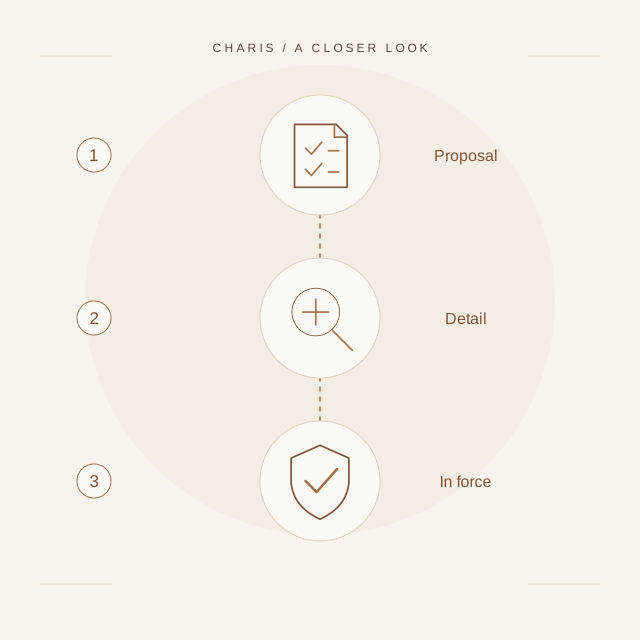
A proposal and an active rule are different things
Published proposal
A consultation document describes what is being considered.
Detailed requirements
The wording, scope and implementation arrangements need to be checked.
Rules in force
Look for the actual legal requirements and commencement dates for your location.
A way to read regulatory information, not a statement that a proposed scheme has commenced. Check the linked official update.
What already is law, and often gets confused with this
Treating under-18s for a cosmetic purpose with filler or anti-wrinkle injections has been a criminal offence in England since 1 October 2021, and so has arranging such an appointment. That is settled law, not a proposal.
The prescription-only status of the substance used in anti-wrinkle injections is medicines law and already applies. It is why a prescriber must assess you.
Local authorities already have their own registration requirements for some skin-piercing style activities, which vary by council and sit underneath any national scheme.
What to do about it as a patient
Nothing urgent. But it does give you a useful question with a clear answer: ask a clinic where they expect to sit under the licensing scheme, and why. Someone who has read the consultation response will tell you plainly. Someone who has not will change the subject.
And it reframes the check that is already worth doing. If the direction of travel is towards regulated healthcare professionals practising unsupervised and everyone else being supervised, then finding out which of those your practitioner is has moved from a preference to something the state is preparing to formalise.
What is settled, and what is not
The scheme is a consultation response, not a law. This is what each part of it currently is.
| Element | Status | What has to happen next |
|---|---|---|
| The three-tier model (green, amber, red) | Proposed | Secondary legislation |
| Which procedures sit in which tier | Not finalised | Detailed scheme rules |
| Who may perform amber and red procedures | Not finalised | The same |
| Licensing of practitioners and premises | Proposed | Secondary legislation, then a transition period |
| Under-18 ban on filler and anti-wrinkle injections | ALREADY LAW in England | Nothing — in force since 2021 |
| Prescription-only status of anti-wrinkle injections | ALREADY LAW | Nothing |
The bottom two rows are the ones worth separating out, because they are routinely quoted as though they were part of the scheme. They are not — they are already in force, and they are the only parts of this that currently protect you.
Sources and further reading
- House of Commons Library — Regulation of non-surgical cosmetic procedures (CBP-10331)
- GOV.UK — Licensing of non-surgical cosmetic procedures: consultation outcome
- Botulinum Toxin and Cosmetic Fillers (Children) Act 2021
- NHS — Cosmetic procedures
This page is general information, not personal medical advice. Every treatment needs an individual assessment, and what is right for someone else may not be right for you.

About the author
Ashleigh Trickett
Registered Nurse & Aesthetic Practitioner
Registered Nurse with a BSc in Nursing and a PGCert in Critical Care (Manchester Metropolitan University, 2025). Ten years in the NHS, four of them in critical care. Advanced facial anatomy education at the Royal College of Surgeons with BAMAN, June 2026. Member of BAMAN and the Aesthetic Complications Expert Group. BAMAN Awards 2026 finalist for Rising Star of the Year.
Treatments this relates to
- Lines & Wrinkles ConsultationOn consultation
A consultation for the treatment of lines and wrinkles — assessment first, with the options and what they can realistically achieve discussed before anything is decided.
- Signature LipsFrom £150
Hyaluronic acid lip enhancement built around your existing anatomy — shape and balance before volume.
Common questions
- When does the aesthetics licensing scheme come into force?
- No date has been set for the green and amber tiers. The consultation response was published on 7 August 2025 and further secondary legislation and consultation are required. The government has said it will prioritise restrictions on the highest-risk procedures first.
- Which tier are anti-wrinkle injections and fillers in?
- Amber, under the proposal — medium risk. Semi-permanent dermal fillers into the face sit there too. This is proposed, not in force, and could still change before legislation.
- Will beauticians be banned from injecting?
- Not under this proposal. A non-healthcare practitioner would need a licence and supervision by a named regulated healthcare professional to perform amber procedures — a restriction rather than a ban. Red-tier procedures would be restricted to regulated professionals in CQC-registered settings.
- What is in the red tier?
- The highest-risk procedures, such as breast, genital and buttock augmentation. These would come under Care Quality Commission regulation and be limited to regulated healthcare professionals in CQC-registered premises.
- Does the licensing scheme mean nurses can prescribe?
- No. Prescribing rights come from an independent prescribing qualification, not from the licensing scheme. A registered nurse who is not an independent prescriber would still need a prescriber to assess the patient before a prescription-only medicine could be used.
- Is this the same as CQC registration?
- No. CQC registration is a separate regime that attaches to regulated activities — under the proposal it would apply to red-tier procedures. Most non-surgical aesthetics is not CQC-regulated, and a clinic that is not CQC registered cannot lawfully claim to treat medical conditions.
Read next
Regulation & who can treat you
Who is legally allowed to inject in the UK?
In most of the UK, no qualification is legally required to inject dermal filler. Anti-wrinkle injections are controlled, but through medicines law rather than through any rule about who may hold the needle. Here is the actual position, and what the proposed licensing scheme would change.
Regulation & who can treat you
Can a beautician do injectables? Nurse, doctor, dentist and non-medic compared
Legally, a non-medic can inject filler today and can administer anti-wrinkle injections that someone else prescribed. What differs is accountability, what happens when it goes wrong, and what the proposed licensing scheme would require of each.
Regulation & who can treat you
How to check any aesthetic practitioner in ten minutes
Every register you need is free, public and searchable. What to look up, in what order, what a clean result actually proves, and the four questions worth asking before you book anything.
Get in touch
Book a consultation
Consultations are £30, and that comes off the cost of your treatment if you go ahead. No pressure to book anything on the day — if you are not sure whether you want treatment at all, that is still a good reason to come and talk.