Lines & Wrinkles Consultation in Rossendale
A consultation for the treatment of lines and wrinkles — assessment first, with the options and what they can realistically achieve discussed before anything is decided.
In short
A consultation for the treatment of lines and wrinkles begins with a full-face assessment and a discussion of which options are appropriate for you; where a prescription-only medicine may be clinically appropriate, an independent prescriber assesses you face to face before anything is prescribed.
- How long it lasts
- 3 to 4 months
- When you see it
- from day 3 to 4, complete at 2 weeks
- Downtime
- none — small raised bumps for an hour, occasional bruising
- Does it hurt
- a very fine needle; most people find it one of the easier treatments
- Sessions
- one, reviewed at 2 weeks
This is a consultation for the treatment of lines and wrinkles. It begins with a full-face assessment: which lines bother you, whether they are caused by movement or are set into the skin, how your brow sits, and how you animate. From that we discuss which of the options available is appropriate for you — and that genuinely includes the option of doing nothing, which is sometimes the right answer.
What the appointment involves
The assessment comes first, and it is not a formality. Lines that appear only on movement, lines that are set into the skin at rest, and a brow that has already dropped are three different problems and they are not addressed the same way. Treating the second as though it were the first is the commonest reason someone is disappointed by a result that was technically well delivered.
We then talk through what is appropriate — which areas, what each would realistically achieve, what it would not, and what the alternatives are where skin quality rather than movement is doing the work. You are given an honest view rather than a menu.
Every treatment begins with a full-face assessment and an honest conversation. If I do not think a treatment is clinically indicated or right for you, I will say so and explain why — including when the answer is to do nothing.
A closer look
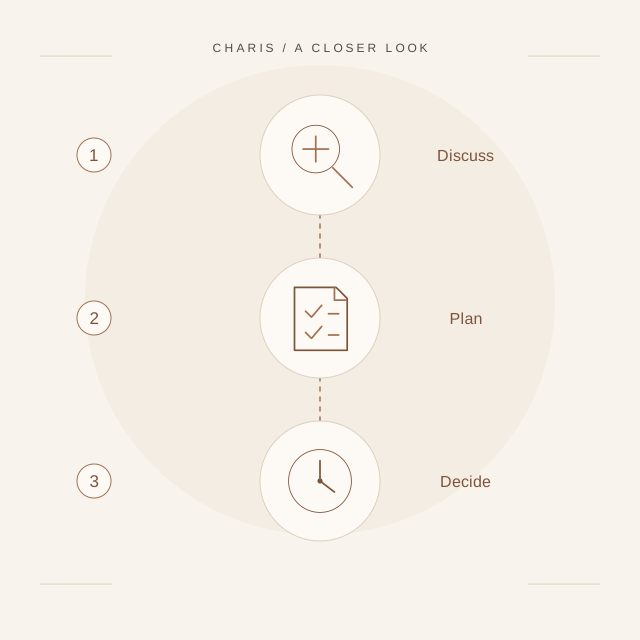
A plan starts with a conversation
Discuss and assess
Talk through your concerns, medical history and previous treatment.
Understand the plan
Discuss options, limits, risks and costs, including doing nothing.
Take time
Ask questions and decide whether you want to proceed.
The sequence describes the consultation approach. It does not mean treatment is appropriate or will happen on the same day.
Where a prescription-only medicine may be appropriate
Some of the options discussed at this consultation involve a prescription-only medicine. Where that may be clinically appropriate, patients undergo a face-to-face consultation with an independent prescriber before any prescription is issued.
I am a registered nurse and not an independent prescriber, and this site says so everywhere for a reason. The prescriber attends the clinic in person and assesses each patient themselves. Nothing is prescribed remotely and nobody is added to a list — which is not how much of this industry operates, and is the single thing most worth asking any clinic about.
The areas assessed
The frown lines between the brows, horizontal forehead lines and the lines at the outer corners of the eyes are what most people come about. Others are assessed individually: a gummy smile, bunny lines across the nose, a brow that would be better lifted than relaxed, and the fine lines around the mouth.
Each is considered in the context of the whole face rather than in isolation. Relaxing one muscle changes what its neighbours do, which is exactly how the compensatory lines people arrive with were produced in the first place.
Dosing, and why it starts conservatively
Doses are individual. Brow position, muscle strength and the way you animate all change what is appropriate, and a dose that suits one person will drop another's brow. I start conservatively and review at two weeks, where adding a little is straightforward — going the other way is not.
The aim is softened lines with expression retained. A face that cannot move is not a good result, and it is not what anybody actually asked for.
Timing and duration
Onset takes three to five days, with the full effect at around two weeks. The effect typically lasts three to four months, sometimes longer once you have had a few treatments.
Do not book within three weeks of an event — at two weeks you are still looking at an incomplete result.
You will be given written aftercare before you leave, and a direct number to reach me on if anything concerns you afterwards. Reviews are offered at two weeks so we can assess the result together and adjust if needed.
Not suitable if
- Anyone pregnant or breastfeeding
- Certain neuromuscular conditions
- Anyone under 18 — it is a criminal offence in England to provide this treatment to under-18s
Sources and further reading
- NHS — Dermal fillers
- British Association of Dermatologists — patient information
- Joint Council for Cosmetic Practitioners
- Aesthetic Complications Expert Group
This page is general information, not personal medical advice. Every treatment needs an individual assessment, and what is right for someone else may not be right for you.
We do not publish before-and-after images for anti-wrinkle treatments. The medicine used is prescription-only, and UK advertising rules do not permit it to be promoted to the public — including through result photographs. We will show you relevant examples in person at your consultation.
Common questions
Lines & Wrinkles Consultation — what people ask
- Will I look frozen?
- Not if it is dosed properly. The aim is softened lines with retained expression — a face that still moves.
- How long does it take to work?
- You will see the start of it at three to five days and the full result at about two weeks. That two-week point is when we review.
- How long does it last?
- Usually three to four months. It varies with dose, muscle strength and metabolism.
- Can I have it as a preventative treatment?
- Softening the movement that creates lines before those lines become static can be reasonable, but it is not right for everyone or at every age. I will give you an honest view rather than sell you a course.
- Why is there no price on this page?
- Because what is appropriate is decided at the assessment, and because the rules on how treatments of this kind may be presented publicly are strict. You are given the exact figure at your consultation, before anything is booked, and you are never asked to commit to anything on the day.
- Who prescribes, and will they see me?
- An independent prescriber. Where a prescription-only medicine may be clinically appropriate, patients undergo a face-to-face consultation with an independent prescriber before any prescription is issued. I am a registered nurse and not a prescriber, and the prescriber attends the clinic in person rather than signing anything off remotely.
- Are anti-wrinkle injections safe?
- The common effects are temporary and minor: a small bruise, occasional headache in the first day, and rarely a temporary heaviness of the brow or eyelid if the product spreads beyond where it was placed. That last one resolves as the effect wears off. Serious complications are rare, and the main variables are anatomical knowledge and dose.
- Can I have anti-wrinkle injections while pregnant or breastfeeding?
- No, not during pregnancy or breastfeeding. As with all injectables here it is a precaution rather than evidence of harm, and it is not a treatment that cannot wait.
Travelling to Charis
The clinic is in Stacksteads, Bacup, with patients travelling in for lines & wrinkles consultation from Rawtenstall, Haslingden, Ramsbottom, Burnley, Rochdale, Bury, Accrington and across the Rossendale valley.
Areas we coverYou may also be looking at
Full-face assessment and treatment planning — restoring support and balance across the face rather than treating features in isolation.
Softening the lines that run down from the corners of the mouth — by restoring the support around them, not only filling the crease.
Read before you book
Lips
What is a lip flip?
A few units of anti-wrinkle treatment to roll the upper lip outward — what it does, what it does not, and who it suits.
Anti-wrinkle
Treating forehead lines
Why the forehead is the area most often treated badly, what the eyebrow has to do with it, and the difference between lines that move and lines that have set.
Anti-wrinkle
Treating crow's feet
The lines at the outer eye — why keeping some of them is usually right, and why the ones under your eye need a different treatment entirely.
Anti-wrinkle
Bunny lines on the nose
The diagonal creases across the bridge of the nose — what causes them, why they sometimes appear after other treatment, and how they are treated.
Anti-wrinkle
Lines around the mouth
Vertical lip lines — usually nothing to do with smoking, rarely fixed by one treatment, and one of the hardest areas to treat well.
Facial harmonisation
Marionette lines
The lines from the mouth corners toward the jaw — why they make a resting face look unhappy, and why the answer is structural.
More on lines & wrinkles consultation
Get in touch
Book a consultation
Consultations are £30, and that comes off the cost of your treatment if you go ahead. No pressure to book anything on the day — if you are not sure whether you want treatment at all, that is still a good reason to come and talk.