
Who prescribes your treatment, and why you should ask
Anti-wrinkle injections use a prescription-only medicine, which means a prescriber must assess you personally. Remote prescribing — signing patients off from a list — is against guidance and widespread. How the chain is supposed to work, and how to tell whether it did.
This is the least understood part of UK aesthetics and the one where the gap between what is supposed to happen and what commonly does happen is widest. It also has the advantage of being easy to check: one question, asked before you book, gets you most of the way there.
How the chain is supposed to work
The substance used in anti-wrinkle injections is a prescription-only medicine. That places a legal requirement on the PRESCRIBER: they must assess the individual patient, satisfy themselves the medicine is appropriate for that person, and prescribe it for them by name.
Prescribers here are doctors, dentists, and nurses or pharmacists who hold an independent prescribing qualification. Most registered nurses working in aesthetics are not independent prescribers, which is entirely normal — it means they work with one.
Once prescribed for you, the medicine can be administered. The administering practitioner and the prescriber can be the same person or different people. What cannot happen is a prescription being written for someone the prescriber has never assessed.
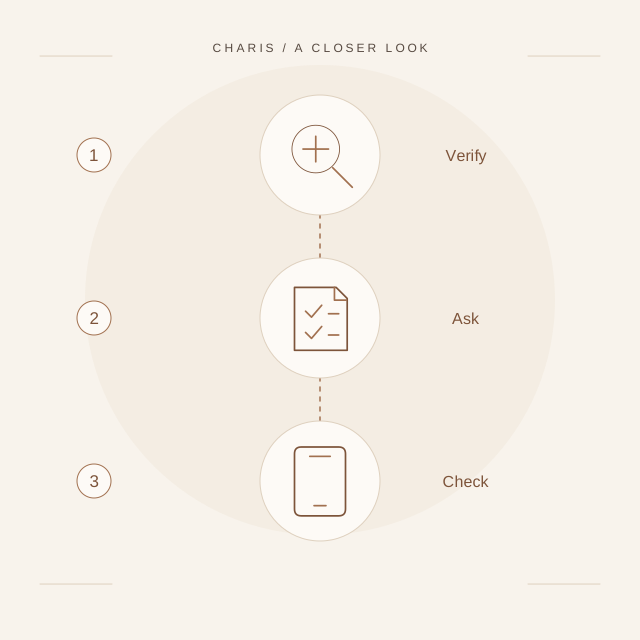
A closer look
Know who is responsible at each stage
Assessment
Know who is assessing you and how they have considered your medical history.
Prescription
Where a prescription is needed, ask who issues it for you.
Administration and follow-up
Know who carries out treatment and who to contact afterwards.
A conversation checklist, not an accreditation, guarantee of safety or substitute for checking the full record.
Remote prescribing, and why it persists
Remote prescribing is a prescriber authorising a medicine for a patient they have not personally assessed — typically working from a list sent by a clinic, sometimes with photographs, sometimes with nothing. It is against professional guidance for injectable cosmetic medicines and has been for years.
It persists because it is cheap and invisible. Booking a prescriber to attend a clinic in person costs money and constrains the diary; a signature obtained at a distance costs almost nothing and no patient ever sees the difference. Nothing about your appointment would look different.
The consequence when it goes wrong is that the assessment which should have caught a contraindication did not happen, and the person legally responsible for the prescribing decision never met you.
How to tell
Ask, in these words: who prescribes, and will they have assessed me? Then listen for whether the answer names a person and a mechanism, or waves at one.
Good answers sound like: 'I'm an independent prescriber, so I prescribe for my own patients after assessing you' — or — 'I'm not a prescriber, so a prescriber attends the clinic on set days and will see you face to face before anything is prescribed.'
Answers worth pausing on: 'It's all handled', 'we work with a prescriber' with no detail about whether they will see you, or any suggestion that a form or photograph substitutes for an assessment.
How it works here
I am not an independent prescriber. Treatments involving a prescription-only medicine are booked into dedicated sessions, and an independent prescriber attends the clinic in person and assesses each patient face to face before anything is prescribed. Nothing is prescribed remotely and nobody is added to a list.
That is the more awkward way to run a diary. It means those treatments happen on set days rather than whenever suits, and it costs more than a signature obtained at a distance. It is also the only version of this that matches what the guidance asks for, which is why it is worth the inconvenience and worth publishing.
Filler is a different matter — it is not a prescription-only medicine, so no prescriber is involved and appointments are not constrained in the same way.
Remote or in person? What each means for you
| Assessed in person | Prescribed remotely | |
|---|---|---|
| Who examines your face | The prescriber | Nobody, or the injector describing it |
| Basis for the prescription | A clinical assessment | A form, a photograph, or a phone call |
| Medical history taken by | The person legally responsible | Often the person administering |
| Professional guidance | What every relevant body advises | Advised against for these treatments |
| If something goes wrong | The prescriber knows your face and your history | They have never seen you |
It persists because it is convenient and cheap, not because it is defensible. The question that settles it takes one sentence: “will the person prescribing this be assessing me in person?”
Sources and further reading
- Nursing & Midwifery Council — search the register
- General Medical Council — the medical register
- General Dental Council — search the registers
- NHS — Cosmetic procedures
- House of Commons Library — Regulation of non-surgical cosmetic procedures (CBP-10331)
This page is general information, not personal medical advice. Every treatment needs an individual assessment, and what is right for someone else may not be right for you.

About the author
Ashleigh Trickett
Registered Nurse & Aesthetic Practitioner
Registered Nurse with a BSc in Nursing and a PGCert in Critical Care (Manchester Metropolitan University, 2025). Ten years in the NHS, four of them in critical care. Advanced facial anatomy education at the Royal College of Surgeons with BAMAN, June 2026. Member of BAMAN and the Aesthetic Complications Expert Group. BAMAN Awards 2026 finalist for Rising Star of the Year.
Treatments this relates to
- Lines & Wrinkles ConsultationOn consultation
A consultation for the treatment of lines and wrinkles — assessment first, with the options and what they can realistically achieve discussed before anything is decided.
- Jaw Slimming£300
Relaxing the masseter muscle to soften a square jawline and taper the lower face.
- Nefertiti Neck Lift£300
Treatment of the platysma bands to soften the downward pull on the jawline and neck.
Common questions
- Who can prescribe anti-wrinkle injections in the UK?
- Doctors, dentists, and nurses or pharmacists holding an independent prescribing qualification. The prescriber must personally assess the patient before prescribing.
- Can a nurse prescribe for aesthetic treatments?
- Only if they hold an independent prescribing qualification. Most aesthetic nurses do not, which is normal — they work alongside a prescriber who assesses the patient.
- What is remote prescribing and why does it matter?
- A prescriber authorising a prescription-only medicine for a patient they have never assessed, often from a list. It is against professional guidance for injectable cosmetic medicines, and it means the assessment that should catch a contraindication never happened.
- Does a prescriber need to see me in person?
- They need to assess you personally. In practice, for injectable cosmetic medicines, that means a face-to-face consultation rather than a form, a photograph or a name added to a list.
- Does filler need a prescription?
- No. Dermal fillers are regulated as devices rather than medicines, so no prescriber is involved. That is also why the law currently says so little about who may inject them.
Read next
Regulation & who can treat you
Who is legally allowed to inject in the UK?
In most of the UK, no qualification is legally required to inject dermal filler. Anti-wrinkle injections are controlled, but through medicines law rather than through any rule about who may hold the needle. Here is the actual position, and what the proposed licensing scheme would change.
Regulation & who can treat you
Can a beautician do injectables? Nurse, doctor, dentist and non-medic compared
Legally, a non-medic can inject filler today and can administer anti-wrinkle injections that someone else prescribed. What differs is accountability, what happens when it goes wrong, and what the proposed licensing scheme would require of each.
Regulation & who can treat you
How to check any aesthetic practitioner in ten minutes
Every register you need is free, public and searchable. What to look up, in what order, what a clean result actually proves, and the four questions worth asking before you book anything.
Get in touch
Book a consultation
Consultations are £30, and that comes off the cost of your treatment if you go ahead. No pressure to book anything on the day — if you are not sure whether you want treatment at all, that is still a good reason to come and talk.