
How does microneedling work?
Microneedling makes controlled micro-injuries in the skin to trigger collagen production, treating texture, scarring and fine lines over a course of three to four sessions four weeks apart, with results building for up to six months.
- When you see it
- glow within a week, remodelling over 8 to 24 weeks
- How it feels
- topical anaesthetic is used; most describe pressure and heat rather than pain
- Sessions
- 3 to 4, four weeks apart
What resurfacing actually is
Controlled, deliberate injury — or in one case, controlled removal. The whole category works by provoking the skin's own repair response, and the skill is entirely in the control: enough to trigger repair, not enough to cause damage the skin does not fully recover from.
Microneedling makes hundreds of tiny vertical channels through the epidermis into the dermis. A chemical peel applies an acid at a concentration that separates and lifts a measured depth of skin. Dermaplaning is different in kind — it removes the outermost dead layer and the fine vellus hair with a blade, without injuring living tissue, which is why it has no downtime and no collagen effect worth claiming.
The depth reached is the entire variable. It decides what a treatment can improve, how long you are red for, and how much risk you are taking. A deeper treatment is not a better treatment; it is a different treatment with a different recovery, and matching depth to the problem is most of the job.
Scroll the table sideways →
| Treatment | Depth reached | What it improves | Visible recovery |
|---|---|---|---|
| Dermaplaning | Dead surface layer only — no injury | Texture, brightness, product absorption | None |
| Superficial peel | Within the epidermis | Tone, brightness, congestion | 1-3 days, light flaking at most |
| Microneedling | Into the dermis, depth chosen per area | Texture, acne scarring, pores, fine lines | 24-48 hours of redness |
| Medium peel | Upper dermis | Established pigmentation, fine lines, some scarring | About a week of visible peeling |
How the repair response works
The moment the skin registers injury it starts a sequence that has been the same for as long as we have had skin. First inflammation — the redness and heat in the hours afterwards, which is the response working rather than a side effect. Then proliferation, over the following days, as fibroblasts migrate in and lay down new collagen. Then remodelling, over weeks to months, as that new collagen is reorganised into something stronger and better aligned than what was there.
The remodelling phase is why the result of a resurfacing treatment is not the result you see when the redness settles. Real improvement in texture and scarring appears from around four weeks and continues for three months. Judging it at day seven is judging inflammation.
It is also why a course beats a single session for anything structural. Each treatment restarts the cascade; the improvements accumulate. One session gives you a glow, which is a real but temporary consequence of increased blood flow and a freshly cleared surface.
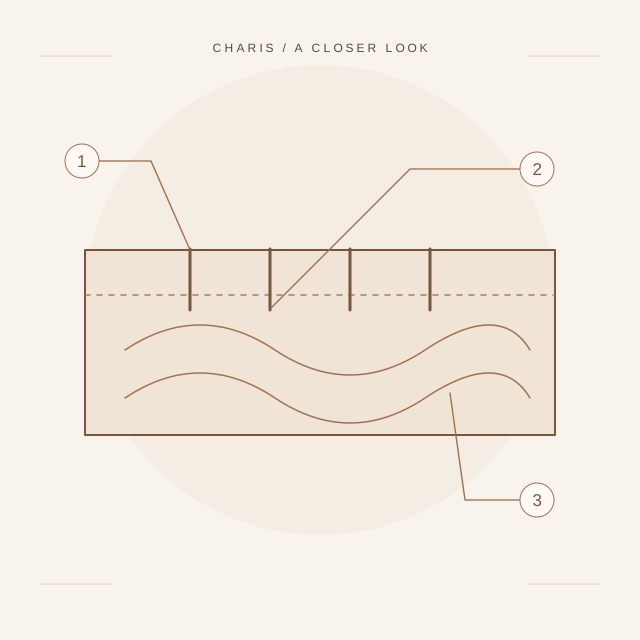
A closer look
What microneedling acts on
Controlled channels
A clinical device creates small punctures in the skin.
Healing response
The treatment uses the skin’s response to controlled injury.
Gradual change
Changes in appearance develop over time rather than at the instant of treatment.
Not to scale; no device setting, depth or home-treatment technique is shown.
What microneedling is good for, and what it is not
It is at its best on texture: acne scarring, enlarged-looking pores, crepey fine lines and the general roughness that comes from sun and time. Those are collagen problems, and microneedling is a collagen treatment.
It is unreliable for pigmentation on its own, and in darker skin types an aggressive setting can provoke pigmentation rather than clear it. It does nothing for volume, laxity or the shape of anything.
Depth is the variable that decides all of it. A superficial pass gives a glow and no meaningful remodelling; a deeper pass reaches the dermis where scarring lives and comes with several days of visible recovery. A clinic that runs everybody at the same depth is not assessing anybody.
How it differs from radiofrequency microneedling
Radiofrequency microneedling adds heat, delivered through insulated needles at a set depth. The needles create the channels; the radiofrequency energy then heats the tissue around the needle tips, adding a thermal injury to the mechanical one.
The intended advantage is more collagen contraction and a firming effect that standard microneedling does not produce. The trade-offs are cost, more downtime, and a higher risk if the settings do not suit the skin in front of the machine.
It is not simply a better version. For texture and scarring the evidence for standard microneedling is solid and the risk is lower, which is why it remains the workhorse.
Does it work, and how many will I need
For texture and atrophic acne scarring, yes — this is one of the better-evidenced treatments in aesthetics, which is unusual in a field with a great deal of marketing and rather less data.
A course of three to six sessions, four to six weeks apart, is the normal answer for anything structural, with maintenance afterwards. A single session gives a temporary glow rather than a change.
If someone offers you one session for acne scarring and predicts a transformation, that is a sales position rather than a clinical one.
Home rollers and why they are a different thing
A home roller does not reach the depth at which collagen remodelling happens, which is the entire mechanism. What it can do is breach the skin barrier enough to cause irritation, spread bacteria if it is not sterile, and drag rather than puncture, which is how tracking marks happen.
It is not a diluted version of the clinic treatment. It is a different and less useful thing that carries a risk the clinic treatment manages.
What it cannot do
It cannot change the shape of anything. Resurfacing improves the surface and the quality of the skin; volume, structure and descent are untouched by it.
It cannot fix pigmentation caused by ongoing sun exposure or by an underlying condition, and in darker skin types an over-aggressive treatment can cause pigmentation rather than clear it. That risk is real, it is assessed beforehand, and it is a reason to be wary of a clinic that offers one protocol to everybody.
And it cannot outrun what you do afterwards. A resurfacing course without daily sun protection is money spent undoing itself, which is the least popular sentence in aesthetics and one of the truest.
Sources and further reading
- NHS — Dermal fillers
- British Association of Dermatologists — patient information
- Joint Council for Cosmetic Practitioners
- Aesthetic Complications Expert Group
This page is general information, not personal medical advice. Every treatment needs an individual assessment, and what is right for someone else may not be right for you.
Common questions
- What is microneedling?
- Microneedling makes controlled micro-injuries in the skin to trigger collagen production, treating texture, scarring and fine lines over a course of three to four sessions four weeks apart, with results building for up to six months.
- How does microneedling work?
- The moment the skin registers injury it starts a sequence that has been the same for as long as we have had skin. First inflammation — the redness and heat in the hours afterwards, which is the response working rather than a side effect. Then proliferation, over the following days, as fibroblasts migrate in and lay down new collagen. Then remodelling, over weeks to months, as that new collagen is reorganised into something stronger and better aligned than what was there.
- How long does microneedling take to work?
- Glow within a week, remodelling over 8 to 24 weeks. Judging it before then is judging an incomplete result.
- Does microneedling hurt?
- topical anaesthetic is used; most describe pressure and heat rather than pain You are told what to expect before anything starts, and you can stop at any point.
- What can microneedling not do?
- It cannot change the shape of anything. Resurfacing improves the surface and the quality of the skin; volume, structure and descent are untouched by it.
Get in touch
Book a consultation
Consultations are £30, and that comes off the cost of your treatment if you go ahead. No pressure to book anything on the day — if you are not sure whether you want treatment at all, that is still a good reason to come and talk.