
What is a lip flip?
A few units of anti-wrinkle treatment to roll the upper lip outward — what it does, what it does not, and who it suits.
A lip flip uses a very small amount of anti-wrinkle treatment placed into the muscle that circles the mouth. Relaxing the top edge of that muscle lets the upper lip roll very slightly outward, so more of the pink shows when you are at rest. It is not filler and it adds no volume at all.
What it actually changes
It shows a little more of the upper lip and can soften a gummy smile by reducing how far the lip lifts. The effect is subtle — measured in millimetres — and it is a change in how the lip sits, not in how big it is.
If you want genuinely more volume, a lip flip will disappoint you and filler is the honest answer. If your upper lip disappears when you smile, or you feel your top lip is thin only because it curls inward, this may be exactly right.
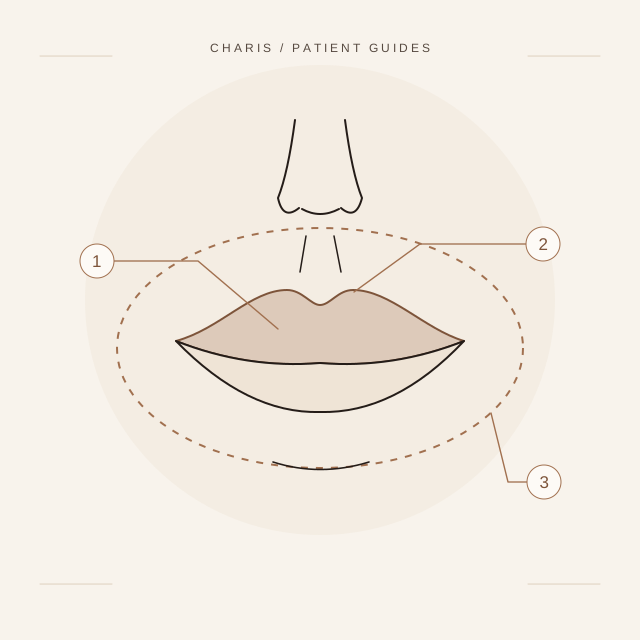
A closer look
The three parts of a lip assessment
Visible lip
The pink part is called the vermilion. How much shows can change with expression.
Lip border
The edge and Cupid’s bow help define the shape. Definition and volume are different features.
Movement
The muscle around the mouth helps close and purse the lips. Assessment includes smiling and speaking.
Schematic anatomy, with the muscle position simplified. The markers identify features, not treatment sites.
How long it lasts
Around six to eight weeks — noticeably shorter than the same treatment in the forehead, because the muscle around the mouth is in constant use. That short duration is worth knowing before you book: it is not a cheaper alternative to filler, it is a different thing that needs repeating more often.
The trade-off
Because the muscle is slightly relaxed, some people notice a temporary difference in sipping through a straw, whistling or pronouncing certain sounds. It is usually mild and it resolves as the treatment wears off, but if you sing, play a wind instrument or present for a living, factor it in.
Lip flip or lip filler — which one are you actually asking for?
These get confused constantly, and they do genuinely different things. A lip flip changes how much of your lip you can see by relaxing the muscle that holds the top edge rolled inward. Filler changes how much lip there is. If you have plenty of lip but it disappears when you smile, you want the first. If you want more lip, no amount of the first will produce it.
| Lip flip | Lip filler | |
|---|---|---|
| What it does | Rolls the upper lip outward so more of the pink shows | Adds volume and reshapes the lip body |
| Best for | A top lip that vanishes when you smile; a gummy smile | Genuinely thin lips, lost definition, asymmetry |
| Visible change | Subtle — 1-2mm of extra show | As much or as little as is placed |
| Lasts | 6-10 weeks | 6-12 months |
| Onset | 3-7 days | Immediate, settled at 2 weeks |
| Reversible | No — it wears off | Yes, with hyaluronidase |
| Typical spend per year | Higher — it needs repeating more often | Lower per year for a comparable effect |
The cost comparison surprises people. A lip flip is cheaper per appointment and more expensive per year, because it lasts a fraction of the time. If you like the effect and want it permanently, filler is usually the better economics as well as the better result.
Getting one that works, first time
Ask for a conservative dose to begin with
The difference between a lip that sits slightly more open and a lip that will not quite behave is a very small number of units. There is no way to remove it once placed, and it takes weeks to wear off — so the sensible first appointment is a small one, reviewed at two weeks and topped up if it is doing too little.
A practitioner who starts at their maximum on a first lip flip is optimising for your review rather than your result.
Time it around anything that matters
The effect starts at around day three and is complete at two weeks, so a lip flip booked the week of a wedding is being judged mid-way through. Three weeks ahead is comfortable; a fortnight is the minimum worth attempting.
It combines well with filler, and often should
The two are frequently done together, because they solve adjacent halves of the same complaint — filler restores the body of the lip, the flip changes how much of it shows. Where a lip has both lost volume and rolls inward, doing only one leaves half the result on the table.
Where they are combined, filler is usually placed first and the flip added once it has settled, so the shape being adjusted is the final one.
Sources and further reading
This page is general information, not personal medical advice. Every treatment needs an individual assessment, and what is right for someone else may not be right for you.

About the author
Ashleigh Trickett
Registered Nurse & Aesthetic Practitioner
Registered Nurse with a BSc in Nursing and a PGCert in Critical Care (Manchester Metropolitan University, 2025). Ten years in the NHS, four of them in critical care. Advanced facial anatomy education at the Royal College of Surgeons with BAMAN, June 2026. Member of BAMAN and the Aesthetic Complications Expert Group. BAMAN Awards 2026 finalist for Rising Star of the Year.
Treatments this relates to
- Lines & Wrinkles ConsultationOn consultation
A consultation for the treatment of lines and wrinkles — assessment first, with the options and what they can realistically achieve discussed before anything is decided.
- Signature Lips£220
Hyaluronic acid lip enhancement built around your existing anatomy — shape and balance before volume.
Common questions
- Is a lip flip the same as lip filler?
- No. A lip flip relaxes a muscle so the lip rolls outward slightly. Filler adds volume. They do different things and are sometimes combined.
- How long does a lip flip last?
- Around six to eight weeks. The muscle around the mouth is very active, so the effect wears off faster than in other areas.
- Will it make my lips bigger?
- Not bigger — slightly more visible. If volume is what you are after, filler is the right treatment.
Get in touch
Book a consultation
Consultations are £30, and that comes off the cost of your treatment if you go ahead. No pressure to book anything on the day — if you are not sure whether you want treatment at all, that is still a good reason to come and talk.