
How to get lip filler that looks natural
Natural is a proportion problem, not a volume problem. What actually makes lips read as done, and the specific things to ask for — and to refuse — at consultation.
Almost everyone who comes to me for lips says they want them to look natural. The interesting part is that what makes lips look done is rarely the amount of product — it is where it went, what happened to the proportions, and whether the lips still move the way the rest of the face does.
The proportions that read as natural
In most faces the lower lip is somewhat fuller than the upper — roughly one to one and a half in vertical height, though it varies with ethnicity and with individual anatomy and should never be applied as a formula. Lips that read as obviously treated have very often had that ratio inverted, with an upper lip built taller than the lower.
Width matters as much as height. A lip that has been given volume without regard for how far it extends toward the corners looks like a shape sitting on a face rather than part of one. Where the corners have dropped with age, addressing that does more for how the mouth reads than adding height ever will.
Projection is the third dimension, and the one most often ignored. Looking at a lip from the side tells you more than looking at it straight on, and a good injector will assess you in profile. Volume added without projection is what produces the flat, pushed-forward look people describe as duck lips.
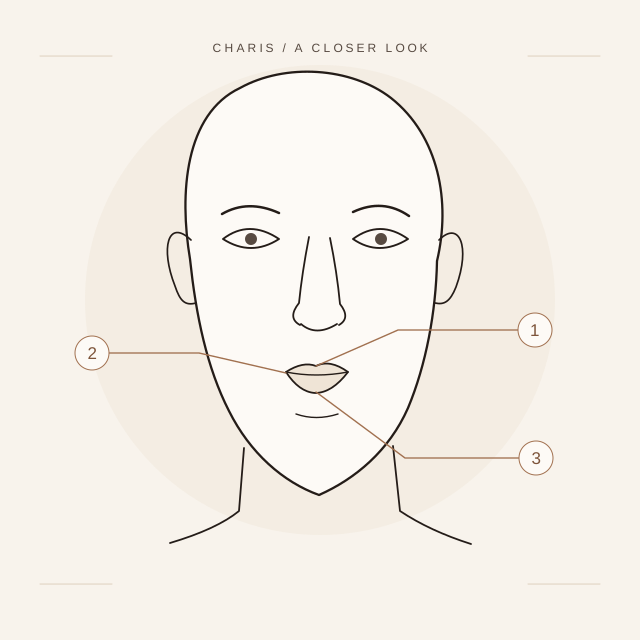
A closer look
A lip is more than its volume
Shape
The Cupid’s bow and the existing lip outline are part of your individual anatomy.
Width
The lips need to be considered in relation to the whole mouth and face.
Proportion
Upper and lower lip proportions vary. A single ideal ratio does not fit everyone.
Simplified illustration, not a diagnosis, treatment map or prediction of your result.
The things that actually give it away
A lost cupid's bow. The double curve at the centre of the upper lip is one of the most identifiable features of a mouth, and filling straight across it flattens it into a single arc. Restoring it afterwards is harder than preserving it.
A hard, over-defined border. A crisp line where the lip meets the skin can look striking in a photograph and artificial in person, because a real lip border is a gradient rather than an edge.
Loss of movement. Lips that stay the same shape whether you are smiling, talking or at rest have too much product in them for the tissue. This is the one people notice without being able to name, and it is a volume problem that no amount of skilful placement fixes.
Going slowly is the technique
The most reliable route to a natural result is a small first treatment, a full assessment at two to four weeks once the swelling has entirely gone, and a decision about more only then. Half a millilitre placed well and reviewed beats a full millilitre placed hopefully.
Swelling is the reason. Lips swell more than any other area of the face and they swell unevenly, so what you see in the first week is not the result. Deciding you need more on day three is deciding based on information you do not have yet.
Build across appointments rather than within one. Lips that have been developed gradually over a year look like lips; lips that were changed substantially in one sitting usually look changed, and the tissue has had no time to accommodate.
What to say at consultation
Bring photographs of your own lips from a few years ago rather than photographs of someone else's. Your lips at twenty-five are an achievable target and someone else's are not, because the tissue, the dental support and the surrounding face are all different.
Say what bothers you rather than what you want done. “My top lip disappears when I smile” is a brief an injector can work to; “I want 1ml” is a request for a quantity, and quantity is our decision to make together after the assessment, not the starting point.
Ask what they will not do. A practitioner who has clear limits — who will decline to keep adding, who will refuse a shape that will not suit you — is generally the one whose results look natural.
When filler is not the answer
If your concern is that your top lip vanishes when you smile, and there is reasonable volume there at rest, a small amount of muscle relaxing to roll the lip outward may serve you better than adding product. It adds nothing and it is not permanent.
If the corners of your mouth turn down, or the lines around the mouth are the real issue, treating the lip body alone will not address it and can make the surrounding area look more tired by comparison.
And if you have had filler before and are unhappy with how it has settled, the honest first step is usually dissolving and starting again rather than adding on top of a result that is not working. Building on a poor foundation is how small problems become large ones.
The tells, and what causes each
When lips look done, it is almost never because of the amount alone. It is one of five specific things, and each has a cause on the technique side.
| The tell | What caused it | How it is avoided |
|---|---|---|
| A visible ridge above the lip line | Product placed too superficially, or beyond the border | Staying inside the vermillion border, at the right depth |
| A top lip heavier than the bottom | Treating the upper lip in isolation | Respecting the natural ratio — the lower lip carries more |
| A flat, sausage-like shape | Even volume along the whole lip | Building the natural peaks and the central tubercle |
| Lips that project forward in profile | Too much volume for the surrounding structure | Assessing from the side, not just face on |
| A duck look on smiling | Volume placed without regard to how the lip moves | Watching the lip animate before deciding placement |
None of those is fixed by using less product. They are fixed by placing it differently, which is why “just do half a millilitre” is not by itself a plan for a natural result.
Sources and further reading
- NHS — Dermal fillers
- British Association of Dermatologists — patient information
- Nursing & Midwifery Council — search the register
- Aesthetic Complications Expert Group
This page is general information, not personal medical advice. Every treatment needs an individual assessment, and what is right for someone else may not be right for you.

About the author
Ashleigh Trickett
Registered Nurse & Aesthetic Practitioner
Registered Nurse with a BSc in Nursing and a PGCert in Critical Care (Manchester Metropolitan University, 2025). Ten years in the NHS, four of them in critical care. Advanced facial anatomy education at the Royal College of Surgeons with BAMAN, June 2026. Member of BAMAN and the Aesthetic Complications Expert Group. BAMAN Awards 2026 finalist for Rising Star of the Year.
Treatments this relates to
- Signature Lips£220
Hyaluronic acid lip enhancement built around your existing anatomy — shape and balance before volume.
- Facial HarmonisationFrom £220
Full-face assessment and treatment planning — restoring support and balance across the face rather than treating features in isolation.
- Dermal Filler DissolvingFrom £200
Removal of hyaluronic acid filler — for migration, overfilling, or a result that no longer suits you.
Common questions
- How much filler is natural?
- For a first treatment I would usually use half a millilitre or less, and review. There is no volume that is natural in the abstract — it depends entirely on your existing lip, the surrounding face and what we are trying to correct.
- Will people be able to tell?
- Done well and built gradually, most people notice that you look well rather than that you have had something done. The results that get spotted are almost always the ones where a lot changed at once.
- Can I bring a photo of someone else's lips?
- You can, and it is useful for understanding the shape you find attractive — but it cannot be the target. Their lips sit on their face, over their teeth and jaw, and the same shape on you would not read the same way.
- How long before I look normal?
- Most swelling settles within a week; the true result is at two to four weeks. I would not book lips within a fortnight of an event you care about.
- What if I don't like them?
- Wait until the swelling has fully settled before deciding — a great deal of early dissatisfaction is swelling. If you still do not like the settled result, hyaluronic acid filler can be dissolved, and I would rather do that than leave you living with something you dislike.
Read next
Lips
Filler migration: what it is and what to do
How to tell migration from swelling, why it happens, and why the right answer is almost always to dissolve and start again rather than to add more.
Lips
Lip filler swelling: what is normal
A day-by-day account of normal swelling, what reduces it, and the difference between swelling and something that needs a phone call.
Lips
What is a lip flip?
A few units of anti-wrinkle treatment to roll the upper lip outward — what it does, what it does not, and who it suits.
Anti-wrinkle
Lines around the mouth
Vertical lip lines — usually nothing to do with smoking, rarely fixed by one treatment, and one of the hardest areas to treat well.
Lips
How much lip filler do I need? What 0.5ml and 1ml actually look like
0.5ml is half of 1ml and is the right starting point for most first-time lips. What each amount changes, why more is rarely better, and how to tell what you actually need.
Get in touch
Book a consultation
Consultations are £30, and that comes off the cost of your treatment if you go ahead. No pressure to book anything on the day — if you are not sure whether you want treatment at all, that is still a good reason to come and talk.