
Purasomes HSC50+ Hair & Scalp Complex in Rossendale
Purasomes HSC50+, an exosome-based scalp treatment for early thinning — the newer alternative to PRP, and the honest position on what the evidence currently supports.
In short
Exosome hair rejuvenation delivers cell-derived signalling into the scalp through freshly created micro-channels, needing no blood draw, as a course of four sessions four weeks apart — the newer alternative to PRP and the one with the younger evidence base.
- How long it lasts
- held with maintenance every 4 to 6 months
- When you see it
- less shedding at 6 to 8 weeks, density at 3 to 6 months
- Downtime
- a tender scalp for a day; no hair washing for 24 hours
- Does it hurt
- manageable with topical anaesthetic; the hairline is most sensitive
- Sessions
- a course of 4, four weeks apart
Exosomes are microscopic vesicles that cells use to signal to one another. Applied to the scalp through freshly created micro-channels, they are used to deliver growth-factor signalling to follicles that have become less active. It is the newer of the two hair treatments I offer, it does not need a blood draw, and the evidence behind it is younger than the evidence behind PRP — all three of those things matter when you are choosing.
What it is, and what it is not
Exosomes are not stem cells and they are not a drug. They are the signalling packages cells release — carrying proteins, lipids and genetic material — which is why the category is described as cell-derived signalling rather than cell therapy. Nothing living is being introduced.
The scalp is first micro-channelled, which opens a temporary route through the outer layer of skin, and the exosome preparation is worked into those channels. That delivery step is part of the treatment rather than an add-on: applied to intact skin, most of it would not reach anything useful.
It is used for the same problem as PRP — early to moderate thinning where the follicles are still present — and, like PRP, it will not regrow hair where the follicle has gone. If an area has been smooth for years, neither treatment is the answer, and I will tell you that rather than sell you a course.
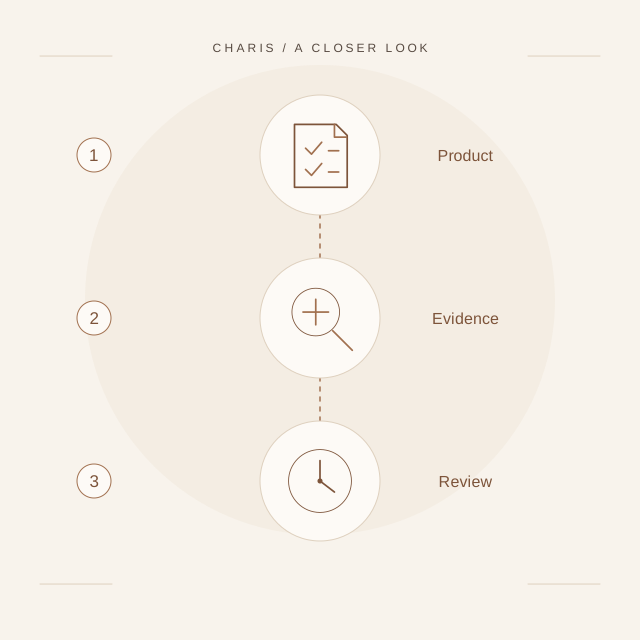
A closer look
Three questions before a newer treatment
Which product?
Ask for the exact product, ingredients and route of use.
What evidence?
Ask what human studies support this use and what remains uncertain.
What review?
Agree realistic expectations and how progress will be assessed.
A decision checklist. It does not imply proven effectiveness or regulatory approval.
Exosomes or PRP?
PRP has the longer track record and more published evidence, and it is made from your own blood, so there is no foreign material at all. Its drawbacks are the blood draw, the variability between people, and that the strength of the concentrate depends on your own blood on the day.
Exosomes need no blood draw, arrive as a standardised preparation rather than a variable one, and the appointment is easier for anyone who dislikes venepuncture. The honest counterweight is that the published evidence base is younger and smaller. That is not a reason to avoid it — it is a reason to be told about it before you choose.
Some people do both, sequenced rather than combined. Which I recommend depends on your pattern of loss, what you have already tried and how you feel about the trade above, and it is a consultation conversation rather than a menu choice.
Course, timeline and cost
A course of three sessions spaced about four weeks apart is typical, then maintenance every four to six months. A single treatment is £310 and a course of three is £900.
Hair grows slowly and no honest timeline is short. Reduced shedding is usually the first sign, at around six to eight weeks. Visible density change takes three to six months, because that is the speed at which hair grows regardless of what is applied to it.
I photograph the same parting in the same light before we start. Hair change is gradual enough that memory is a poor judge of it, and without a week-zero photograph neither of us can say honestly whether it has worked.
Before you book
Hair loss that came on suddenly, in patches, or alongside other symptoms needs a GP first. Thyroid disease, iron deficiency, several autoimmune conditions and a number of medicines all cause hair loss, and treating the scalp while the cause goes unaddressed wastes your time and your money.
This treatment does not change the underlying hormonal drive behind pattern hair loss, so what it achieves is held while treatment continues and the original process resumes if you stop. If a repeating cost every few months is not something you want indefinitely, decide that before the first session rather than after the fourth.
Every treatment begins with a full-face assessment and an honest conversation. If I do not think a treatment is clinically indicated or right for you, I will say so and explain why — including when the answer is to do nothing.
You will be given written aftercare before you leave, and a direct number to reach me on if anything concerns you afterwards. Reviews are offered at two weeks so we can assess the result together and adjust if needed.
What the whole course involves, start to finish
| Stage | What happens | When |
|---|---|---|
| Assessment | Your skin is assessed for what it actually lacks — hydration, density, or repair capacity. These need different products | Before the first session |
| Session 1 | A series of small injections at fixed points, around 20 minutes | Day 0 |
| Straight afterwards | Small raised bumps at each point, settling within hours to a day. Little else to see | 0–24 hours |
| The gap | Nothing visible. This is the phase people mistake for the treatment not working | 2–4 weeks |
| The rest of the course | Sessions 2 and 3, sometimes 4, at the interval that product calls for | Weeks 2–12 |
| The result | Firmness, hydration and texture — judged here, not before | 8–12 weeks after the final session |
| Maintenance | A single top-up session rather than a repeat course | 6–9 months |
How the plan is decided
What your skin is short of decides the product
The question at assessment is not which brand you have heard of. It is whether your skin is dehydrated, whether it has genuinely thinned and lost density, or whether its repair machinery needs supporting — because those three want different things, and a product chosen for the first will underperform on the third.
Skin that is reasonably thick but dull and flat generally does well with hydration and firmness. Skin that is crepey and fragile, showing fine lines at rest, usually needs building blocks or a repair signal instead.
Why a course, and why the spacing is not padding
One session produces a signal; a course produces a sustained one, and sustained signalling is what actually changes tissue. The intervals are set by how long the previous session keeps working — treating again before that has finished spends a session on skin that was already busy.
What this category cannot do
None of it changes the shape of your face. If what bothers you is lost volume, a flat midface or a heavy jowl, the honest answer is that you are looking at the wrong category — and a clinic offering a skin treatment for a structural problem is selling rather than assessing.
Often suits
- Early to moderate pattern thinning with follicles still present
- A widening parting or loss of density across the crown
- Anyone who wants a hair treatment without a blood draw
- Alongside or in sequence with PRP
Not suitable if
- Areas that have been completely smooth for years
- Scarring alopecia, where the follicle has been destroyed
- Sudden or patchy hair loss that has not been investigated by a GP
- Active scalp infection or inflammation
- Anyone pregnant, breastfeeding, or under 18
Sources and further reading
- NHS — Dermal fillers
- British Association of Dermatologists — patient information
- Joint Council for Cosmetic Practitioners
- Aesthetic Complications Expert Group
This page is general information, not personal medical advice. Every treatment needs an individual assessment, and what is right for someone else may not be right for you.
Common questions
Purasomes HSC50+ Hair & Scalp Complex — what people ask
- How is this different from PRP?
- PRP is made from your own blood on the day. Exosomes arrive as a standardised preparation, so there is no blood draw and no variability between people. PRP has the longer evidence base; exosomes are the newer option. Both are for the same problem and neither regrows hair where the follicle has gone.
- Is the evidence good?
- It is early. There are encouraging studies and a great deal of clinical enthusiasm, and there is not yet the volume of published trial data that PRP has. I would rather say that plainly than let you assume the two are equally established.
- Does it hurt?
- The micro-channelling is the uncomfortable part and the front hairline is the most sensitive area. Topical anaesthetic is used and most people describe it as very manageable. The scalp is usually tender for a day afterwards.
- When will I see something?
- Reduced shedding at six to eight weeks is the earliest realistic sign. Density change takes three to six months. Anyone promising a difference in a fortnight is not describing hair biology.
- Can I have it while pregnant or breastfeeding?
- No. I do not treat during pregnancy or breastfeeding — not because harm has been demonstrated, but because it has not been studied, and an elective treatment is not the place to accept an unquantified risk.
- Is Purasomes hair treatment safe?
- The risks are mostly the ordinary ones of any injection — bruising, swelling, small bumps at the injection points, and rarely infection. The products are highly purified and the reaction rate is low. Under the eyes is the area with the most bruising and the least margin for error, which is a reason to ask how often your practitioner treats it.
- Can I have Purasomes hair treatment while pregnant or breastfeeding?
- No. Injectable treatment is not offered during pregnancy or breastfeeding, on the same precautionary basis as everything else injectable here.
Travelling to Charis
The clinic is in Stacksteads, Bacup, with patients travelling in for purasomes hsc50+ hair & scalp complex from Rawtenstall, Haslingden, Ramsbottom, Burnley, Rochdale, Bury, Accrington and across the Rossendale valley.
Areas we coverYou may also be looking at
Platelet-rich plasma injected into the scalp to support follicle health in early-stage thinning.
Regenerative injectable treatment that works on skin quality — hydration, elasticity and firmness — rather than adding volume.
Controlled micro-injury that prompts the skin to remodel — used for texture, scarring, pore size and overall quality.
Get in touch
Book a consultation
Consultations are £30, and that comes off the cost of your treatment if you go ahead. No pressure to book anything on the day — if you are not sure whether you want treatment at all, that is still a good reason to come and talk.