
Does PRP work for hair loss?
What platelet-rich plasma can and cannot do for thinning hair, who it suits, what the evidence actually shows, and the honest answer about how long it lasts.
PRP for hair loss is one of the treatments people ask me about most and one of the easiest to oversell. The short answer is that it has reasonable evidence behind it for one specific pattern of hair loss, in one specific window, and very little for several of the things it gets promoted for. This page is the long answer, including the parts that might talk you out of it.
What PRP actually is
Platelet-rich plasma is made from your own blood. I take a sample much as a nurse would for a blood test, spin it in a centrifuge to separate the components by density, and draw off the plasma layer carrying the highest concentration of platelets. That concentrate is injected into the scalp in a grid across the thinning area.
Platelets are not only clotting cells. They carry growth factors — signalling proteins the body releases at a site of injury to recruit repair. The theory of PRP is that delivering a concentrated dose of those signals to a follicle that has become dormant nudges it back toward an active growing phase.
Because it is made from your own blood there is no foreign material and no allergy risk in the way there is with an injected product. What there is instead is variability: the platelet count of the concentrate depends on your own blood on the day, which is one honest reason results differ between people more than they do with a standardised product.
The type of hair loss it suits
PRP has the most evidence in androgenetic alopecia — pattern hair loss, the gradual thinning that runs in families and affects both men and women. In women it usually shows as a widening parting and a general loss of density across the crown rather than a receding hairline.
It has much weaker evidence in scarring alopecias, where the follicle has been destroyed and replaced with fibrous tissue. If the follicle is gone, no growth signal will bring it back, and I would rather tell you that at consultation than take payment for a course that cannot work.
Hair loss that has come on suddenly, in patches, or alongside other symptoms is a reason to see your GP before you see me. Thyroid disease, iron deficiency, several autoimmune conditions and a number of medicines all cause hair loss, and treating the scalp while the cause goes unaddressed wastes your time and your money. The NHS page on hair loss is a sensible starting point for working out which category you are in.
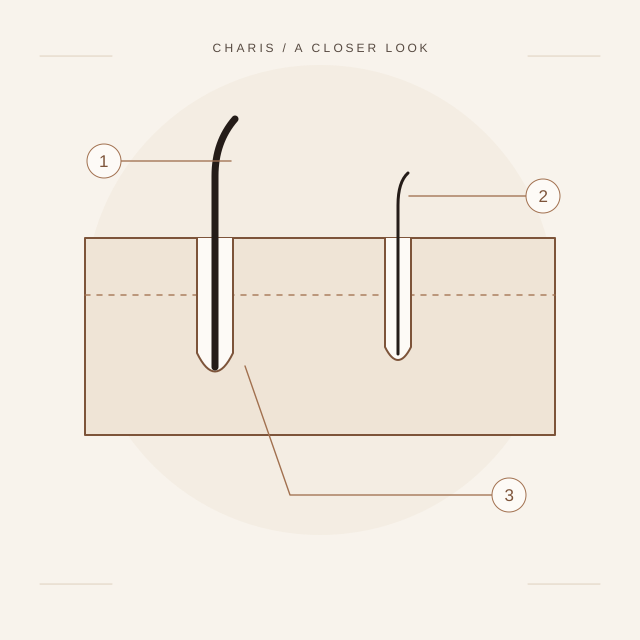
A closer look
Hair loss starts with the follicle
Thicker shaft
Hair diameter is one of the features assessed when looking at density.
Finer shaft
Miniaturised hairs can be part of pattern hair loss, but appearance alone does not establish the cause.
Follicle
An assessment considers the scalp and the cause of hair loss before discussing a course.
Schematic comparison, not a before-and-after result. Sudden, patchy or unexplained hair loss should be assessed medically.
What the evidence supports
Published studies in pattern hair loss generally report increases in hair density and hair thickness over a course of treatments, with the clearest effects in people who still have visible miniaturised hairs in the thinning area rather than smooth scalp. The trials are mostly small, the preparation methods vary between them, and there is no single agreed protocol — all of which are reasons to treat the numbers as encouraging rather than settled.
The practical translation is this: PRP is most likely to help you hold and thicken what you still have. It is not a transplant and it does not create follicles. If you are looking at an area that has been completely smooth for years, the honest expectation is very little.
Earlier is better. The window where PRP does its best work is when thinning has started and is bothering you but the density is still there to protect. People often wait until it is obvious in photographs, which is the point at which there is least left to work with.
What a course looks like
A typical course is three to four sessions spaced about four weeks apart, then a maintenance session every four to six months. Hair grows slowly, so nothing is visible early — most people notice reduced shedding first, at around six to eight weeks, and any change in density considerably later.
I ask people to photograph the same parting in the same light before we start. Hair change is gradual enough that memory is a poor judge of it, and a set of photographs at week zero is the only way either of us will be able to say honestly whether it has worked.
The appointment takes about forty-five minutes, most of which is drawing and spinning the blood. The injections themselves are quick. The scalp is sensitive, so I use a very fine needle and work in small stages; most people describe it as uncomfortable rather than painful.
Afterwards, and what it costs you beyond money
The scalp is usually tender and may look slightly puffy for a day. Leave the hair unwashed for the rest of the day, skip the gym and anything that raises the scalp temperature for twenty-four hours, and avoid dye or chemical treatments for a few days.
The real cost to weigh is the maintenance. PRP does not change the underlying hormonal drive behind pattern hair loss, so what it achieves is held only while treatment continues. Stopping does not undo the gains overnight, but the original process resumes. If a repeating cost every few months is not something you want indefinitely, that is worth deciding before the first session rather than after the fourth.
It sits alongside medical treatment rather than replacing it. If a dermatologist or your GP has you on something for the same problem, tell me what you are taking so the plan is built around it.
Where the evidence is strong, and where it is not
The honest version of this varies enormously by who is asking, and a page that gives one answer for everybody is not being straight with you.
| Pattern | What the evidence supports | Realistic expectation |
|---|---|---|
| Early androgenetic thinning | The strongest evidence base of any group | Improved density and calibre; not a restored hairline |
| Diffuse thinning with follicles still present | Reasonable support | Thickening of what is there |
| Long-established loss, smooth scalp | No good evidence | Nothing. The follicles are gone |
| Loss with an underlying medical cause | Not the right starting point | See your GP first — the cause is the treatment |
Sources and further reading
- NHS — Hair loss
- British Association of Dermatologists — patient information
- Nursing & Midwifery Council — search the register
- British Association of Medical Aesthetic Nurses
This page is general information, not personal medical advice. Every treatment needs an individual assessment, and what is right for someone else may not be right for you.

About the author
Ashleigh Trickett
Registered Nurse & Aesthetic Practitioner
Registered Nurse with a BSc in Nursing and a PGCert in Critical Care (Manchester Metropolitan University, 2025). Ten years in the NHS, four of them in critical care. Advanced facial anatomy education at the Royal College of Surgeons with BAMAN, June 2026. Member of BAMAN and the Aesthetic Complications Expert Group. BAMAN Awards 2026 finalist for Rising Star of the Year.
Treatments this relates to
- PRP for Hair Loss£200
Platelet-rich plasma injected into the scalp to support follicle health in early-stage thinning.
- Purasomes HSC50+ Hair & Scalp Complex£310
Purasomes HSC50+, an exosome-based scalp treatment for early thinning — the newer alternative to PRP, and the honest position on what the evidence currently supports.
- PolynucleotidesFrom £195
Regenerative injectable treatment that works on skin quality — hydration, elasticity and firmness — rather than adding volume.
Common questions
- Does it hurt?
- The blood draw is a standard venepuncture. The scalp injections sting briefly — the front hairline is usually the most sensitive area. It is uncomfortable rather than painful, and it is over quickly.
- How soon will I see anything?
- Reduced shedding at six to eight weeks is the earliest realistic sign. Visible density change takes three to six months, because that is simply how fast hair grows. Anyone promising a difference in a fortnight is not describing hair biology.
- Will it work if I am completely bald in that area?
- Almost certainly not. PRP works on follicles that are still present but underperforming. Where the scalp has been smooth for years the follicles have usually gone, and a hair transplant is the honest option to explore instead.
- Is it safe?
- It uses your own blood, so there is no allergy or rejection risk. The risks are those of any injection — bruising, tenderness, and the small infection risk that sterile technique exists to control. It is not suitable if you have a platelet or clotting disorder, an active scalp infection, or are taking certain blood-thinning medication, which is why the medical history at consultation matters.
- Can I have it while pregnant or breastfeeding?
- No. I do not treat during pregnancy or breastfeeding — not because harm has been demonstrated, but because it has not been studied, and an elective treatment is not the place to accept an unquantified risk.
- Is there an alternative to PRP for hair?
- Yes — Purasomes HSC50+, an exosome-based scalp treatment, which needs no blood draw and arrives as a standardised preparation rather than one that varies with your own blood on the day. The trade is that its published evidence base is younger than PRP’s. Both are offered here and the choice is a consultation conversation.
Read next
Regenerative & skin quality
What are polynucleotides?
Purified DNA fragments used to support the skin's own repair processes — where they come from, what the evidence supports, and who they suit.
Choosing a practitioner
How to choose a safe injector
The UK aesthetics industry is barely regulated. Here is exactly what to check, wherever you go.
Get in touch
Book a consultation
Consultations are £30, and that comes off the cost of your treatment if you go ahead. No pressure to book anything on the day — if you are not sure whether you want treatment at all, that is still a good reason to come and talk.