Non-Surgical Rhinoplasty in Rossendale
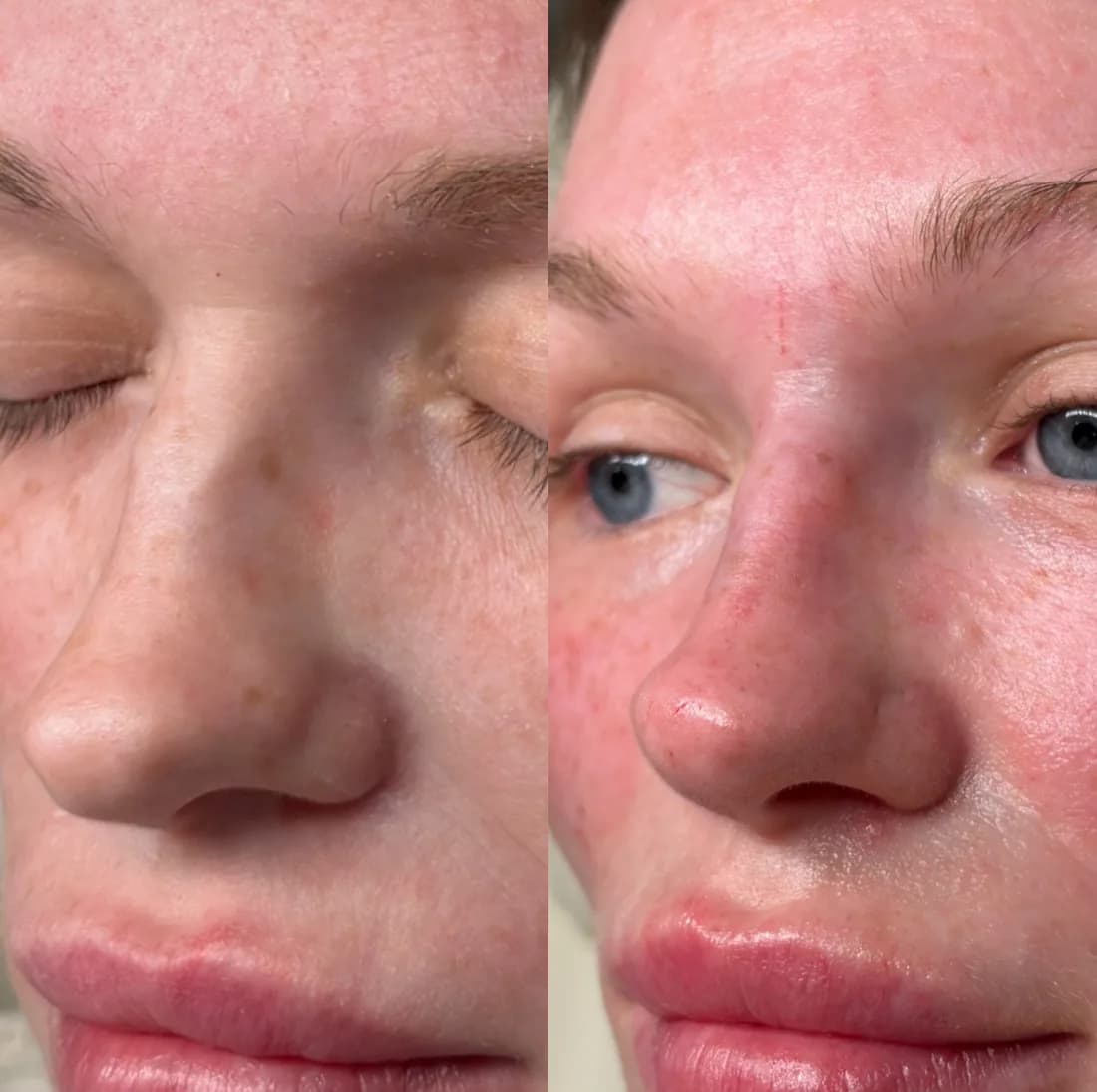
Filler used to refine the profile of the nose — camouflaging a dorsal hump, lifting the tip, improving symmetry.
In short
Non-surgical rhinoplasty uses small amounts of filler to camouflage a dorsal hump, lift the tip or straighten the profile in about twenty minutes; it can make a nose look straighter but not smaller, and it lasts twelve to eighteen months.
- How long it lasts
- 12 to 18 months
- When you see it
- immediately
- Downtime
- minimal — mild swelling for a couple of days
- Does it hurt
- brief and manageable with topical anaesthetic
- Sessions
- one; it is one of the highest-risk areas vascularly, so technique matters
Also called a liquid rhinoplasty, this treatment uses small, precisely placed amounts of dermal filler to change how the nose reads in profile — softening a dorsal hump, supporting the tip, or improving the appearance of asymmetry. It adds; it cannot reduce. Someone who wants a smaller nose needs a surgeon, and I will say so.
What it can and cannot do
It can camouflage a hump by building the bridge above and below it, support a drooping tip, straighten the appearance of a deviation, and refine the profile. It cannot make the nose narrower or smaller, and it cannot correct a breathing problem.
Every treatment begins with a full-face assessment and an honest conversation. If I do not think a treatment is clinically indicated or right for you, I will say so and explain why — including when the answer is to do nothing.
A closer look
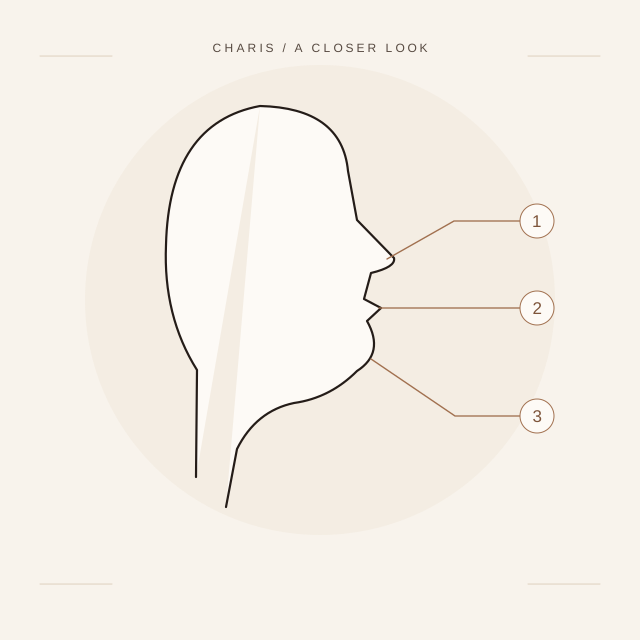
Read the profile as a whole
Nose
The profile is assessed along with the concern you want to discuss.
Lips
Lip projection forms part of the relationship between facial features.
Chin
Chin projection influences the overall balance of the profile.
Surface landmarks, not treatment sites. Filler cannot make a nose physically smaller or move bone.
Safety
The nose is the highest-risk area in facial aesthetics for vascular complications, because of its blood supply and its proximity to the vessels supplying the eye. This is not a treatment to have from someone who does not have detailed anatomical training, and it is not a treatment to choose on price.
It should not be performed on a nose that has had surgical rhinoplasty without careful assessment, as the vasculature is altered and less predictable.
What to expect
You will be given written aftercare before you leave, and a direct number to reach me on if anything concerns you afterwards. Reviews are offered at two weeks so we can assess the result together and adjust if needed.
What we use: Restylane®
Restylane is an established range of hyaluronic acid dermal fillers developed by Galderma, with 30 years of clinical experience and ongoing scientific research.
Different areas of the face require different levels of support, flexibility and movement. Restylane offers a range of formulations designed to address these individual requirements and preserve natural expression as much as possible.
Is Restylane animal-derived?
Restylane uses non-animal-derived, stabilised hyaluronic acid produced through bacterial fermentation.
Although this may be relevant to patients with specific ethical or religious considerations, non-animal-derived does not necessarily mean halal-certified. Patients seeking religious assurance should discuss their requirements during consultation.
Safety and suitability
Restylane is a medical device and, like all injectable treatments, carries risks. Common side effects include temporary swelling, bruising, redness and tenderness. Less commonly, serious complications including vascular occlusion, tissue damage and visual impairment can occur.
A thorough consultation, appropriate product selection and an individualised treatment plan are essential. Results and longevity vary depending on the product, treatment area and individual factors.
What the whole thing involves, start to finish
| Stage | What happens | When |
|---|---|---|
| Assessment | A full-face assessment, a discussion of what is actually needed, and the exact figure before anything is booked | Before treatment — same visit or a separate one |
| Treatment | Topical numbing, then placement. The product used contains its own anaesthetic | 30–45 minutes |
| Straight afterwards | Swelling, sometimes bruising, small firm areas at the injection points. You will look treated | 0–48 hours |
| Settling | Swelling drops noticeably and the actual shape starts to show | Day 3–7 |
| Review | Assessed together and adjusted if it needs it. This is where a small top-up happens if one is warranted | 2 weeks |
| The result | What you keep, and what should be judged rather than the day-two version | From 2 weeks |
| Repeat | Reassessed rather than automatically topped up — how much is left is the question, not how long it has been | 9–18 months depending on the area |
The row people skip is the review, and it is the one that separates a good result from a nearly-right one. Two weeks is the first point at which what you are looking at is product rather than swelling, and an adjustment made then is small, cheap and easy.
How the plan is decided
The face is assessed as a whole, not as the area you named
Almost nobody arrives asking about the right area. Somebody unhappy with their nasolabial folds usually needs midface support; somebody who wants a sharper jaw often needs the chin first. Treating the area named rather than the area responsible is the commonest reason a technically good result does not read as an improvement.
That is why the assessment covers the whole face even when you have come about one thing, and why the recommendation is sometimes for a different area than the one you booked to discuss.
How much, and why it is not decided in advance
Volumes are not published here on purpose. A minimum on a price list invites people to shop by quantity, which is the opposite of how the amount should be decided — what is appropriate depends on your anatomy, your starting point and what the face needs, and you are given the exact figure before anything is booked.
Starting conservatively is not caution for its own sake. Adding is straightforward at a review; removing means dissolving, a fortnight looking flatter than you started, and paying twice.
When the answer is no
There are faces where more volume is the wrong answer and saying so costs a booking. Significant skin laxity is the clearest case — adding weight to tissue that has already descended makes it heavier rather than tighter, and the honest conversation is about skin tightening or a surgical opinion.
Not suitable if
- Previous surgical rhinoplasty, without careful individual assessment
- Anyone wanting a reduction in size
- Anyone under 18
Sources and further reading
- NHS — Dermal fillers
- British Association of Dermatologists — patient information
- Joint Council for Cosmetic Practitioners
- Aesthetic Complications Expert Group
This page is general information, not personal medical advice. Every treatment needs an individual assessment, and what is right for someone else may not be right for you.
Results
Non-Surgical Rhinoplasty — Ashleigh’s patients
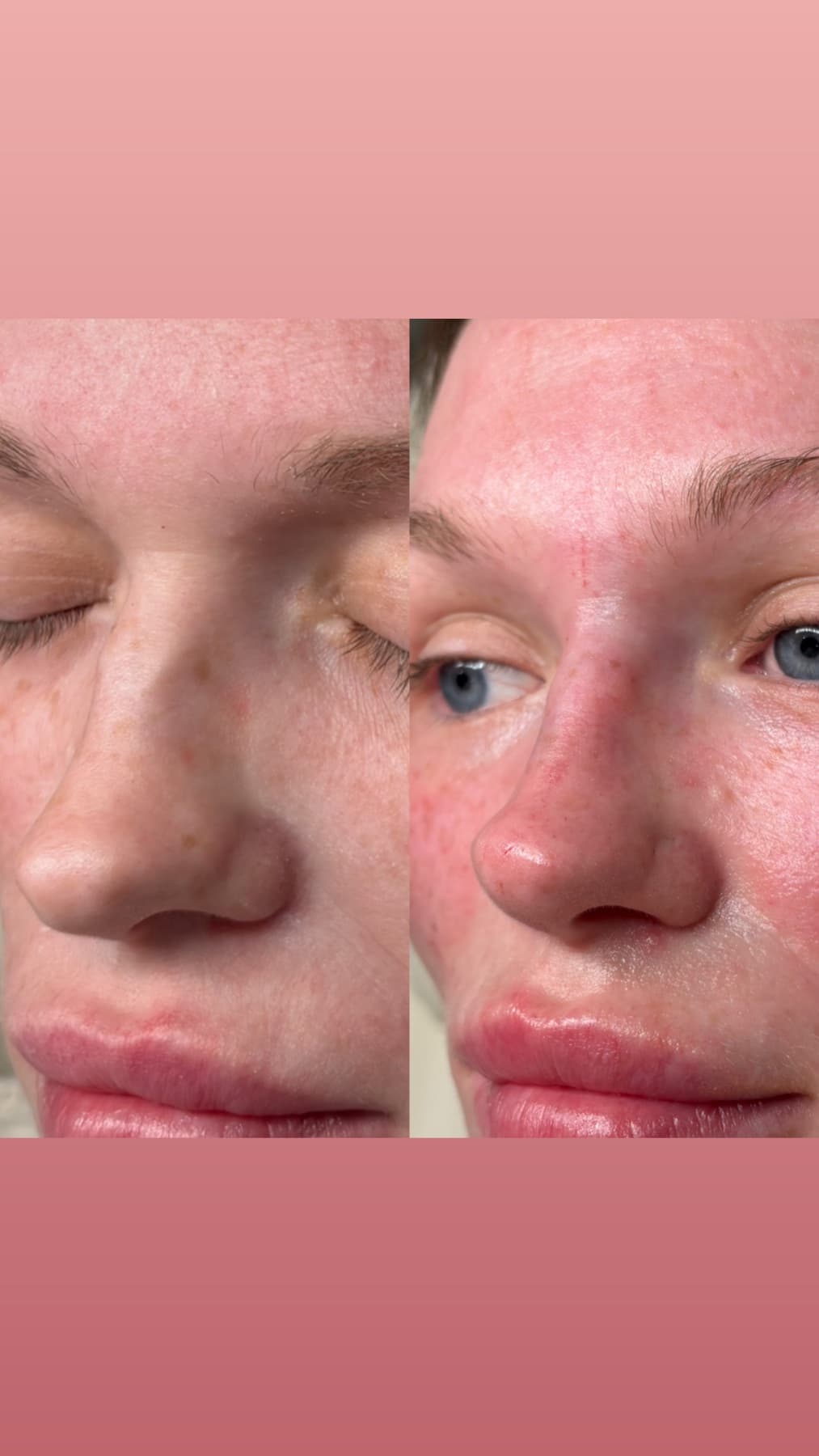
Individual results vary. Shared with patient consent.
Common questions
Non-Surgical Rhinoplasty — what people ask
- How long does it last?
- Typically 12 to 18 months. The nose is a static area, so product tends to last longer here than in mobile areas.
- Can it make my nose smaller?
- No. Filler only adds. It can make a nose look straighter and more balanced in profile, which often reads as more refined — but the actual volume increases.
- Is it safe?
- In trained hands with proper assessment, complications are uncommon — but this area carries the highest risk of any facial site, and that should inform who you choose, not whether you proceed.
- Is non-surgical rhinoplasty safe?
- It is a medical procedure with real risks, so the honest answer is that it is safe in the right hands and not otherwise. The complication that matters is vascular occlusion — product entering or pressing on a blood vessel — which is uncommon, time-critical, and treatable if recognised quickly. That is why hyaluronidase is held on site here, why the training to recognise it matters more than the product used, and why you should ask any practitioner those two questions before booking.
- Can I have non-surgical rhinoplasty while pregnant or breastfeeding?
- No. Injectable treatment is not offered during pregnancy or while breastfeeding. That is a precaution rather than a finding of harm — the safety studies do not exist, because nobody runs trials on pregnant women for elective cosmetic treatment, and an unquantified risk is not one worth taking for something that can wait. Come back afterwards and you will be very welcome.
Travelling to Charis
The clinic is in Stacksteads, Bacup, with patients travelling in for non-surgical rhinoplasty from Rawtenstall, Haslingden, Ramsbottom, Burnley, Rochdale, Bury, Accrington and across the Rossendale valley.
Areas we coverYou may also be looking at
Get in touch
Book a consultation
Consultations are £30, and that comes off the cost of your treatment if you go ahead. No pressure to book anything on the day — if you are not sure whether you want treatment at all, that is still a good reason to come and talk.