
Dermal Filler Dissolving in Rossendale
Removal of hyaluronic acid filler — for migration, overfilling, or a result that no longer suits you.
In short
Filler dissolving uses hyaluronidase to break down hyaluronic acid filler, usually within twenty-four to forty-eight hours; the area looks flatter than your true baseline for about two weeks while your own hyaluronic acid replenishes.
- How long it lasts
- permanent for the product dissolved
- When you see it
- 24 to 48 hours
- Downtime
- swelling and tenderness for a day or two; a deflated look for 2 weeks
- Does it hurt
- stings more than filler placement does
- Sessions
- usually one; long-standing migration sometimes needs two
Hyaluronidase is an enzyme that breaks down hyaluronic acid, and it is what allows HA filler to be removed. It is used electively when filler has migrated, when an area has been overfilled, or when a result placed years ago no longer suits the face it is in — and it is used urgently in the rare event of a vascular complication.
Elective dissolving
There is no shame in this and I see it often. Filler migrates, techniques and products have improved, and what was placed five years ago was not necessarily wrong at the time. Dissolving and rebuilding properly usually produces a better result than continuing to add on top of something that is not working.
The area will look deflated for a period afterwards — hyaluronidase breaks down some of your own hyaluronic acid too, and that recovers over a few weeks. I would not rebuild before two to four weeks have passed.

A closer look
A plan starts with a conversation
Discuss and assess
Talk through your concerns, medical history and previous treatment.
Understand the plan
Discuss options, limits, risks and costs, including doing nothing.
Take time
Ask questions and decide whether you want to proceed.
The sequence describes the consultation approach. It does not mean treatment is appropriate or will happen on the same day.
Patch testing and safety
Hyaluronidase carries a small risk of allergic reaction, so patch testing is discussed at consultation. This is also why any practitioner injecting HA filler should hold hyaluronidase on site and know how to use it under pressure — I do, and I am trained in the management of vascular occlusion.
Filler placed at another clinic
Much of the dissolving I do is on filler placed elsewhere, and people come to the clinic in Rossendale for it from across Lancashire — Burnley, Accrington, Rochdale, Bury and further. You do not need the original practitioner's permission, and you do not need to know exactly what was used, although any detail you have helps.
If you can, give the original practitioner the chance to review it first; a good one will want to. If you would rather not go back, a consultation here starts with an assessment of what is there and whether dissolving is actually the right answer — sometimes it is not.
What the appointment involves, start to finish
| Stage | What happens | When |
|---|---|---|
| Assessment | What was placed, where, how long ago, and whether what you dislike is product or swelling | Before anything is decided |
| Patch test | Where there is any relevant allergy history | Beforehand |
| Treatment | The enzyme is injected into the treated area | 15–30 minutes |
| Straight afterwards | Swelling, often more than the original treatment produced | 0–48 hours |
| The change | Most of the breakdown happens here, though swelling disguises it | 24–48 hours |
| The flat phase | The area can look flatter than your true baseline. Expected, and it recovers | 1–2 weeks |
| Review | What actually remains, and whether a second small treatment is needed — which is common and is not a failure | 2 weeks |
| Re-treating, if you want to | A separate decision, made on a settled face | From 2 weeks |
How the decision is made
Whether to dissolve at all
The first question is whether what you dislike is actually product. At under two weeks it is usually swelling, and dissolving something that would have settled on its own costs money and a fortnight of looking worse. At months or years, it is product — and then the question is whether the problem is placement, volume, or migration beyond where it was put.
There are also results that are simply not to your taste rather than badly done, and that is a legitimate reason to reverse something. It is your face.
How much to dissolve
Not always all of it. Where a result is close but one area sits wrong, a small, targeted treatment can correct that area alone and leave the rest — which is a considerably better outcome than starting from nothing and paying to rebuild.
Where migration has crossed a border, or where several rounds have accumulated over years, clearing the area completely and replanning from a settled face is usually the honest answer.
What happens afterwards is a separate decision
Dissolving returns you to a starting point; whether you re-treat, and with what, is a different conversation held on a face that has recovered. Booking both in the same appointment is how people end up making the same decision twice.
Sources and further reading
- NHS — Dermal fillers
- British Association of Dermatologists — patient information
- Joint Council for Cosmetic Practitioners
- Aesthetic Complications Expert Group
This page is general information, not personal medical advice. Every treatment needs an individual assessment, and what is right for someone else may not be right for you.
Results
Dermal Filler Dissolving — Ashleigh’s patients
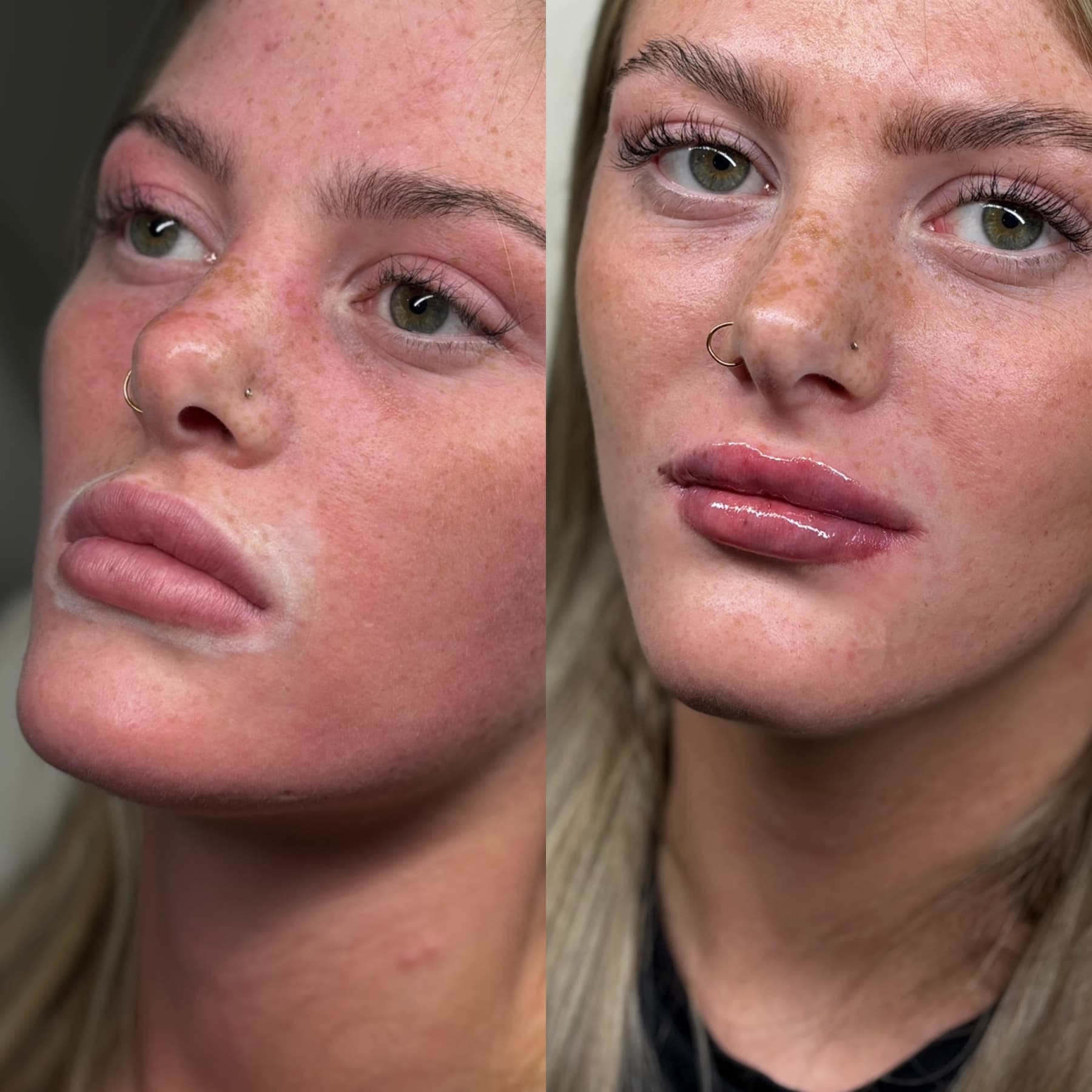
Individual results vary. Shared with patient consent.
Common questions
Dermal Filler Dissolving — what people ask
- Will it dissolve all of my filler?
- It may take more than one session to fully remove, particularly with older or firmer product. We assess after two weeks and repeat if needed.
- Can I have new filler straight afterwards?
- No. Allow two to four weeks so the tissue settles and your own hyaluronic acid recovers, then we plan the rebuild properly.
- Will I look strange in the meantime?
- The area will look flatter than you are used to for a couple of weeks. That is expected and it does resolve.
- Can you dissolve filler that was done at another clinic?
- Yes, provided it is hyaluronic acid filler, which most UK filler is. Bring whatever you know about what was used and when — but not knowing is not a barrier. Patients travel to the clinic in Rossendale for this from across Lancashire.
- Is filler dissolving safe?
- It carries its own risks rather than being a free undo. Allergic reaction to the enzyme is possible, which is why patch testing is standard. The area can look flatter than your true baseline for a fortnight, and judging the dose is genuinely difficult — too little leaves a lumpier result than you started with. It is safe when done carefully and it is not something to have casually.
- Can I have filler dissolving while pregnant or breastfeeding?
- Not routinely, no. If there is a genuine clinical reason to dissolve during pregnancy that is a discussion to have properly rather than a booking to make, and it would involve your midwife or GP.
Travelling to Charis
The clinic is in Stacksteads, Bacup, with patients travelling in for dermal filler dissolving from Rawtenstall, Haslingden, Ramsbottom, Burnley, Rochdale, Bury, Accrington and across the Rossendale valley.
Areas we coverYou may also be looking at
Hyaluronic acid lip enhancement built around your existing anatomy — shape and balance before volume.
Full-face assessment and treatment planning — restoring support and balance across the face rather than treating features in isolation.
Treatment of the under-eye hollow — where correct assessment matters more than any product choice.
Read before you book
Lips
Lip filler aftercare
What to do in the first forty-eight hours, what is normal in the first week, and the specific symptoms that mean you should contact me immediately rather than wait.
Lips
Lip filler swelling: what is normal
A day-by-day account of normal swelling, what reduces it, and the difference between swelling and something that needs a phone call.
Lips
How to get lip filler that looks natural
Natural is a proportion problem, not a volume problem. What actually makes lips read as done, and the specific things to ask for — and to refuse — at consultation.
Lips
Filler migration: what it is and what to do
How to tell migration from swelling, why it happens, and why the right answer is almost always to dissolve and start again rather than to add more.
Facial harmonisation
Nasolabial folds
The folds beside the nose are usually a midface problem. Treating them directly is why some faces end up looking heavy.
Choosing a practitioner
When filler has gone wrong
How to tell a bad result from normal settling, what can be corrected, and what to do next.
Get in touch
Book a consultation
Consultations are £30, and that comes off the cost of your treatment if you go ahead. No pressure to book anything on the day — if you are not sure whether you want treatment at all, that is still a good reason to come and talk.