
Treating acne scarring
Which scars respond to which treatment, why the acne has to be settled first, and what a realistic improvement looks like.
Acne scarring is treatable, gradually and with a course. But the type of scar matters enormously, because they do not all respond to the same approach — and a good deal of what people call scarring is not scarring at all, which is genuinely good news for the people it applies to.
Marks are not scars
Flat red, purple or brown marks left behind after a spot are post-inflammatory pigmentation or erythema, not scars. The skin surface is intact; the colour simply has not settled. These fade on their own over months, and they respond well to sun protection, gentle treatment and time.
A true scar is textural — the skin surface itself has changed, either lost or raised. Run a finger over it: if you can feel it, it is a scar. If you can only see it, it is a mark.
This distinction changes the plan entirely, and it is the first thing I assess. People are frequently relieved to find that what has been bothering them for a year is going to fade largely on its own.
The scar types, and what each responds to
Rolling scars — shallow, wide, with soft sloping edges, giving the skin an undulating look. These respond best to microneedling and to collagen-stimulating treatment, because the aim is to build volume underneath and smooth the transition.
Boxcar scars — wider with sharply defined vertical edges, like small craters. These respond moderately; the edges are the difficult part.
Ice-pick scars — narrow and deep, as though the skin was punctured. These respond least to microneedling, because the scar extends deeper than the treatment reaches. They often need a different approach entirely.
Most people have a mixture, and a plan usually needs to address more than one type.
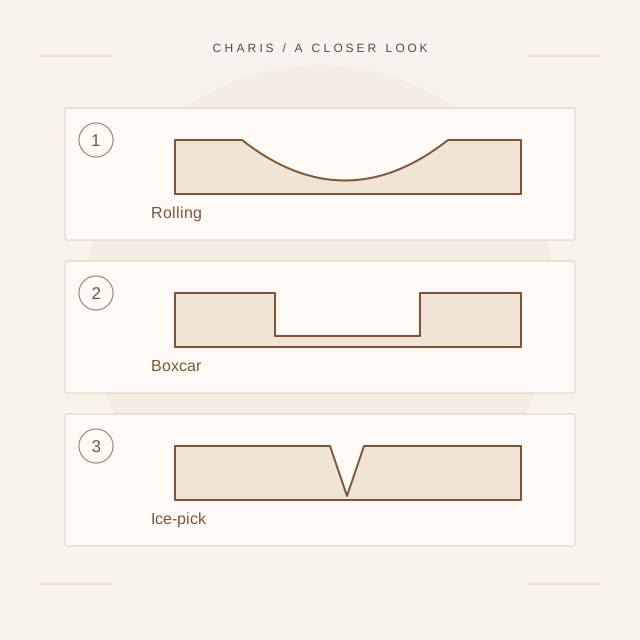
A closer look
Three shapes of depressed acne scar
Rolling
Broad depressions with gently sloping edges.
Boxcar
More sharply defined depressions with steeper sides.
Ice-pick
Narrow openings that extend deeper into the skin.
Shapes and depths are schematic. Many people have a mixture; these examples do not select a treatment for you.
Settle the acne first
Treating scars while acne is still active is a poor use of money and carries a real risk of spreading bacteria across the face during treatment. Get the acne controlled first — with your GP or a dermatologist if it needs prescription treatment, which it often does.
If you have taken isotretinoin, most practitioners wait six to twelve months after finishing before resurfacing treatment, as the skin's healing response is altered during and shortly after. I follow that.
This is a conversation where I regularly tell people to come back in a year. It is not what anyone wants to hear and it is the right advice.
Skin tone and the risk of making it worse
Richer skin tones carry a higher risk of post-inflammatory hyperpigmentation after any resurfacing treatment. That does not mean no treatment — it means gentler settings, proper preparation of the skin for several weeks beforehand, and more patience between sessions.
Any practitioner who proposes the same aggressive protocol regardless of skin type has not understood the risk, and treating acne scarring in a way that leaves pigmentation behind is trading one problem for another.
What a realistic result looks like
Meaningful improvement, not erasure. Somewhere between 30% and 70% improvement across a full course is a fair expectation for most scar types — enough that the skin reads as textured rather than scarred, and enough that most people stop noticing it in the mirror.
It takes several sessions spaced four weeks apart, and the result continues improving for months after the final one as collagen remodels.
Anyone showing you a single-session transformation for established scarring is showing you lighting.
What to expect, by scar type
Improvement rather than erasure is the honest frame for all of this, and how much improvement depends almost entirely on which type you have. This is what a realistic course looks like.
Scroll the table sideways →
| Scar type | How it looks | Realistic improvement | Course |
|---|---|---|---|
| Rolling | Broad, shallow dips with sloping edges | Good — often the most rewarding to treat | 3–6 sessions |
| Boxcar | Sharp-edged, flat-bottomed craters | Moderate; shallow ones respond better than deep | 4–6 sessions |
| Ice pick | Narrow, deep, needle-like pits | Limited from needling alone; usually needs a different technique | Assess first |
| Post-inflammatory marks | Flat red or brown patches, no texture change | Very good — these are not scars at all | Often resolves with time and sun protection |
Most faces carry a mix, which is why the plan is built around the type that dominates rather than around a treatment name.
Sources and further reading
This page is general information, not personal medical advice. Every treatment needs an individual assessment, and what is right for someone else may not be right for you.

About the author
Ashleigh Trickett
Registered Nurse & Aesthetic Practitioner
Registered Nurse with a BSc in Nursing and a PGCert in Critical Care (Manchester Metropolitan University, 2025). Ten years in the NHS, four of them in critical care. Advanced facial anatomy education at the Royal College of Surgeons with BAMAN, June 2026. Member of BAMAN and the Aesthetic Complications Expert Group. BAMAN Awards 2026 finalist for Rising Star of the Year.
Treatments this relates to
- MicroneedlingFrom £150
Controlled micro-injury that prompts the skin to remodel — used for texture, scarring, pore size and overall quality.
- Chemical Peels£80
A resurfacing treatment that accelerates cell turnover — used for pigmentation, congestion, texture and dullness.
- Skin BoostersFrom £200
The category explained — what a skin booster is, how the options differ, and how to work out which one you actually need.
Common questions
- Can acne scars be removed completely?
- Rarely. A realistic aim is 30% to 70% improvement across a course, which for most people is the difference between skin that reads as scarred and skin that reads as textured.
- How many sessions will I need?
- Usually four to six microneedling sessions spaced about four weeks apart, sometimes more for deeper scarring. It is a course, not an appointment.
- Can I have treatment while I still get breakouts?
- Not over active, inflamed lesions. Occasional spots are workable; ongoing active acne should be treated first, with your GP if it needs prescription medication.
- I took isotretinoin — how long should I wait?
- Most practitioners wait six to twelve months after finishing before resurfacing treatment. Tell me when you finished and we will plan around it.
- Are my red marks scars?
- Probably not. If you can see it but not feel it, it is post-inflammatory colour rather than a scar, and it will fade substantially on its own with sun protection and time.
Read next
Skin
Improving skin texture
Roughness, visible pores and an uneven surface — what causes them, what genuinely improves them, and what no treatment can change.
Skin
Treating pigmentation on the face
Sun damage, post-inflammatory marks and melasma look similar and are treated differently — how to tell them apart, what actually works, and what makes each of them worse.
Skin
Microneedling aftercare and recovery
Day by day, what to use and what to leave alone — and why sun protection is part of the treatment.
Get in touch
Book a consultation
Consultations are £30, and that comes off the cost of your treatment if you go ahead. No pressure to book anything on the day — if you are not sure whether you want treatment at all, that is still a good reason to come and talk.