
Improving skin texture
Roughness, visible pores and an uneven surface — what causes them, what genuinely improves them, and what no treatment can change.
Texture is one of those things people notice about their own skin long before anyone else does. It covers roughness you can feel, pores you can see, an uneven surface in certain light, and the general sense that skin no longer looks smooth. Some of it responds very well to treatment. One part of it does not, and it is worth knowing which is which.
What causes rough texture
Slowing cell turnover is the main driver. In your twenties the surface layer renews roughly every four weeks; by your forties that has slowed considerably, so dead cells accumulate and the surface becomes uneven.
Sun damage thickens and disorganises the outer layer over years. Congestion — oil and dead cells trapped in the follicle — creates a bumpy surface, particularly across the nose, chin and forehead. Dehydration exaggerates all of it.
And the residue of past acne: not always true scarring, but often a persistent unevenness that is easy to mistake for it.
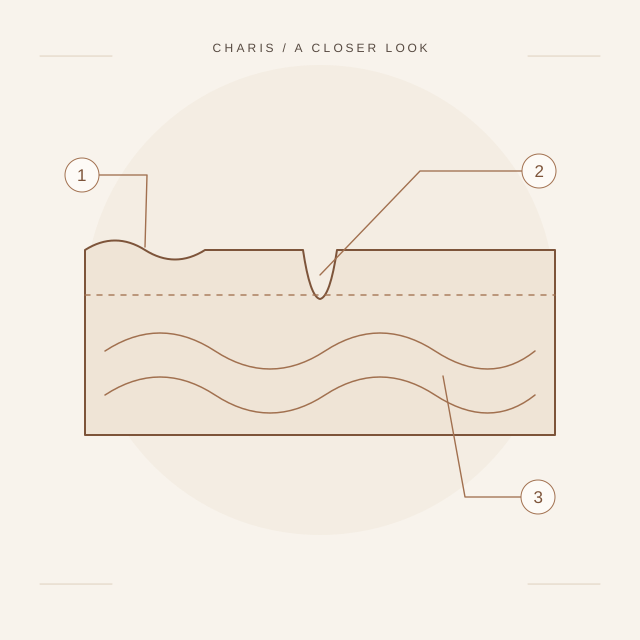
A closer look
The surface is not the whole story
Surface
Dryness and an uneven outer layer can change the feel of the skin.
Follicle opening
Pores are normal structures. They are not holes that can be permanently closed.
Underlying tissue
Scarring and support beneath the surface also influence texture.
Simplified illustration, not a diagnosis, treatment map or prediction of your result.
Pores: what can and cannot change
Pore size is largely genetic and it is set by the size of the oil gland beneath. Nothing shrinks a pore permanently, and any product or treatment claiming to do so is overstating.
What can change is how visible a pore is — and that is substantial. A pore that is clear rather than full of trapped oil and dead cells looks smaller. Skin with better collagen support around the pore holds its shape better and the opening looks tighter. Texture treatment can make a real difference to the appearance while changing nothing about the underlying anatomy.
I say this at consultation because it is the most common unrealistic expectation in this area, and it is much better addressed before treatment than after.
What works in clinic
Microneedling is the most reliable option. The controlled micro-injury prompts genuine remodelling — new collagen and elastin laid down over the weeks that follow — rather than just removing the top layer. Depth matters and should be set for your skin and your concern.
Chemical peels accelerate turnover and help considerably with congestion and tone as well as texture.
Skin boosters and polynucleotides improve hydration and density, which changes how light falls on the surface — texture that is better hydrated simply reads as smoother.
Dermaplaning gives an immediate smoothness by removing the surface layer, though it is a surface effect rather than a structural change.
Why a course beats a single session
Collagen remodelling is a process that runs over weeks, not hours. A single microneedling session produces some response; a course of three to six spaced about four weeks apart produces a cumulative one, and that is where the visible difference comes from.
This is also why treatments spaced too closely together do not work better. Going back before the skin has finished responding interrupts the process rather than accelerating it.
What you do at home matters more than people expect
A retinoid, used consistently over months, does more for cell turnover and texture than any single in-clinic treatment. It is the most evidence-backed thing available to you and it is cheap.
Daily SPF, because sun damage is undoing the collagen you are paying to build. A gentle exfoliating acid two or three times a week where your skin tolerates it. And enough patience to give any of it three months before judging.
If someone is selling you a course of treatment without discussing your home routine, they are selling you the less important half.
Cause, treatment and timescale, side by side
Scroll the table sideways →
| Cause | In clinic | At home | When you see it |
|---|---|---|---|
| Build-up of surface cells | A superficial peel | Regular gentle exfoliation | Within days |
| Congestion and enlarged-looking pores | Peels, microneedling | Consistent cleansing, a retinoid | 4–8 weeks |
| Sun damage | Resurfacing course | Daily SPF, without exception | 8–12 weeks |
| Loss of dermal collagen | Microneedling course, skin boosters | Retinoid, sun protection | 8–12 weeks after the course |
The right-hand column is the one worth reading twice. Nothing in the middle two columns works on a fortnight's notice, and a course judged at four weeks is a course judged too early.
Sources and further reading
This page is general information, not personal medical advice. Every treatment needs an individual assessment, and what is right for someone else may not be right for you.

About the author
Ashleigh Trickett
Registered Nurse & Aesthetic Practitioner
Registered Nurse with a BSc in Nursing and a PGCert in Critical Care (Manchester Metropolitan University, 2025). Ten years in the NHS, four of them in critical care. Advanced facial anatomy education at the Royal College of Surgeons with BAMAN, June 2026. Member of BAMAN and the Aesthetic Complications Expert Group. BAMAN Awards 2026 finalist for Rising Star of the Year.
Treatments this relates to
- MicroneedlingFrom £150
Controlled micro-injury that prompts the skin to remodel — used for texture, scarring, pore size and overall quality.
- Chemical Peels£80
A resurfacing treatment that accelerates cell turnover — used for pigmentation, congestion, texture and dullness.
- Skin BoostersFrom £200
The category explained — what a skin booster is, how the options differ, and how to work out which one you actually need.
- Facial£59
A thorough facial: double cleanse, exfoliation, dermaplaning where your skin needs it, then a soothing moisturiser finished with SPF 50.
Common questions
- Can I shrink my pores?
- Not permanently — pore size is largely genetic. You can significantly reduce how visible they are by keeping them clear and improving the collagen support around them.
- How many microneedling sessions will I need?
- Three to six for general texture, spaced about four weeks apart. Acne scarring usually needs the higher end of that and sometimes more.
- Is microneedling or a peel better for texture?
- Microneedling generally does more for texture and scarring because it remodels rather than resurfaces. Peels do more for tone, congestion and pigmentation. They are often combined in a plan rather than chosen between.
- How long until I see a difference?
- Some immediate smoothness after any resurfacing treatment, but genuine textural change takes a course and shows over two to three months as new collagen forms.
- Will treatment help old acne marks?
- Flat red or brown marks usually fade with time and gentle treatment. Textural scarring responds to microneedling as a course, with realistic improvement rather than erasure.
Read next
Skin
Treating acne scarring
Which scars respond to which treatment, why the acne has to be settled first, and what a realistic improvement looks like.
Skin
Why skin looks dull, and what actually helps
Dullness is a light problem before it is a skin problem. What causes it, what fixes it quickly, and what fixes it properly.
Skin
Treating pigmentation on the face
Sun damage, post-inflammatory marks and melasma look similar and are treated differently — how to tell them apart, what actually works, and what makes each of them worse.
Skin
Chemical peel aftercare and recovery
What to expect day by day, what to use, and the one mistake that undoes the treatment.
Anti-wrinkle
Treating crow's feet
The lines at the outer eye — why keeping some of them is usually right, and why the ones under your eye need a different treatment entirely.
Skin
Microneedling aftercare and recovery
Day by day, what to use and what to leave alone — and why sun protection is part of the treatment.
Get in touch
Book a consultation
Consultations are £30, and that comes off the cost of your treatment if you go ahead. No pressure to book anything on the day — if you are not sure whether you want treatment at all, that is still a good reason to come and talk.