
What are polynucleotides?
Purified DNA fragments used to support the skin's own repair processes — where they come from, what the evidence supports, and who they suit.
Polynucleotides are chains of nucleotides — the building blocks of DNA — purified for medical use and injected into the skin. They are one of the fastest-growing treatments in UK aesthetics and one of the most misdescribed, so it is worth being precise about what they are, what they do, and what they cannot do.
What they are made from
Most polynucleotide products used in aesthetics are derived from the DNA of salmon or trout, chosen because fish DNA is highly similar to human DNA at this structural level. The material is then purified to remove the proteins that would otherwise cause an allergic response, leaving the nucleotide chains themselves.
That purification is why a fish allergy is not automatically a barrier — the allergenic proteins are what is removed. It is still worth telling me at consultation so the decision is made properly rather than assumed.
It also means they are not suitable if you avoid animal-derived products for ethical or religious reasons. There is no vegan equivalent that works by the same mechanism, and I would rather say that plainly than steer you toward something else without explaining why.
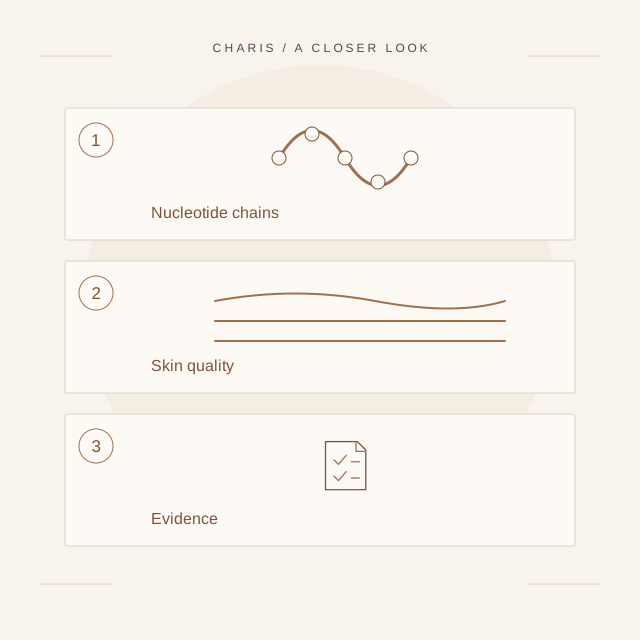
A closer look
Material, purpose, evidence
The material
Polynucleotides are chains of nucleotides, commonly obtained from purified fish-derived DNA.
The aim
They are used for skin quality concerns, rather than as a substitute for a structural filler.
The evidence
Research is developing. Products, protocols and study quality vary, so results should not be promised.
The chain is symbolic, not a molecular model. Product suitability, including allergies, must be checked against the specific product information.
How they work
Two things appear to happen. The polynucleotide chains act as a scaffold that holds water in the tissue, improving hydration in a way that is not simply a filling effect. And they appear to signal to fibroblasts — the cells that produce collagen and elastin — prompting them to behave more like younger, more active cells.
The second is the interesting part. Most injectables add something to the face. This category is trying to change how your own tissue behaves, which is why the results build over a course and continue developing after the last session rather than being immediate.
What the evidence supports
Published work supports improvements in skin hydration, elasticity and thickness, and a role in tissue repair. Polynucleotides have a considerably longer history in wound healing and in orthopaedics than they do in aesthetics, which is part of why the safety profile is reasonably well characterised.
What the evidence does not support is any volumising or lifting effect. They will not replace lost volume, they will not lift descended tissue, and they will not do a filler's job. Anyone telling you otherwise is overselling, and it is worth noticing when they do.
Who they suit — and the under-eye
Thin, crepey skin. Skin that has become dull and dehydrated. Sun-damaged skin where the quality rather than the shape is the problem. And anyone who wants a visible improvement without any change to the shape of their face.
The under-eye is where they most often outperform the alternatives, and it is the reason I use them as much as I do. The skin there is too thin for a spreading hyaluronic acid to achieve much, and filler placed into a hollow that is really a skin-quality problem tends to look worse over time — puffy, sometimes with a bluish cast. Polynucleotides address the actual problem.
This is the treatment I most often recommend to someone who came in asking for under-eye filler.
The course, and what to expect
Typically three sessions, two to four weeks apart, with maintenance every six to twelve months depending on the area and how your skin responds. Some areas and some skin types benefit from more.
Small raised bumps at the injection points are normal and settle within a few hours to a day. Bruising is possible, particularly under the eyes.
Hydration and glow are usually noticed first, within a couple of weeks. Firmness and texture build across the course and for several weeks after it finishes. If you want an immediate visible change, this is not the treatment — and I would say so at consultation rather than take your money and disappoint you at week two.
How they compare with the alternatives
Against bio-remodelling: bio-remodelling supplies hyaluronic acid that spreads through the tissue to hydrate and firm, and suits lax, dull skin across a whole area. Polynucleotides support repair, and suit thin, damaged or crepey skin — especially around the eyes.
Against amino-acid injectables such as Sunekos: those supply the raw materials the skin uses to rebuild its matrix. The categories overlap and are often used in sequence rather than chosen between.
Against filler: not comparable. Different job entirely.
What happens across the course
The commonest reason people conclude this category does not work is stopping after one session and judging it at a fortnight. Here is what the course actually looks like.
| Stage | What happens | What you notice |
|---|---|---|
| Session 1 | Small injections at fixed points; around 20 minutes | Small marks settling within hours; little else |
| 2–3 weeks | Session 2 | Often nothing yet. This is normal and it is where people give up |
| 2–3 weeks | Session 3 | Early change in how the skin holds light |
| 4–6 weeks after | Fibroblast activity building | Texture and firmness improving |
| 8–12 weeks after | The result | This is what you judge it on |
| 6–9 months | Maintenance | A single top-up session |
That second row is worth taking seriously before you book. You are paying for a change in how your own tissue behaves, and tissue does not turn around in a fortnight.
Sources and further reading
This page is general information, not personal medical advice. Every treatment needs an individual assessment, and what is right for someone else may not be right for you.

About the author
Ashleigh Trickett
Registered Nurse & Aesthetic Practitioner
Registered Nurse with a BSc in Nursing and a PGCert in Critical Care (Manchester Metropolitan University, 2025). Ten years in the NHS, four of them in critical care. Advanced facial anatomy education at the Royal College of Surgeons with BAMAN, June 2026. Member of BAMAN and the Aesthetic Complications Expert Group. BAMAN Awards 2026 finalist for Rising Star of the Year.
Treatments this relates to
- PolynucleotidesFrom £195
Regenerative injectable treatment that works on skin quality — hydration, elasticity and firmness — rather than adding volume.
- Skin BoostersFrom £200
The category explained — what a skin booster is, how the options differ, and how to work out which one you actually need.
- Tear Trough Treatment£350
Treatment of the under-eye hollow — where correct assessment matters more than any product choice.
Common questions
- Are polynucleotides safe?
- The safety profile is reasonably well established, helped by a long history of use outside aesthetics in wound healing and orthopaedics. As with any injectable there remain risks of bruising, swelling and, rarely, infection — which is why technique and sterility matter.
- Are they vegan?
- No. They are derived from purified fish DNA, so they are not suitable if you avoid animal-derived products. There is no equivalent that works the same way, and I will tell you that rather than substitute something quietly.
- Can I have them if I am allergic to fish?
- Possibly — the purification process removes the proteins responsible for allergic reactions. Raise it at consultation so it is a considered decision rather than an assumption.
- How soon will I see results?
- Hydration and glow often show within a couple of weeks. Firmness and texture build across the course and for several weeks after the last session. This is a gradual treatment by design.
- Are polynucleotides better than filler for under the eyes?
- For a lot of people, yes — because what looks like a hollow is frequently a skin-quality problem, and filler placed into that can look worse over time. Which one you need depends on assessment, and some people need neither.
Read next
Regenerative & skin quality
Polynucleotides vs bio-remodelling
Both are injected across the face rather than into one spot, and both improve skin quality — but they work by different mechanisms and suit different skin. How to tell which one you are being offered and why.
Regenerative & skin quality
Skin booster or filler — which do you need?
One changes the quality of the skin, the other changes the shape of the face. They are not alternatives, and picking the wrong one is the most common reason a treatment disappoints.
Regenerative & skin quality
Sunekos vs bio-remodelling
Amino acids versus hyaluronic acid — what each supplies, which skin each suits, and why the choice is clinical rather than a preference.
Regenerative & skin quality
Does PRP work for hair loss?
What platelet-rich plasma can and cannot do for thinning hair, who it suits, what the evidence actually shows, and the honest answer about how long it lasts.
Get in touch
Book a consultation
Consultations are £30, and that comes off the cost of your treatment if you go ahead. No pressure to book anything on the day — if you are not sure whether you want treatment at all, that is still a good reason to come and talk.