
Polynucleotides vs bio-remodelling
Both are injected across the face rather than into one spot, and both improve skin quality — but they work by different mechanisms and suit different skin. How to tell which one you are being offered and why.
These two are the most frequently confused treatments in UK aesthetics, partly because they are given in similar ways and partly because clinics describe both with the same vocabulary. They are not the same thing. One adds a large amount of hyaluronic acid that spreads through the tissue; the other adds no hyaluronic acid at all and works by signalling to your own cells.
The mechanism, plainly
Bio-remodelling uses a very high concentration of hyaluronic acid that is stabilised without heavy cross-linking, so instead of staying where it is placed it disperses through the tissue over the following days. The effect is hydration and firmness across a whole area, plus a stimulatory effect on collagen and elastin production.
Polynucleotides are chains of nucleotides — purified DNA fragments, usually from salmon or trout — that act as a scaffold holding water in the tissue and appear to signal to fibroblasts, prompting them to behave more like younger, more active cells. There is no hyaluronic acid involved.
That difference has a practical consequence. Bio-remodelling gives you something that is measurably present in the skin from the day it is injected. Polynucleotides give you a change in how your own tissue behaves, which is slower to appear and, in my experience, holds differently.
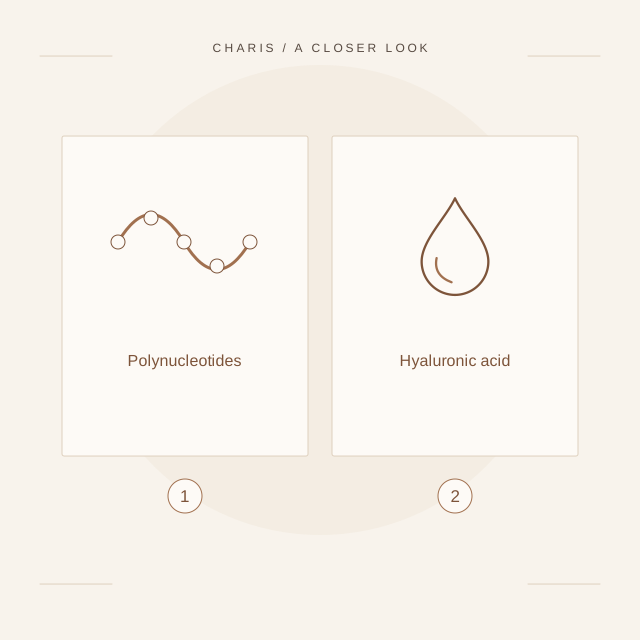
A closer look
Start with what is in the product
Polynucleotides
Nucleotide chains are the defining ingredient in this category. Check the actual formulation, as products differ.
Bio-remodelling
Hyaluronic acid is the defining material in the bio-remodelling category discussed here.
Choosing between them
The clinical assessment, product information and strength of evidence matter more than the category name.
Ingredient comparison only; no claim of equivalent effectiveness or suitability. Charis’s offered alternative is explained in the article.
What each is better at
Bio-remodelling tends to be the stronger choice where skin has lost firmness and bounce — the lower face, the jawline, the neck — and where someone wants a visible lift in skin quality within a few weeks. It suits skin that is dehydrated and slack more than skin that is thin and fragile.
Polynucleotides tend to be the stronger choice for thin, delicate or damaged skin: under the eyes, around a scarred area, skin that is reactive or has been over-treated. The under-eye is where the difference is clearest, because that skin is too thin to take a spreading hyaluronic acid product comfortably.
Where someone has both problems — and plenty do — they can be sequenced, and I would generally start with whichever addresses the thing that bothers you most.
How each course runs
Bio-remodelling is usually two sessions four weeks apart, with maintenance at around six months. Polynucleotides are usually a course of three sessions at two to three week intervals, then maintenance at six to nine months.
Both are given as a series of small injections at fixed points rather than as a general mesh across the face, and both take roughly twenty minutes. Bio-remodelling characteristically leaves visible raised blebs at each injection point which settle within a few hours to a day; polynucleotides leave smaller marks that settle faster.
Bio-remodelling shows itself at around four to six weeks. Polynucleotides build more slowly and are usually judged at eight to twelve weeks after the final session, which is a genuinely different amount of patience to ask for.
Who each is not for
Polynucleotides are derived from fish DNA. The proteins that cause allergic reactions are removed during purification, so a fish allergy is not an automatic barrier, but it must be declared and assessed. They are not suitable if you avoid animal-derived products on ethical or religious grounds, and there is no equivalent that works the same way.
Neither is appropriate during pregnancy or breastfeeding, or over active skin infection or inflammation in the treatment area. Neither will change the shape of your face, so if what bothers you is volume loss or a heavy jowl, the honest answer is that you are looking at the wrong category.
Both require a practitioner who will assess your skin rather than sell you the one they have in the fridge. The Aesthetic Complications Expert Group and BAMAN both maintain guidance on assessment and consent that a good clinic will be working to.
Cost and how to decide
Per course the two are broadly comparable, with the exact figures on the treatment pages. Deciding between them on price alone is the wrong axis, because they are not doing the same job.
The question I ask at consultation is what your skin is short of. If it is water and firmness across a broad area, bio-remodelling. If it is resilience in thin or damaged skin, polynucleotides. If you cannot tell from the mirror, that is what the £30 consultation is for — and it comes off the treatment if you go ahead.
The two, side by side
| Bio-remodelling | Polynucleotides | |
|---|---|---|
| What is in it | Very high concentration hyaluronic acid, lightly stabilised | Purified DNA fragments — no hyaluronic acid at all |
| How it works | Disperses through the tissue; hydrates, firms, stimulates | Signals to your fibroblasts to behave more actively |
| Best for | Dehydrated, slack skin — lower face, jawline, neck | Thin, delicate or damaged skin — under the eyes especially |
| Course | 2 sessions, 4 weeks apart | 3 sessions, 2–3 weeks apart |
| Result appears | 4–6 weeks | 8–12 weeks after the final session |
| Maintenance | Around 6 months | 6–9 months |
| Injection marks | Visible raised blebs, settling in hours to a day | Smaller marks, settling faster |
| Not for | Very thin skin, where it has little to work with | Anyone avoiding animal-derived products |
Where someone has both problems — and plenty do — these are sequenced rather than chosen between.
Sources and further reading
- British Association of Dermatologists — patient information
- Nursing & Midwifery Council — search the register
- British Association of Medical Aesthetic Nurses
- Aesthetic Complications Expert Group
This page is general information, not personal medical advice. Every treatment needs an individual assessment, and what is right for someone else may not be right for you.

About the author
Ashleigh Trickett
Registered Nurse & Aesthetic Practitioner
Registered Nurse with a BSc in Nursing and a PGCert in Critical Care (Manchester Metropolitan University, 2025). Ten years in the NHS, four of them in critical care. Advanced facial anatomy education at the Royal College of Surgeons with BAMAN, June 2026. Member of BAMAN and the Aesthetic Complications Expert Group. BAMAN Awards 2026 finalist for Rising Star of the Year.
Treatments this relates to
- PolynucleotidesFrom £195
Regenerative injectable treatment that works on skin quality — hydration, elasticity and firmness — rather than adding volume.
- Teoxane BabyGLOW£295
A skin booster that improves hydration, elasticity and firmness across larger areas — face, neck and hands — without adding volume.
- Skin BoostersFrom £200
The category explained — what a skin booster is, how the options differ, and how to work out which one you actually need.
Common questions
- Can I have both?
- Yes, and combining them is reasonable where different areas have different problems — polynucleotides under the eyes and bio-remodelling in the lower face, for instance. I would not layer them in the same area on the same day.
- Which lasts longer?
- Bio-remodelling typically needs maintenance at around six months; polynucleotides at six to nine. The difference is small enough that it should not be the deciding factor.
- Will either fill my lines?
- Neither is a filler. Fine crepey lines caused by poor skin quality usually soften; a static fold caused by lost volume or by muscle movement will not, and needs a different treatment.
- Are the bumps afterwards normal?
- With bio-remodelling, yes — the raised points at each injection site are expected and settle within hours to a day. Anything still raised, hard or painful after a few days is worth showing me.
- Is one safer than the other?
- Both have good safety records in trained hands and both carry the ordinary injection risks of bruising, swelling and a small infection risk. The meaningful safety variable is who is holding the needle and what they do when something goes wrong.
Read next
Regenerative & skin quality
What are polynucleotides?
Purified DNA fragments used to support the skin's own repair processes — where they come from, what the evidence supports, and who they suit.
Regenerative & skin quality
Sunekos vs bio-remodelling
Amino acids versus hyaluronic acid — what each supplies, which skin each suits, and why the choice is clinical rather than a preference.
Regenerative & skin quality
Skin booster or filler — which do you need?
One changes the quality of the skin, the other changes the shape of the face. They are not alternatives, and picking the wrong one is the most common reason a treatment disappoints.
Get in touch
Book a consultation
Consultations are £30, and that comes off the cost of your treatment if you go ahead. No pressure to book anything on the day — if you are not sure whether you want treatment at all, that is still a good reason to come and talk.