
Skin booster or filler — which do you need?
One changes the quality of the skin, the other changes the shape of the face. They are not alternatives, and picking the wrong one is the most common reason a treatment disappoints.
These two get compared constantly and they are not really comparable. A dermal filler is a structural product: it goes into a specific place, in a specific volume, to change a shape. A skin booster is a quality product: it goes across an area, in small amounts, to change how the skin itself behaves. Choosing between them starts with working out which of those two problems you actually have.
The question that decides it
Stand in front of a mirror in flat, honest light and pull the skin gently upward and outward at the cheekbone. If the thing that bothers you improves, the issue is largely structural and filler is the relevant category. If the skin still looks dull, crepey or lined once it is smoothed out, the issue is skin quality and a booster is the relevant one.
Most people over about thirty-five have some of both, which is why the answer at consultation is frequently “one now, the other later” rather than a choice between them. What matters is the order. Treating skin quality first often reduces how much structural work turns out to be needed, and it makes the structural work look better when it happens.
The mistake to avoid is treating a skin-quality problem with volume. Filling a face because the skin looks tired is how people end up looking heavier without looking fresher, and it is not easily undone by adding more.
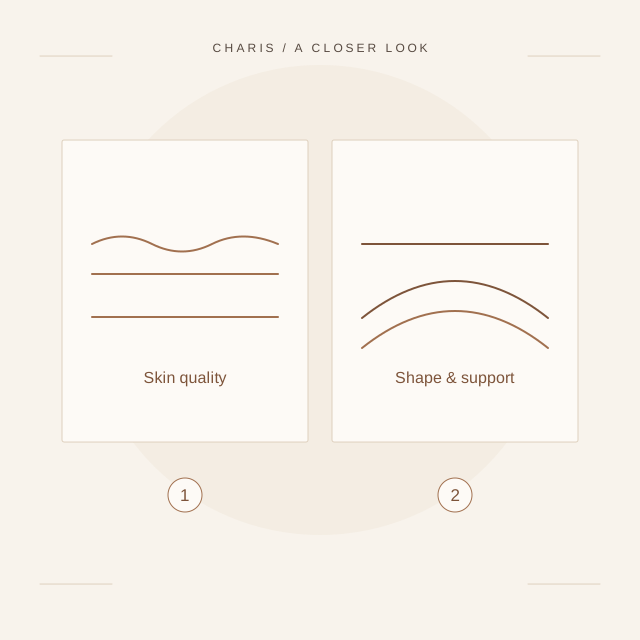
A closer look
Skin quality and facial contour are different questions
Skin quality
Texture, hydration and fine surface lines are skin-quality concerns.
Shape
Volume and contour concern the shape and support of the face.
Often both
These can coexist. Assessment is needed to decide whether any treatment would help.
Conceptual categories, not injection depths. A home lifting or pinch test cannot establish suitability.
What a filler does
A filler is a cross-linked hyaluronic acid gel firm enough to hold a shape. It is placed with intent — on bone at the cheek, along a jawline, into the body of the lip — and it lifts, projects or defines the tissue above it. The result is immediate and it is measurable in millimetres.
It lasts because the cross-linking resists breakdown, typically nine to eighteen months depending on the site and how much that area moves. It is reversible with hyaluronidase, which is a meaningful safety feature.
What it does not do is improve the skin. A filled cheek with poor skin quality is a filled cheek with poor skin quality, and in strong light it can read as fuller rather than better.
What a booster does
A skin booster is a much softer, usually non-cross-linked or lightly cross-linked hyaluronic acid, sometimes carrying amino acids or antioxidants. It is placed in small deposits across an area rather than in one spot, and it holds water in the dermis and encourages fibroblast activity.
The result is not a shape change. It is a change in how light behaves on the skin — more bounce, hydration held over weeks rather than hours, finer texture, and a gradual softening of the crepey lines that do not respond to muscle relaxing because no muscle is causing them.
It is a course rather than an appointment. Two or three sessions a few weeks apart, then maintenance every six to nine months. Results build across that period and are at their most obvious at around eight to twelve weeks, which asks for patience if you are used to the immediacy of filler.
Where polynucleotides and bio-remodelling sit
The category has widened and the labels have not kept up. Bio-remodelling products use a high concentration of hyaluronic acid that spreads through the tissue rather than staying where it is placed, giving a hydration and firmness effect over a broad area. Polynucleotides work by a different mechanism again — purified DNA fragments that signal to the repair machinery of the skin rather than adding hyaluronic acid at all.
For practical purposes all three sit on the quality side of the line rather than the structural one. Which suits you depends on your skin, your age, what you have had before and how much downtime you can accept, which makes it a consultation question rather than a menu question.
If a clinic offers you one of these for a problem that is clearly structural — a flat midface, a heavy jowl, a lip with no shape — the treatment is being sold rather than chosen.
Cost, and how to think about it
Compared per appointment, boosters usually look more expensive because they come as a course. Compared per year the gap narrows considerably, and compared on what each is for, the comparison stops making sense at all.
My usual advice for someone with a limited budget and both problems is to spend it on skin quality first. Good skin over an unchanged structure looks well; poor skin over a well-built structure still looks tired. Prices for everything I offer are on the treatment pages, and the £30 consultation comes off whatever you decide to have.
Structure or quality, side by side
| Dermal filler | Skin booster | |
|---|---|---|
| What it changes | The shape of the face | How the skin itself behaves |
| The product | Cross-linked gel, firm enough to hold a shape | Soft, lightly cross-linked or not at all |
| How it is placed | In one site, with intent — on bone, along a jawline | Small deposits across a whole area |
| When you see it | Immediately; settled at 2 weeks | Builds over 8–12 weeks |
| How long | 9–18 months depending on the site | Maintenance every 6–9 months |
| One appointment or a course | One | A course of 2–3, then maintenance |
| What it cannot do | Improve the skin | Change facial shape or lift anything |
Most people over about thirty-five have some of both problems, which is why the answer is usually “one now, the other later” — and why the order matters more than the choice.
Sources and further reading
- NHS — Dermal fillers
- British Association of Dermatologists — patient information
- Nursing & Midwifery Council — search the register
- British Association of Medical Aesthetic Nurses
This page is general information, not personal medical advice. Every treatment needs an individual assessment, and what is right for someone else may not be right for you.

About the author
Ashleigh Trickett
Registered Nurse & Aesthetic Practitioner
Registered Nurse with a BSc in Nursing and a PGCert in Critical Care (Manchester Metropolitan University, 2025). Ten years in the NHS, four of them in critical care. Advanced facial anatomy education at the Royal College of Surgeons with BAMAN, June 2026. Member of BAMAN and the Aesthetic Complications Expert Group. BAMAN Awards 2026 finalist for Rising Star of the Year.
Treatments this relates to
- Skin BoostersFrom £200
The category explained — what a skin booster is, how the options differ, and how to work out which one you actually need.
- PolynucleotidesFrom £195
Regenerative injectable treatment that works on skin quality — hydration, elasticity and firmness — rather than adding volume.
- Facial HarmonisationFrom £220
Full-face assessment and treatment planning — restoring support and balance across the face rather than treating features in isolation.
Common questions
- Can I have both?
- Yes, and many people do — usually staged rather than on the same day, so that each is judged on its own. If both are planned together I generally treat skin quality first and reassess the structural need afterwards, because it often turns out to be less than expected.
- Will a skin booster make my face look fuller?
- No. The volumes involved are small and spread over an area, so there is no shape change. Some people notice a mild plumping effect from the hydration in the first days, which settles.
- Which has more downtime?
- Boosters typically leave small raised bumps at each injection point that settle within a day or so, and occasional bruising. Filler swelling is usually more visible but in fewer places. Neither requires time off, though I would not book either the day before an event.
- I'm in my twenties — is a booster too early?
- Not necessarily, and it is often the more appropriate choice at that age than filler. Skin quality treatments do not change your face, so there is no risk of the gradual over-treatment that starting filler young can lead to.
- How do I know which one I'm being sold?
- Ask what specifically it is expected to change, and how that change will be judged. A good answer names the problem and a timescale. A vague answer about rejuvenation usually means the product was chosen before the assessment was done.
Read next
Regenerative & skin quality
What are polynucleotides?
Purified DNA fragments used to support the skin's own repair processes — where they come from, what the evidence supports, and who they suit.
Regenerative & skin quality
Polynucleotides vs bio-remodelling
Both are injected across the face rather than into one spot, and both improve skin quality — but they work by different mechanisms and suit different skin. How to tell which one you are being offered and why.
Skin
Why skin looks dull, and what actually helps
Dullness is a light problem before it is a skin problem. What causes it, what fixes it quickly, and what fixes it properly.
Regenerative & skin quality
Sunekos vs bio-remodelling
Amino acids versus hyaluronic acid — what each supplies, which skin each suits, and why the choice is clinical rather than a preference.
Facial harmonisation
Is there such a thing as a non-surgical facelift?
What the phrase actually means, what it can and cannot do, and when the honest answer is a surgeon.
Facial harmonisation
Treating jowls without surgery
Why jowls form, which stage responds to treatment, and the point at which filler makes them worse.
Get in touch
Book a consultation
Consultations are £30, and that comes off the cost of your treatment if you go ahead. No pressure to book anything on the day — if you are not sure whether you want treatment at all, that is still a good reason to come and talk.