Bunny lines on the nose
The diagonal creases across the bridge of the nose — what causes them, why they sometimes appear after other treatment, and how they are treated.
Bunny lines are the diagonal creases that fan across the bridge of the nose when you scrunch it, laugh hard or smile broadly. They come from a small muscle called the nasalis, and they are one of the smallest treatments in aesthetics with a disproportionate effect on how a face reads in photographs.
What causes them
The nasalis muscle sits over the side of the nose and pulls upward and inward. Some people recruit it heavily when they smile or squint, and the skin over the bridge is thin, so the folding shows early.
Whether you get them is largely down to how you animate rather than how old you are. I see them in people in their twenties who scrunch when they laugh, and not at all in people twice that age who do not.
A closer look
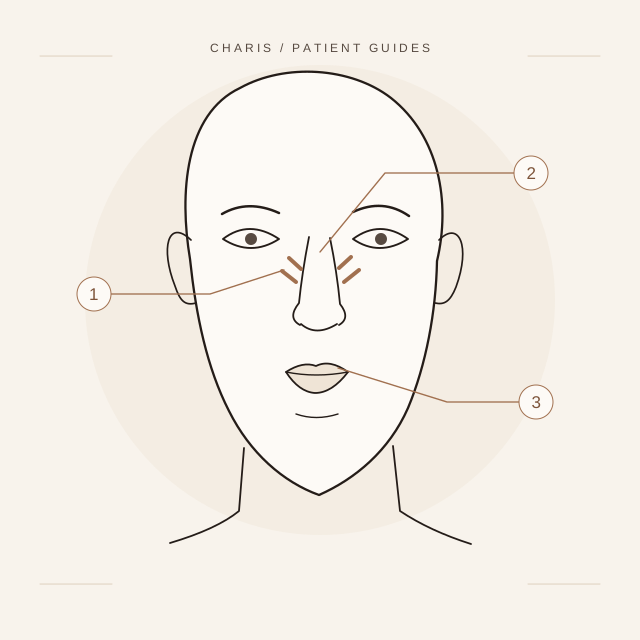
Where nose creases appear
Nose creases
These diagonal folds may become more visible when you laugh or scrunch your nose.
Bridge of the nose
The location differs from frown lines between the eyebrows.
Nearby upper lip
Movement around the nose and upper lip is connected, so a consultation considers both.
Illustrative surface landmarks. Normal expression varies; no treatment locations or doses are shown.
Why they sometimes appear after other treatment
This is the part worth knowing before you have anything done. When the frown lines between the brows are treated, some people unconsciously recruit the nasalis to compensate — the expression still wants to happen and finds another muscle to do it with. Bunny lines can appear, or become noticeably more obvious, for the first time.
It is not a complication and it is not a sign anything was done badly. It is a predictable consequence of changing how one muscle group behaves within a connected system. It is straightforward to treat when it happens, and I would rather you heard it from me beforehand than discovered a new line on your face and assumed something had gone wrong.
How they are treated
A very small dose either side of the nose, placed superficially. The technique matters more than the product: the levator muscles that lift the upper lip run close by, and product drifting into them produces a heavy or asymmetric smile that lasts until the treatment wears off.
So this is a small, precise treatment, and it is one where I would rather under-dose and review at two weeks than be bold.
When not to treat them
If bunny lines only appear when you scrunch your nose deliberately, and not in ordinary expression, they are not really a problem worth treating and I will say so.
If lines across the bridge are visible at rest, that is usually skin quality rather than muscle — thin, sun-damaged skin holding a crease — and relaxing the muscle will not do much for it. Skin-quality treatment does more.
Keeping expression
Nose scrunching is part of how many people laugh. Removing it entirely can make a face read as slightly flat in animation, in a way that is hard to name but easy to notice.
The aim here is softening rather than abolition, and it is worth saying out loud at consultation which of those you actually want.
Are they yours, or has something else caused them?
Bunny lines have three quite different origins, and which one applies changes what should be done about them.
| Origin | How to tell | What it means |
|---|---|---|
| Naturally expressive | Present since your twenties; strongest when you laugh or scrunch | A normal expression pattern rather than a problem, unless it genuinely bothers you |
| Compensatory | Appeared after treatment elsewhere in the upper face | The small muscle across the nose is working harder because its neighbours are not. Predictable, and preventable |
| Etched | Visible at rest, with the face completely relaxed | The line is in the skin as well as in the movement, so movement alone will not fully resolve it |
The second is worth understanding because it is nobody's fault and it is avoidable. When the muscles either side of the nose bridge are relaxed, the small muscle across it can take up more of the work — so lines that were never noticeable become noticeable. Treating the upper face as one unit from the outset, rather than region by region, is what prevents it.
Why the nose is treated cautiously
The muscles here are small, superficial, and sit very close to the ones that lift the upper lip. A small amount of product in the wrong plane can flatten how the lip lifts on one side — which shows in every smile and is considerably more noticeable than the lines being treated.
That is the entire argument for conservative dosing in this area. The cost of doing slightly too little is a fortnight more with the lines; the cost of doing slightly too much is a smile you do not recognise for three months. Those two risks are not symmetrical, and the plan should say so.
What to do about a line that is etched in
Where the line is visible with the face entirely at rest, softening the movement stops it deepening but will not remove what is already there. The skin itself has to change, and that is a different category of treatment.
- Skin quality treatment — microneedling, or a resurfacing course — works on the collagen underneath, over weeks rather than days.
- A very small amount of a soft, superficial product is occasionally used in an etched line. In this area that is a decision made carefully rather than routinely.
- Time helps. A line that has stopped being creased hundreds of times a day does soften on its own — slowly, over months.
Anyone promising to erase an etched line in one appointment is describing an outcome rather than a mechanism.
Sources and further reading
This page is general information, not personal medical advice. Every treatment needs an individual assessment, and what is right for someone else may not be right for you.
About the author
Ashleigh Trickett
Registered Nurse & Aesthetic Practitioner
Registered Nurse with a BSc in Nursing and a PGCert in Critical Care (Manchester Metropolitan University, 2025). Ten years in the NHS, four of them in critical care. Advanced facial anatomy education at the Royal College of Surgeons with BAMAN, June 2026. Member of BAMAN and the Aesthetic Complications Expert Group. BAMAN Awards 2026 finalist for Rising Star of the Year.
Treatments this relates to
- Lines & Wrinkles ConsultationOn consultation
A consultation for the treatment of lines and wrinkles — assessment first, with the options and what they can realistically achieve discussed before anything is decided.
- MicroneedlingFrom £150
Controlled micro-injury that prompts the skin to remodel — used for texture, scarring, pore size and overall quality.
Common questions
- Why did I get bunny lines after my frown treatment?
- Because the expression still wants to happen and recruits a neighbouring muscle to do it. It is common, predictable and easy to treat. It is not a sign that anything went wrong.
- How long does treating bunny lines last?
- Usually three to four months, in line with other facial areas. Some people find it lasts a little less because the muscle is small and active.
- Can treating bunny lines affect my smile?
- It can if product reaches the muscles that lift the upper lip, which is why placement matters and why the dose is small. Done correctly, your smile is unaffected.
- Are bunny lines a sign of ageing?
- Not particularly. They are more about how you animate than how old you are, and they show up in people in their twenties.
Read next
Anti-wrinkle
Treating forehead lines
Why the forehead is the area most often treated badly, what the eyebrow has to do with it, and the difference between lines that move and lines that have set.
Anti-wrinkle
Treating crow's feet
The lines at the outer eye — why keeping some of them is usually right, and why the ones under your eye need a different treatment entirely.
Anti-wrinkle
Lines around the mouth
Vertical lip lines — usually nothing to do with smoking, rarely fixed by one treatment, and one of the hardest areas to treat well.
Get in touch
Book a consultation
Consultations are £30, and that comes off the cost of your treatment if you go ahead. No pressure to book anything on the day — if you are not sure whether you want treatment at all, that is still a good reason to come and talk.