Treating crow's feet
The lines at the outer eye — why keeping some of them is usually right, and why the ones under your eye need a different treatment entirely.
Crow's feet fan out from the outer corner of the eye when you smile or squint, produced by the orbicularis oculi, the muscle that circles the eye. They are among the first lines most people notice on themselves, among the most responsive to treatment, and among the easiest to overtreat.
Why they appear earlier than other lines
The skin around the eye is the thinnest on the face — a fraction of the thickness of the cheek — with very few oil glands and a muscle underneath that contracts constantly. Every smile, every squint, every bright day folds it in the same place.
Add sun exposure, which is concentrated here because we squint against it, and you have the conditions for early lines regardless of how well you look after your skin.
Why not to remove them completely
The eyes carry most of what people read as warmth in a face. A genuine smile — a Duchenne smile — involves the muscle around the eye, and that crinkle is a large part of how sincerity is recognised.
A face that smiles with the mouth and not the eyes reads as flat or insincere, even when the viewer cannot articulate why. This is the area where I most often recommend less than the person asks for, and where softening rather than erasing gives the better-looking result.
When it is not a muscle problem at all
Fine crepey lines under the eye, visible when your face is completely still, are usually skin quality rather than movement — thin, sun-damaged, dehydrated skin. Muscle relaxation will not do much for those, and treating them that way is a common source of disappointment.
Polynucleotides are usually the better answer under the eye, because they improve the density and quality of the skin rather than stopping it moving. Skin boosters and gentle microneedling also help.
Distinguishing the two is straightforward in clinic: lines that only appear on smiling are muscle, lines present at rest are skin. Most people have some of each.
Dosing and the brow
The outer eye is close to the muscles that support the brow tail. Product placed too high or too medially can drop the outer brow, which reads as a heavy or slightly sad expression.
This is why the treatment is placed laterally and why the dose is modest. It is also why I review at two weeks: adding a small amount is easy, and removing it is not possible.
What helps besides injections
Sunglasses, genuinely. A great deal of the squinting that etches these lines is avoidable.
Daily SPF around the eye, which most people skip. A retinoid formulated for the eye area, used carefully. And treating the skin quality directly, which is what makes the result hold rather than needing ever more frequent treatment.
Dynamic or static? The test takes five seconds
Relax your face completely in front of a mirror and look at the outer corner of your eye. Whether the lines are still there decides what will actually help.
| Dynamic | Static | |
|---|---|---|
| Visible at rest | No — only when you smile or squint | Yes |
| What is causing it | Muscle movement folding the skin | Movement, plus collagen loss and sun damage in the skin itself |
| Responds to softening the movement | Very well | Partially — it stops them deepening |
| Also needs | Nothing | Skin quality work: resurfacing, microneedling, daily sun protection |
| Realistic outcome | Softened or absent on smiling | Noticeably softer, not erased |
Most people past forty have some of both, which is why a plan aimed at only one of them disappoints. It is also why the honest answer to “can you get rid of these” is usually “we can soften them considerably”.
A closer look
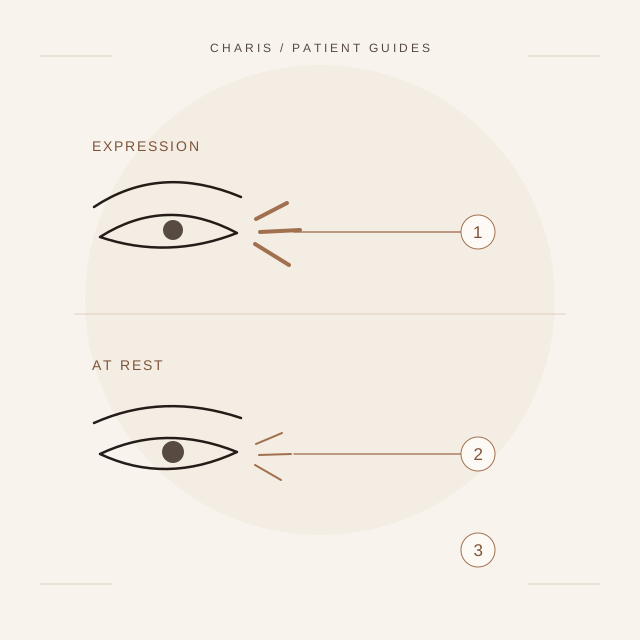
Movement and resting lines
With expression
Dynamic folds appear with smiling or squinting.
At rest
Static creases remain visible when the face relaxes.
Often a mixture
Movement and changes in skin quality can both contribute. The illustration is not a treatment comparison.
Schematic examples of facial expression, not before-and-after results.
The things that make them worse, ranked
Ultraviolet exposure, by a distance
The skin around the eye is the thinnest on the face and it takes the most sun. Cumulative UV damages the collagen and elastin that let skin recover from being folded — which is precisely what turns a dynamic line into a static one. Daily protection and sunglasses do more for this area across a decade than any single appointment.
Squinting you have stopped noticing
An out-of-date glasses prescription, screens without a break, driving into low sun. All of it is repeated forceful contraction of exactly the muscle that creases this skin, and none of it registers as squinting at the time. An eye test is an unglamorous but genuinely effective intervention here.
Smoking, and sleeping on one side
Smoking damages dermal collagen and adds a pursing movement on top of it. Consistently sleeping on the same side compresses one eye area for hours every night, which is a common reason these lines are asymmetric and the fold on that side is deeper.
Why complete stillness is the wrong goal here
The eyes carry most of the information in a smile. Whether a smile reads as genuine is judged largely at the outer eye — it is why a smile that involves only the mouth reads as polite rather than warm. Remove that movement entirely and the face becomes harder to read, in a way people notice without being able to name.
There is a mechanical reason too: the muscle around the eye also helps hold the area up, and over-treating it can make the lower lid look heavier or worsen under-eye puffiness. Softening the fold while leaving the smile intact is the harder skill and the better result.
Sources and further reading
This page is general information, not personal medical advice. Every treatment needs an individual assessment, and what is right for someone else may not be right for you.

About the author
Ashleigh Trickett
Registered Nurse & Aesthetic Practitioner
Registered Nurse with a BSc in Nursing and a PGCert in Critical Care (Manchester Metropolitan University, 2025). Ten years in the NHS, four of them in critical care. Advanced facial anatomy education at the Royal College of Surgeons with BAMAN, June 2026. Member of BAMAN and the Aesthetic Complications Expert Group. BAMAN Awards 2026 finalist for Rising Star of the Year.
Treatments this relates to
- Lines & Wrinkles ConsultationOn consultation
A consultation for the treatment of lines and wrinkles — assessment first, with the options and what they can realistically achieve discussed before anything is decided.
- PolynucleotidesFrom £195
Regenerative injectable treatment that works on skin quality — hydration, elasticity and firmness — rather than adding volume.
- Skin BoostersFrom £200
The category explained — what a skin booster is, how the options differ, and how to work out which one you actually need.
Common questions
- How long does crow's feet treatment last?
- Usually three to four months. The muscle is active, so this area sometimes wears off slightly sooner than the frown.
- Will it help the lines under my eyes?
- Only partly. Under-eye crepiness is usually a skin-quality problem and responds better to polynucleotides or skin boosters. Lines that only appear when you smile are the ones that respond to muscle relaxation.
- Will my smile look strange?
- Not if it is dosed properly. The aim is softening while keeping the eye crinkle that makes a smile read as genuine. I will usually recommend less than you might expect here, for that reason.
- Can I start treatment in my twenties?
- You can, and for someone with strong movement and early etching it can be reasonable. It is not right for everyone at every age and I will give you an honest view rather than sell you a course.
- Why did my brow feel heavy afterwards?
- Usually product affecting the muscles supporting the brow tail. It resolves as the treatment wears off, and it informs how I dose you next time — tell me if it happened.
Read next
Anti-wrinkle
Treating forehead lines
Why the forehead is the area most often treated badly, what the eyebrow has to do with it, and the difference between lines that move and lines that have set.
Anti-wrinkle
Bunny lines on the nose
The diagonal creases across the bridge of the nose — what causes them, why they sometimes appear after other treatment, and how they are treated.
Skin
Improving skin texture
Roughness, visible pores and an uneven surface — what causes them, what genuinely improves them, and what no treatment can change.
Get in touch
Book a consultation
Consultations are £30, and that comes off the cost of your treatment if you go ahead. No pressure to book anything on the day — if you are not sure whether you want treatment at all, that is still a good reason to come and talk.