
Treating forehead lines
Why the forehead is the area most often treated badly, what the eyebrow has to do with it, and the difference between lines that move and lines that have set.
The forehead is where over-treatment shows most obviously and where the consequences are hardest to hide, because the muscle being relaxed is the only one that lifts your eyebrows. Treating it well is less about the forehead itself than about the balance between it and the muscles that pull the brow down.
One muscle up, several muscles down
The horizontal lines across your forehead are made by the frontalis, a broad flat sheet of muscle that runs from the hairline down to the brow. It is the only muscle in the face that raises the eyebrows. Everything else in that region — the muscles between the brows and the ones at the outer corner of the eye — pulls them down.
That asymmetry is the whole problem. Relax the frontalis heavily on its own and you have removed the only lifting force while leaving all the lowering forces intact, and the brow settles lower. On someone whose brow position was already low, or whose upper eyelid skin is heavy, that reads as a hooded, tired look — and it is the single most common complaint I hear about treatment performed elsewhere.
Treating the frontalis and the depressor muscles together, in proportion, is what keeps the brow where it was. It is also why a competent injector will look at your brow position before they look at your lines.
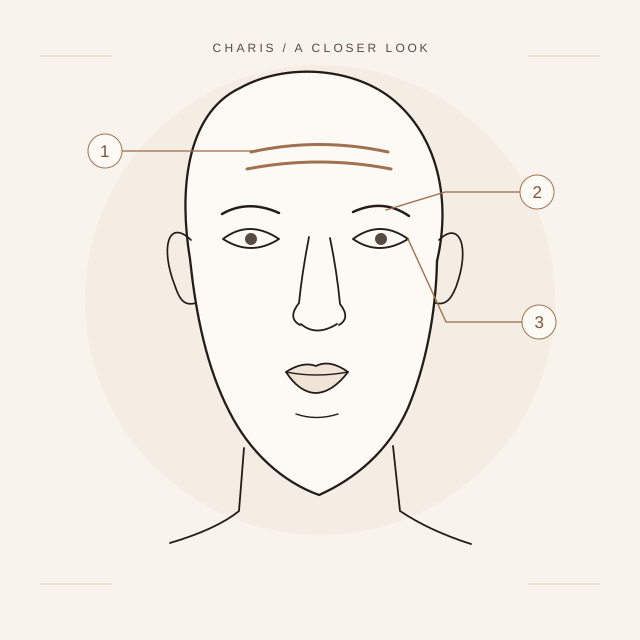
A closer look
The forehead and brow work together
Forehead
Forehead movement helps raise the eyebrows and creates horizontal folds.
Brow position
Resting position and movement are assessed together.
Surrounding movement
The nearby muscles and eyelids are part of the same assessment.
Surface landmarks only. No injection sites, doses or treatment effects are illustrated.
Lines that move and lines that have set
Raise your eyebrows in a mirror, then relax completely. The lines that vanish when you relax are dynamic, caused purely by movement, and they respond well to muscle relaxing. The lines still visible at rest are static — the skin has been creased often enough that the crease persists — and relaxing the muscle will soften them but not erase them.
Static lines need the skin itself treated, which means collagen stimulation over time: microneedling, a good topical routine with a retinoid, and patience. Relaxing the muscle stops them deepening, which is the more valuable half of the deal even when it is the less visible one.
This is worth being clear about before treatment, because the disappointment I most often meet is someone who expected a set line to disappear and was not told it would not. If your lines are deep at rest, expect improvement rather than erasure, and expect it over months rather than at two weeks.
Why less is usually right here
A completely motionless forehead is not a natural look and it is not the goal. Some movement in the frontalis is what makes a face read as expressive, and most people who have had a frozen forehead describe it as feeling heavy rather than smooth.
I generally start conservatively on a first forehead treatment and review at two weeks. Adding a little more is straightforward; waiting three months for too much to wear off is not, and a dropped brow cannot be corrected on the day.
Small foreheads, low brows and heavy upper lids are all reasons to treat lightly or, occasionally, not at all. Where the brow is already sitting low, treating the forehead can make someone look worse rather than better, and saying so at consultation is part of the job.
What to expect from the appointment
Treatment takes about ten minutes. The needle is very fine and most people find the forehead one of the more comfortable areas. There is no anaesthetic needed and no downtime beyond the general advice to stay upright for four hours, avoid the gym that day, and not rub or massage the area.
Nothing happens for the first three to four days. Movement begins to reduce from around day four, and the effect is complete at around two weeks — which is when I review, and when any adjustment is made.
It lasts three to four months for most people. Regular treatment at sensible intervals tends to extend that over time as the muscle becomes less strong; over-frequent treatment does not, and carries its own problems.
What else the forehead responds to
Skin quality matters more on the forehead than people assume, because the skin there is thin and takes a lot of ultraviolet exposure. Daily sunscreen and a retinoid do more for the static component of forehead lines than any injectable, and they cost less.
Microneedling can be used across the forehead to remodel set creases, generally as a course rather than a single session and generally alongside muscle relaxing rather than instead of it.
Filler is very rarely appropriate in the forehead itself. It is a high-risk area vascularly and the results are frequently poor, so if it is offered to you casually, ask a great many questions first.
What the forehead responds to, and what it does not
The forehead is treated cautiously because the muscle that creates the lines is also the only one that lifts the brow. Softening it too far does not produce a smooth forehead; it produces a heavy one.
| What bothers you | What it is | What helps |
|---|---|---|
| Lines only when you raise your brows | Movement folding the skin | Anti-wrinkle injections, conservatively dosed |
| Lines visible with the face at rest | The crease is set into the skin as well | Skin quality treatment — microneedling, resurfacing, boosters |
| A brow that feels heavy already | Descent, not movement | Not more relaxation — this is where over-treating causes the problem |
| Hollowing or crepey skin across the forehead | Loss of volume and dermal density | Skin boosters; occasionally structural support at the temple |
Rows two and four are the reason a forehead can be treated correctly and still not look how someone hoped. Movement was never the whole problem.
Sources and further reading
- NHS — Anti-wrinkle injections
- British Association of Dermatologists — patient information
- Nursing & Midwifery Council — search the register
- British Association of Medical Aesthetic Nurses
This page is general information, not personal medical advice. Every treatment needs an individual assessment, and what is right for someone else may not be right for you.

About the author
Ashleigh Trickett
Registered Nurse & Aesthetic Practitioner
Registered Nurse with a BSc in Nursing and a PGCert in Critical Care (Manchester Metropolitan University, 2025). Ten years in the NHS, four of them in critical care. Advanced facial anatomy education at the Royal College of Surgeons with BAMAN, June 2026. Member of BAMAN and the Aesthetic Complications Expert Group. BAMAN Awards 2026 finalist for Rising Star of the Year.
Treatments this relates to
- Lines & Wrinkles ConsultationOn consultation
A consultation for the treatment of lines and wrinkles — assessment first, with the options and what they can realistically achieve discussed before anything is decided.
- MicroneedlingFrom £150
Controlled micro-injury that prompts the skin to remodel — used for texture, scarring, pore size and overall quality.
Common questions
- Will my eyebrows drop?
- Not if the forehead is treated in proportion with the muscles that pull the brow down, and not if your starting brow position has been assessed properly. A drop is almost always a dosing or assessment problem rather than an inevitable risk, and it wears off — but it takes months to do so.
- Can the forehead be treated on its own?
- It can, but in many people it should not be. Treating the frontalis alone removes the lifting force and leaves the lowering ones, so the brow tends to settle. Treating the frown area at the same time is usually the safer plan.
- How soon does it work?
- Three to four days for the first signs, two weeks for the full effect. Judging the result before two weeks is judging an incomplete result.
- Will my lines come back worse?
- No. When it wears off you return to your baseline, not past it. What people sometimes notice is that they had become used to smoother skin, so the return feels like a deterioration when it is simply the original.
- I'm in my twenties — is it too early?
- If your lines are visible at rest, it is not too early. If they only appear on movement and you are treating them preventively, that is a legitimate choice but it is one to make deliberately, at a light dose, and with the understanding that it is an ongoing commitment.
Read next
Anti-wrinkle
Treating crow's feet
The lines at the outer eye — why keeping some of them is usually right, and why the ones under your eye need a different treatment entirely.
Anti-wrinkle
Lines around the mouth
Vertical lip lines — usually nothing to do with smoking, rarely fixed by one treatment, and one of the hardest areas to treat well.
Anti-wrinkle
Bunny lines on the nose
The diagonal creases across the bridge of the nose — what causes them, why they sometimes appear after other treatment, and how they are treated.
Get in touch
Book a consultation
Consultations are £30, and that comes off the cost of your treatment if you go ahead. No pressure to book anything on the day — if you are not sure whether you want treatment at all, that is still a good reason to come and talk.