
Lines around the mouth
Vertical lip lines — usually nothing to do with smoking, rarely fixed by one treatment, and one of the hardest areas to treat well.
The fine vertical lines running up from the top lip get called smoker's lines, which is unfair to a great many people who have never smoked. They are one of the most common things people ask me about and one of the least well served by a single treatment, because three separate things cause them and each needs a different answer.
Why they form — three causes, not one
The first is muscle. The orbicularis oris circles the mouth and does an enormous amount of work: speaking, eating, drinking, kissing, pursing. Every contraction folds the skin above the lip in the same place, and over decades that fold gets etched in.
The second is skin quality. The skin above the upper lip is thin, has relatively few oil glands, and loses collagen early. As it thins, it holds a crease that plumper skin would spring back from.
The third is volume. The upper lip and the philtral columns lose support with age. When the structure beneath the skin deflates, the skin above it has nowhere to sit and gathers into vertical lines. This is the cause people least expect and it is often the biggest contributor.
Smoking accelerates all three — the repeated pursing, the collagen damage, the reduced blood supply — which is where the name comes from. But sun exposure does much the same, and so does simply getting older.
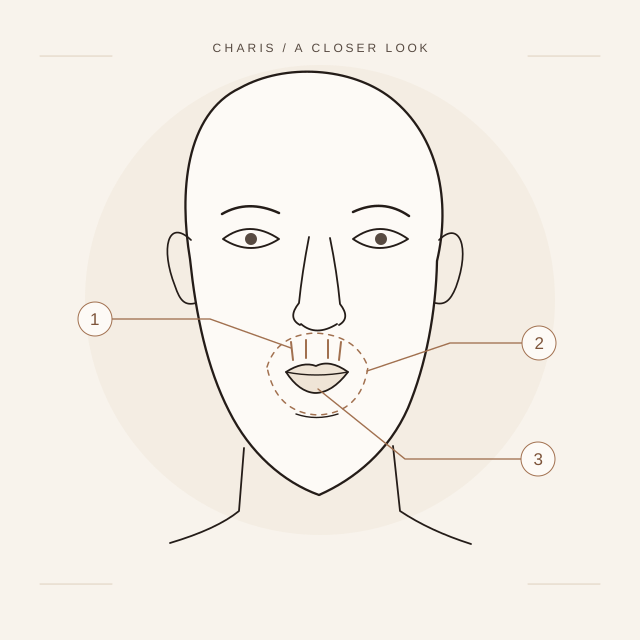
A closer look
Lip lines and the structures around them
Skin above the lip
Fine vertical creases can be present even in people who have never smoked.
Movement
The mouth is active during speaking, eating and expression.
Lip support
The surrounding tissue and lip shape also form part of the assessment.
Simplified illustration, not a diagnosis, treatment map or prediction of your result.
Why one treatment rarely fixes them
Treat only the muscle and the lines soften but the skin still looks crepey, because you have not changed its quality. Treat only with filler and the movement keeps re-etching what you have just smoothed. Treat only the skin and the underlying support is still missing.
In practice a combined, staged plan does far more than any single intervention. My usual sequence is to restore support first, treat skin quality alongside it, and consider a small amount of muscle relaxation last — because relaxing that muscle too early or too heavily creates problems of its own.
Why this area needs a light touch
The muscle around the mouth is functional in a way the forehead is not. Over-relax it and people notice: difficulty with a straw, an odd feeling when pronouncing p and b sounds, an asymmetric smile, sometimes trouble keeping liquid in the mouth. It resolves as the treatment wears off, but three months of that is a long time.
So the dose here is a fraction of what would be used in the frown, placed superficially and conservatively. Anyone offering you a standard dose in this area has not thought about it. If you sing, play a wind instrument, or speak or present for a living, say so — it changes what I would recommend, and sometimes it means I would not recommend it at all.
Filler in the lip lines specifically
Very small amounts of a soft product placed into the lines themselves can help where the line is etched and static. It is technically demanding: the skin is thin, product placed too superficially shows as a white or lumpy ridge, and this area is unforgiving of a heavy hand.
More often the better move is to support the vermillion border and the philtral columns rather than filling the lines directly — restoring the structure the skin sits on, so the lines have less reason to gather. The result reads as a lip that looks like itself rather than a lip that has been worked on.
What skin quality treatment adds
Microneedling and appropriate peels genuinely improve the etched component by prompting the skin to remodel. Polynucleotides and skin boosters improve density and hydration in an area where thin skin is a large part of the problem.
This is the slowest part of the plan and the part people are most tempted to skip. It is also the part that determines whether the result still looks good in two years, because a line etched into poor-quality skin will come back faster than one in skin that has been improved.
What you can do yourself
Daily SPF, because UV is the single largest contributor to the collagen loss underneath these lines. A retinoid, used consistently, which does more for skin quality above the lip than most in-clinic treatments do on their own. And stopping smoking if you smoke — which improves the blood supply to an area that has very little to spare.
None of that is exciting advice and all of it works better than it sounds.
Three causes, three different answers
The name is misleading — plenty of people who have never smoked have them, and they form for three reasons that are usually all present at once.
| Cause | What is happening | What addresses it |
|---|---|---|
| Repeated pursing | The muscle circling the mouth folds the skin thousands of times a day | A very small amount of anti-wrinkle treatment, cautiously — this muscle is needed |
| Loss of dermal collagen | The skin no longer recovers from being folded | Skin quality treatment: microneedling, resurfacing, boosters |
| Loss of support beneath | The lip and the tissue around it have deflated | Structural support at the lip border and the surrounding area |
Sources and further reading
- NHS — Anti-wrinkle injections
- NHS — Dermal fillers
- British Association of Dermatologists — patient information
This page is general information, not personal medical advice. Every treatment needs an individual assessment, and what is right for someone else may not be right for you.

About the author
Ashleigh Trickett
Registered Nurse & Aesthetic Practitioner
Registered Nurse with a BSc in Nursing and a PGCert in Critical Care (Manchester Metropolitan University, 2025). Ten years in the NHS, four of them in critical care. Advanced facial anatomy education at the Royal College of Surgeons with BAMAN, June 2026. Member of BAMAN and the Aesthetic Complications Expert Group. BAMAN Awards 2026 finalist for Rising Star of the Year.
Treatments this relates to
- Lines & Wrinkles ConsultationOn consultation
A consultation for the treatment of lines and wrinkles — assessment first, with the options and what they can realistically achieve discussed before anything is decided.
- Signature Lips£220
Hyaluronic acid lip enhancement built around your existing anatomy — shape and balance before volume.
- MicroneedlingFrom £150
Controlled micro-injury that prompts the skin to remodel — used for texture, scarring, pore size and overall quality.
- Skin BoostersFrom £200
The category explained — what a skin booster is, how the options differ, and how to work out which one you actually need.
Common questions
- Can lines around the mouth be removed completely?
- Softened substantially, usually. Removed entirely, rarely — particularly where they are deeply etched into thin skin. Anyone promising complete erasure is overselling. A realistic aim is that they are much less noticeable at rest and that they stop deepening.
- How many treatments will it take?
- A combined plan usually runs over several months: structural support, then skin-quality treatment as a course of three to six sessions, with muscle relaxation considered along the way. It is not a one-appointment fix and I would rather tell you that at the start than halfway through.
- Will treating the muscle affect my speech?
- At the small doses used here, it should not. Some people notice a mild difference with straws or certain sounds for a couple of weeks. If you use your mouth professionally — singing, wind instruments, presenting — tell me, because it changes my recommendation.
- I do not smoke. Why do I have smoker's lines?
- The name is misleading. Repeated muscle movement, thinning skin and loss of lip support cause these lines in people who have never smoked. Sun exposure is a bigger contributor for most people than smoking is.
- Is filler safe this close to the lip?
- In trained hands and in small amounts, yes — but it is a technically demanding area with thin skin and nearby vasculature, and it is not a place to choose a practitioner on price. Ask about anatomy training and whether hyaluronidase is held on site.
Read next
Anti-wrinkle
Treating forehead lines
Why the forehead is the area most often treated badly, what the eyebrow has to do with it, and the difference between lines that move and lines that have set.
Facial harmonisation
Marionette lines
The lines from the mouth corners toward the jaw — why they make a resting face look unhappy, and why the answer is structural.
Lips
How to get lip filler that looks natural
Natural is a proportion problem, not a volume problem. What actually makes lips read as done, and the specific things to ask for — and to refuse — at consultation.
Anti-wrinkle
Bunny lines on the nose
The diagonal creases across the bridge of the nose — what causes them, why they sometimes appear after other treatment, and how they are treated.
Get in touch
Book a consultation
Consultations are £30, and that comes off the cost of your treatment if you go ahead. No pressure to book anything on the day — if you are not sure whether you want treatment at all, that is still a good reason to come and talk.