Treatment for thinning hair: the options
The main options for thinning hair, what each one can realistically do, and why finding the cause comes before choosing any of them.
Charis Aesthetics · Consultation planning guide · Published . This guide has not been clinically reviewed by Ashleigh.
Thinning hair has many causes, and the right treatment depends almost entirely on which one you have. This guide sets out the main options honestly, including the ones I do not offer, so you can see where each fits. The most important step is the first one: finding out why it is happening.
Find the cause first
Hair loss can come from pattern hair loss that runs in families, from a recent illness, childbirth or stress, from iron deficiency or thyroid problems, from some medicines, and from autoimmune conditions. Each of these is managed differently, and some need medical treatment rather than anything cosmetic.
If your hair loss came on suddenly, is patchy, or comes with other symptoms, see your GP before you see any clinic. Blood tests are often the most useful first step. The NHS page on hair loss is a good starting point for working out which category you are in.
The main options
| Option | What it is | Best suited to |
|---|---|---|
| Treating the underlying cause | Correcting iron or thyroid problems, or waiting out shedding after illness or childbirth | Hair loss with a medical cause |
| Medication from a pharmacy | A lotion or foam applied to the scalp every day | Early pattern hair loss, used long term |
| Prescription treatment | Medicines your GP or a dermatologist may prescribe after assessment | Pattern hair loss, depending on your situation |
| PRP (platelet-rich plasma) | A concentrate from your own blood, injected into the scalp | Early-to-moderate pattern thinning with follicles still present |
| Purasomes scalp treatment | A professional scalp treatment applied in a course | Thinning and shedding, often alongside other options |
| Hair transplant | Surgery moving follicles from denser areas | Established, stable loss in suitable candidates |
| Cosmetic camouflage | Fibres, styling, toppers or scalp micropigmentation | Anyone wanting an immediate visual difference |
Several of these work best combined. PRP, for example, is often used alongside a treatment you apply at home rather than instead of it.
Where PRP fits
PRP has the most evidence in pattern hair loss, where follicles are still alive but shrinking. It aims to support those follicles and help hold and thicken what you have. It does not create new follicles, and it does very little for an area that has been smooth for years.
Earlier is better. The best time to consider it is when thinning has started and is bothering you but there is still density to protect. A course is usually three to four sessions, about four weeks apart, then maintenance. The guide to whether PRP works for hair loss goes into the evidence in detail.
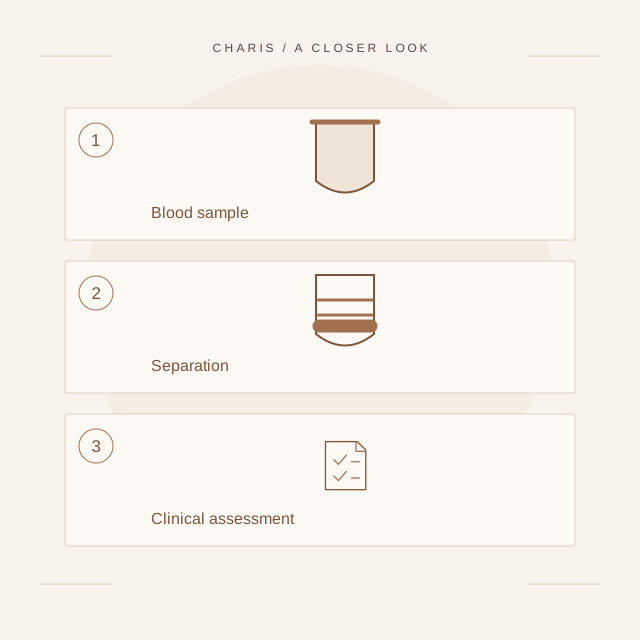
A closer look
From a blood sample to a clinical plan
Sample
PRP starts with a sample of your own blood.
Preparation
The sample is processed to separate a platelet-rich preparation.
Clinical use
Preparation and suitability depend on the procedure. Using your own blood does not make a treatment risk-free.
A process overview, not preparation instructions or a prediction of benefit.
Setting realistic expectations
Hair grows slowly. With almost any treatment, reduced shedding comes first and any change in density takes months. Judge results at around six months, not six weeks, and take photographs of the same parting in the same light before you start, because memory is a poor judge of gradual change.
Most options also need maintaining. Stopping a treatment that is holding hair loss back usually means the loss resumes. Factor the ongoing cost into your decision, not only the first course.
What a consultation covers
At Charis I look at the pattern of thinning, ask about your history and anything that might point to a medical cause, and talk through which options make sense, including ones I do not provide. If something needs investigating, I will send you to your GP first rather than start a course.
Sources and further reading
This page is general information, not personal medical advice. Every treatment needs an individual assessment, and what is right for someone else may not be right for you.
Treatments this relates to
- PRP for Hair Loss£200
Platelet-rich plasma injected into the scalp to support follicle health in early-stage thinning.
- Purasomes HSC50+ Hair & Scalp Complex£310
Purasomes HSC50+, an exosome-based scalp treatment for early thinning — the newer alternative to PRP, and the honest position on what the evidence currently supports.
Common questions
- What is the best treatment for thinning hair?
- It depends on the cause. Pattern hair loss, shedding after illness or childbirth, and hair loss from a deficiency are all managed differently. Find the cause first, then choose the option that fits it.
- Can thinning hair grow back?
- Often, if the follicles are still alive. Shedding after illness or stress usually recovers on its own, and pattern thinning can be slowed and sometimes partly reversed when treated early. Follicles that are completely gone do not regrow.
- Should I see my GP or a clinic first?
- Your GP, if the loss is sudden, patchy or comes with other symptoms. For gradual thinning that fits a family pattern, a consultation can help you compare options, and a good clinic will still refer you if anything needs investigating.
Read next
Regenerative & skin quality
Does PRP work for hair loss?
What platelet-rich plasma can and cannot do for thinning hair, who it suits, what the evidence actually shows, and the honest answer about how long it lasts.
Regenerative & skin quality
PRP or Purasomes for thinning hair?
Compare the questions to ask about PRP and Purasomes hair appointments, including assessment, evidence, course cost and follow-up before booking.
Request a consultation
Tell me what you have in mind
Leave us your name and number and I will give you a call to discuss and book you in for a consultation.
Get in touch
Book a consultation
Consultations are £30, and that comes off the cost of your treatment if you go ahead. No pressure to book anything on the day — if you are not sure whether you want treatment at all, that is still a good reason to come and talk.