Tear Trough Treatment in Rossendale
Treatment of the under-eye hollow — where correct assessment matters more than any product choice.

In short
Tear trough treatment addresses the hollow between the lower eyelid and cheek, and it is only the right answer when the problem is volume — skin quality, pigmentation and the shadow of the orbital rim all look similar and need different treatments.
- How long it lasts
- 9 to 18 months
- When you see it
- immediately, settled at 4 weeks — this area swells for longer
- Downtime
- bruising and swelling are common here and can last a week
- Does it hurt
- mild, but the most anxiety-provoking area for most people
- Sessions
- one, conservatively, reviewed at 4 weeks
The tear trough is the most technically demanding area in facial aesthetics and the one where poor treatment is hardest to undo. The skin is thin, the anatomy is unforgiving, and a hollow that looks like it needs filling is often being caused by something else entirely.
Why assessment comes first
Under-eye shadowing has several possible causes: true volume loss, thin skin, pigmentation, fat pad descent, the shadow cast by the orbital rim, or fluid retention. Each has a different answer, and filler is the right answer for only some of them.
Placing filler into an under-eye that is actually a skin-quality or fat-pad problem produces puffiness and a bluish cast that can persist for years. If that is what I find at assessment, I will tell you — and often the better treatment is polynucleotides, or nothing at all.
A closer look
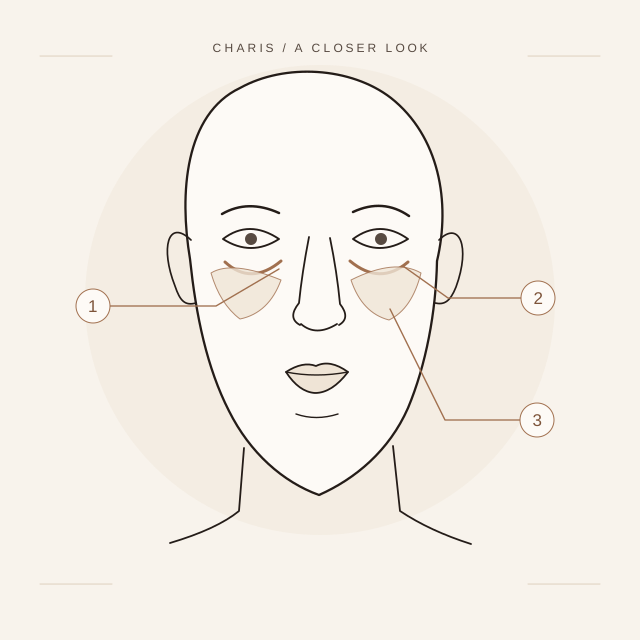
A shadow is not always a hollow
Contour
A hollow can create a shadow beneath the eye.
Skin and colour
Thin skin and pigmentation can also change the appearance.
Nearby tissue
Puffiness and cheek support need to be considered before choosing treatment.
Schematic landmarks only. This drawing cannot establish suitability for tear trough filler.
Anatomy and safety
This area sits close to significant vasculature, and vascular complications here carry real consequences. My advanced facial anatomy education at the Royal College of Surgeons was undertaken precisely so that areas like this are treated with the understanding they demand.
Hyaluronidase is held on site and I am trained in managing vascular occlusion. Anyone injecting this area who cannot say the same should not be injecting it.
What to expect
You will be given written aftercare before you leave, and a direct number to reach me on if anything concerns you afterwards. Reviews are offered at two weeks so we can assess the result together and adjust if needed.
What we use: Restylane®
Restylane is an established range of hyaluronic acid dermal fillers developed by Galderma, with 30 years of clinical experience and ongoing scientific research.
Different areas of the face require different levels of support, flexibility and movement. Restylane offers a range of formulations designed to address these individual requirements and preserve natural expression as much as possible.
Is Restylane animal-derived?
Restylane uses non-animal-derived, stabilised hyaluronic acid produced through bacterial fermentation.
Although this may be relevant to patients with specific ethical or religious considerations, non-animal-derived does not necessarily mean halal-certified. Patients seeking religious assurance should discuss their requirements during consultation.
Safety and suitability
Restylane is a medical device and, like all injectable treatments, carries risks. Common side effects include temporary swelling, bruising, redness and tenderness. Less commonly, serious complications including vascular occlusion, tissue damage and visual impairment can occur.
A thorough consultation, appropriate product selection and an individualised treatment plan are essential. Results and longevity vary depending on the product, treatment area and individual factors.
What the whole thing involves, start to finish
| Stage | What happens | When |
|---|---|---|
| Assessment | A full-face assessment, a discussion of what is actually needed, and the exact figure before anything is booked | Before treatment — same visit or a separate one |
| Treatment | Topical numbing, then placement. The product used contains its own anaesthetic | 30–45 minutes |
| Straight afterwards | Swelling, sometimes bruising, small firm areas at the injection points. You will look treated | 0–48 hours |
| Settling | Swelling drops noticeably and the actual shape starts to show | Day 3–7 |
| Review | Assessed together and adjusted if it needs it. This is where a small top-up happens if one is warranted | 2 weeks |
| The result | What you keep, and what should be judged rather than the day-two version | From 2 weeks |
| Repeat | Reassessed rather than automatically topped up — how much is left is the question, not how long it has been | 9–18 months depending on the area |
The row people skip is the review, and it is the one that separates a good result from a nearly-right one. Two weeks is the first point at which what you are looking at is product rather than swelling, and an adjustment made then is small, cheap and easy.
How the plan is decided
The face is assessed as a whole, not as the area you named
Almost nobody arrives asking about the right area. Somebody unhappy with their nasolabial folds usually needs midface support; somebody who wants a sharper jaw often needs the chin first. Treating the area named rather than the area responsible is the commonest reason a technically good result does not read as an improvement.
That is why the assessment covers the whole face even when you have come about one thing, and why the recommendation is sometimes for a different area than the one you booked to discuss.
How much, and why it is not decided in advance
Volumes are not published here on purpose. A minimum on a price list invites people to shop by quantity, which is the opposite of how the amount should be decided — what is appropriate depends on your anatomy, your starting point and what the face needs, and you are given the exact figure before anything is booked.
Starting conservatively is not caution for its own sake. Adding is straightforward at a review; removing means dissolving, a fortnight looking flatter than you started, and paying twice.
When the answer is no
There are faces where more volume is the wrong answer and saying so costs a booking. Significant skin laxity is the clearest case — adding weight to tissue that has already descended makes it heavier rather than tighter, and the honest conversation is about skin tightening or a surgical opinion.
Not suitable if
- Significant under-eye fat pad prolapse
- Marked fluid retention or morning puffiness
- Very thin or poor-quality under-eye skin — treat the skin first
- Anyone under 18
Sources and further reading
- NHS — Dermal fillers
- British Association of Dermatologists — patient information
- Joint Council for Cosmetic Practitioners
- Aesthetic Complications Expert Group
This page is general information, not personal medical advice. Every treatment needs an individual assessment, and what is right for someone else may not be right for you.
Results
Tear Trough Treatment — Ashleigh’s patients
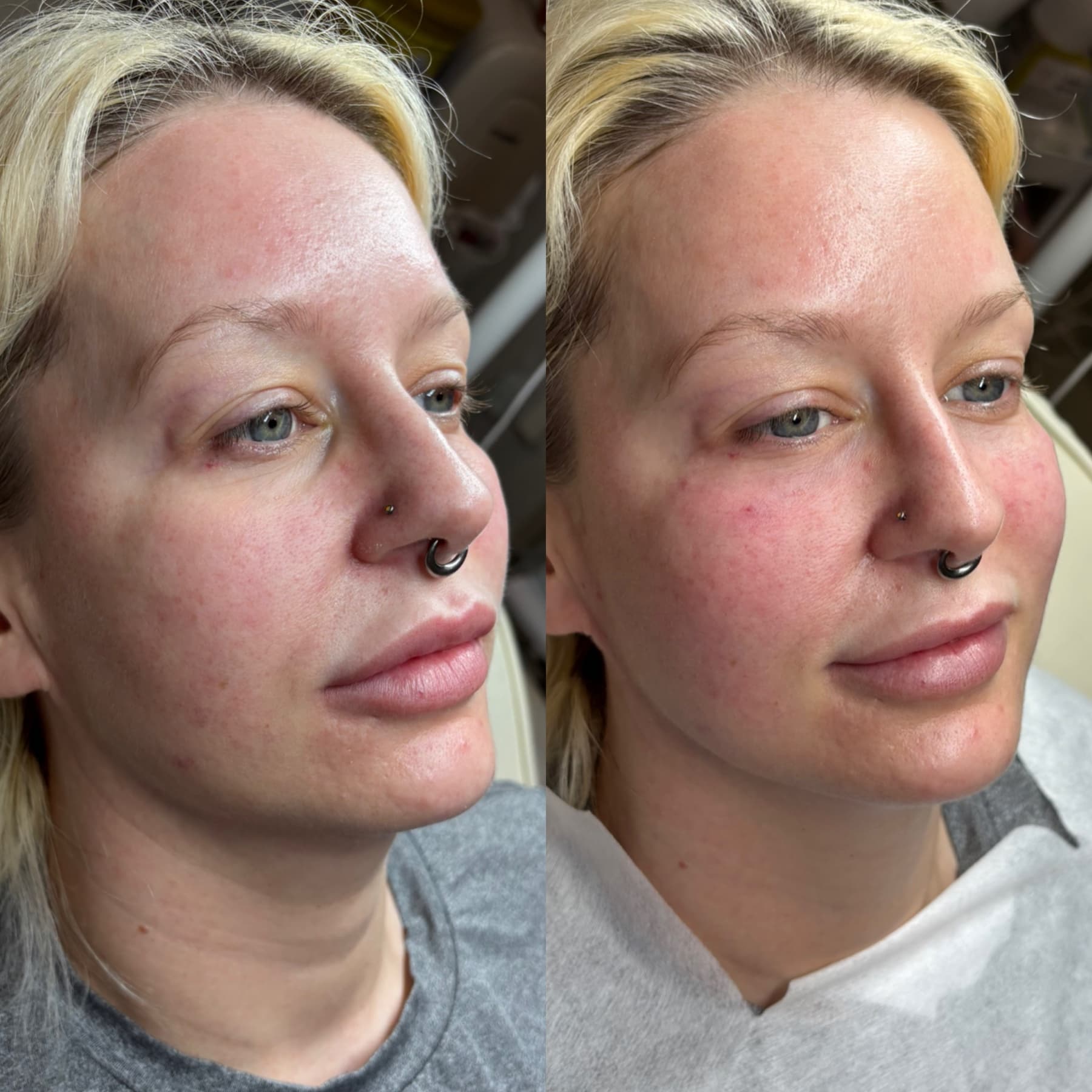
Individual results vary. Shared with patient consent.
Common questions
Tear Trough Treatment — what people ask
- Am I a suitable candidate?
- Many people are not, and I decline this treatment more often than any other. Good candidates have true volume loss, reasonable skin quality and no significant fat pad descent or fluid retention.
- What if I don't like it?
- Hyaluronic acid filler can be dissolved with hyaluronidase. That said, the aim is to assess properly so that dissolving is not needed.
- How long does it last?
- Often longer than other areas — 12 to 18 months is common — because the under-eye is relatively static.
- Is tear trough filler safe?
- It is the least forgiving area on the face and the one most often treated when it should not be. The skin is thin, the tissue holds fluid readily, and product placed badly stays visible for a long time. Done by someone who assesses whether filler is even the right answer — often it is not, and the cause is skin quality or shadow rather than volume — it is safe. Done reflexively because it was asked for, it is where most of the results people want dissolved come from.
- Can I have tear trough filler while pregnant or breastfeeding?
- No. Injectable treatment is not offered during pregnancy or while breastfeeding. That is a precaution rather than a finding of harm — the safety studies do not exist, because nobody runs trials on pregnant women for elective cosmetic treatment, and an unquantified risk is not one worth taking for something that can wait. Come back afterwards and you will be very welcome.
Travelling to Charis
The clinic is in Stacksteads, Bacup, with patients travelling in for tear trough treatment from Rawtenstall, Haslingden, Ramsbottom, Burnley, Rochdale, Bury, Accrington and across the Rossendale valley.
Areas we coverYou may also be looking at
Regenerative injectable treatment that works on skin quality — hydration, elasticity and firmness — rather than adding volume.
Full-face assessment and treatment planning — restoring support and balance across the face rather than treating features in isolation.
Removal of hyaluronic acid filler — for migration, overfilling, or a result that no longer suits you.
Get in touch
Book a consultation
Consultations are £30, and that comes off the cost of your treatment if you go ahead. No pressure to book anything on the day — if you are not sure whether you want treatment at all, that is still a good reason to come and talk.