
Filler migration: what it is and what to do
How to tell migration from swelling, why it happens, and why the right answer is almost always to dissolve and start again rather than to add more.
Migration is when filler ends up somewhere it was not placed. In lips it shows as a shelf or ridge of product sitting above the lip border, giving the shadow above the top lip that people describe as a moustache line. It is common, it is fixable, and the most important thing to know is that adding more filler is not the fix.
Migration or swelling?
Timing is one clue, not a test. Early swelling commonly improves over days to weeks, but the course varies and delayed swelling can occur. A persistent ridge may be migration, residual product or another problem. Appearance and timing alone cannot confirm the cause or rule out a complication.
Location is another clue. A ridge above the vermilion border is worth having assessed, especially if it persists, but swelling and other changes can also be uneven or localised. Bring earlier photographs and details of previous treatment if you have them.
A clinician may examine the tissue and, where appropriate, use ultrasound to help establish what is present. Do not repeatedly press or massage an area to diagnose it yourself. New vision changes, unusual pain or pale or mottled skin need urgent medical attention rather than a routine correction appointment.
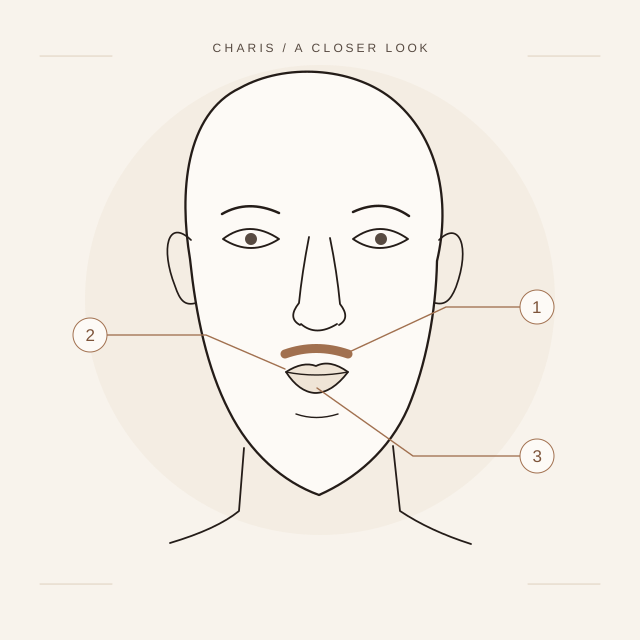
A closer look
Location and timing are clues, not a diagnosis
Skin above the lip
A persistent ridge can have several explanations and should be examined.
Lip border
Assessment checks where a change sits in relation to the lip’s original outline.
Visible lip
Swelling, existing filler and your own tissue all influence what you see.
The shaded region is illustrative. A photograph, a timeline or a home touch test cannot confirm migration.
Why it happens
Too much product for the tissue is the commonest reason. A lip can hold a certain volume; beyond that, the product has to go somewhere, and the path of least resistance is upward into the softer tissue above the border.
Too frequent treatment is the second. Topping up before the previous filler has substantially gone means each appointment adds to a lip that is already at capacity, and the cumulative volume — not the volume of any one session — is what pushes product out of place.
Placement is the third: product deposited too superficially, or too close to the border, has less to hold it. And a firm, highly cross-linked gel used in a lip is more likely to sit as a defined ridge when it does move, which is one reason I prefer softer gels here.
Massaging or pressing the lips in the first days can contribute, which is why the aftercare advice about not manipulating them is not arbitrary.
Why adding more makes it worse
The instinct when a lip looks unbalanced is to fill the part that looks deficient. In a migrated lip that is precisely wrong: the problem is that there is already too much product in the wrong place, and adding more increases the pressure that caused it.
It also disguises the problem temporarily. A larger lip makes a shelf above it less obvious for a while, so people top up, feel better for a month, and return with a worse version of the same thing. I see this pattern regularly and it is why the answer is so often to reset.
The other reason to stop adding is that migrated filler in the perioral area can be surprisingly long-lived. Hyaluronic acid in a low-movement site breaks down slowly, so waiting it out can mean waiting years rather than months.
Dissolving, and what it involves
Hyaluronidase is an enzyme that breaks down hyaluronic acid filler. Injected into the affected area it clears the migrated product, usually within twenty-four to forty-eight hours, and often in a single session — though stubborn or long-standing migration sometimes needs two.
It is a medical procedure and it has real risks. Allergic reaction is uncommon but possible, which is why an allergy assessment and, where appropriate, a patch test come first, and why it should only be performed by someone equipped to manage a reaction. It also does not discriminate: it will dissolve your own natural hyaluronic acid in the area alongside the filler, which is temporary but worth knowing.
The lips look deflated afterwards — sometimes more deflated than your true baseline — and that is normal. Your own hyaluronic acid replenishes over a couple of weeks. I would not re-treat for at least two weeks, and I would rather wait four so that what we are building on is genuinely your starting point.
Not repeating it
Once the lip has been reset, the things that prevent it happening again are all about restraint: smaller volumes, longer intervals, a softer product, and a practitioner who will tell you when to stop.
Leave at least six months between lip appointments as a default, and longer if there is still visible product. Let it go fully at least occasionally so you and I can see what your actual baseline is rather than guessing at it.
And be wary of any practitioner who agrees to top you up without examining what is already there. The most common route into migration is a series of individually reasonable decisions made by someone who never assessed the cumulative effect.
Migration, swelling or too much? How to tell
These three get confused constantly, and the difference decides whether you wait, come back, or dissolve.
Scroll the table sideways →
| Swelling | Overfilling | Migration | |
|---|---|---|---|
| When it appears | Immediately | Immediately, and stays | Months later, gradually |
| Where it sits | The treated area | The treated area | Outside it — above the lip border, into the philtrum |
| What it feels like | Soft, tender, warm | Firm, even, not tender | A distinct shelf or ridge with a defined edge |
| What it does over time | Resolves in 2 weeks | Unchanged until it breaks down | Slowly becomes more obvious |
| What to do | Wait | Review at two weeks; consider dissolving | Dissolve and replan — adding more makes it worse |
The bottom-right cell is the whole point of the page. Migration looks like a lip that has lost its border, the instinct is to add definition, and adding product to a border that has already been crossed is how a small problem becomes an obvious one.
Sources and further reading
- NHS — Dermal fillers
- Aesthetic Complications Expert Group
- Nursing & Midwifery Council — search the register
- British Association of Medical Aesthetic Nurses
This page is general information, not personal medical advice. Every treatment needs an individual assessment, and what is right for someone else may not be right for you.

About the author
Ashleigh Trickett
Registered Nurse & Aesthetic Practitioner
Registered Nurse with a BSc in Nursing and a PGCert in Critical Care (Manchester Metropolitan University, 2025). Ten years in the NHS, four of them in critical care. Advanced facial anatomy education at the Royal College of Surgeons with BAMAN, June 2026. Member of BAMAN and the Aesthetic Complications Expert Group. BAMAN Awards 2026 finalist for Rising Star of the Year.
Treatments this relates to
- Dermal Filler DissolvingFrom £200
Removal of hyaluronic acid filler — for migration, overfilling, or a result that no longer suits you.
- Signature Lips£220
Hyaluronic acid lip enhancement built around your existing anatomy — shape and balance before volume.
Common questions
- Does migrated filler go away on its own?
- Eventually, but slowly — filler in the low-movement tissue above the lip can persist far longer than filler in the lip body, sometimes for years. Dissolving is the practical answer for most people.
- Is dissolving painful?
- It stings more than filler injection does, and the lips are usually tender for a day afterwards. It is quick, and topical anaesthetic helps.
- Will my lips be ruined afterwards?
- No. They will look deflated for a couple of weeks while your own hyaluronic acid replenishes, and then they return to your natural lip. That temporary flatness is the part people find hardest, and it is genuinely temporary.
- Can I have filler again after dissolving?
- Yes — after at least two weeks, and I would generally prefer four. Starting again from a clean baseline with a smaller volume is usually how a much better result gets built.
- How do I know whether it is migration or just my anatomy?
- A shelf that was not there before you had filler is migration. If you are not sure, send me a profile photograph — it is one of the easier things to assess remotely, and it costs you nothing to ask.
Read next
Lips
How to get lip filler that looks natural
Natural is a proportion problem, not a volume problem. What actually makes lips read as done, and the specific things to ask for — and to refuse — at consultation.
Lips
Lip filler aftercare
What to do in the first forty-eight hours, what is normal in the first week, and the specific symptoms that mean you should contact me immediately rather than wait.
Choosing a practitioner
When filler has gone wrong
How to tell a bad result from normal settling, what can be corrected, and what to do next.
Lips
Lip filler swelling: what is normal
A day-by-day account of normal swelling, what reduces it, and the difference between swelling and something that needs a phone call.
Lips
How much lip filler do I need? What 0.5ml and 1ml actually look like
0.5ml is half of 1ml and is the right starting point for most first-time lips. What each amount changes, why more is rarely better, and how to tell what you actually need.
Facial harmonisation
Facial asymmetry: what can be treated, and what should be left alone
Every face is asymmetric, and most asymmetry should not be treated. The four causes, which respond to treatment and which do not, the one presentation that needs a doctor rather than an injector, and how much of the difference is realistically going to change.
Get in touch
Book a consultation
Consultations are £30, and that comes off the cost of your treatment if you go ahead. No pressure to book anything on the day — if you are not sure whether you want treatment at all, that is still a good reason to come and talk.