Facial asymmetry: what can be treated, and what should be left alone
Every face is asymmetric, and most asymmetry should not be treated. The four causes, which respond to treatment and which do not, the one presentation that needs a doctor rather than an injector, and how much of the difference is realistically going to change.
Nobody has a symmetrical face. Photograph yourself, mirror the left half onto itself and then the right, and you will produce two people who look related to you and not much like each other. That is normal, it is true of everyone reading this, and it is worth saying before anything else — because the most common thing that goes wrong with asymmetry is not the asymmetry. It is what people do to it once they have started looking.
Why every face is asymmetric
It starts in development
The two halves of your face grow from separate populations of cells, driven by the same genes acting independently on each side. Perfect symmetry would be the anomaly rather than the norm. Studies that set out to measure facial symmetry find measurable deviation in essentially every face examined, and the amount most people carry sits comfortably inside what anyone would call normal.
It is worth holding onto that, because the mirroring trick that makes asymmetry so visible is a distortion. Doubling one half of your face produces something no human being has ever looked like, then invites you to compare yourself to it.
And it increases with age, fairly predictably
Bone resorbs unevenly. Fat pads descend at different rates on each side. Decades of chewing on a preferred side, sleeping on a preferred side and expressing more strongly on one side all leave their mark on the tissue.
Someone who has always slept on their right side often has a flatter right cheek by fifty. That is not a defect that appeared — it is a difference that became visible. Which is also why a small correction earlier tends to work better than a large one later.
The practical point is that a small asymmetry is not evidence that something has gone wrong. It is evidence that you have a face.
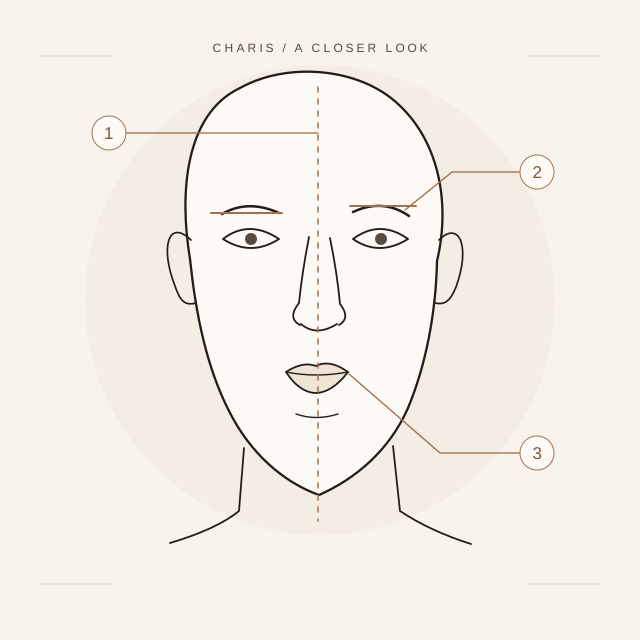
A closer look
The midline is a reference, not a target
Reference line
A central line can help describe differences without defining an ideal face.
Paired features
Small differences between the two sides are common.
Movement and history
Assessment considers how long a difference has been present and how the face moves.
Normal variation is illustrated, not a treatment result. Sudden facial droop can be a stroke symptom: call 999.
The four causes, and why the difference decides everything
Almost every disappointing outcome in this area comes from treating the wrong cause. The four behave completely differently, they are distinguishable in a five-minute assessment, and only two of them respond well to injectables.
Scroll the table sideways →
| Cause | How it presents | Responds to injectables? | What actually helps |
|---|---|---|---|
| Skeletal | A jaw sitting further forward on one side, an orbit fractionally higher, a chin point off the midline. Present at rest and unchanged by movement. | Partially — camouflage only | Filler to the shallower side softens how it reads. Nothing injectable moves bone. |
| Muscular | One brow lifting higher, a smile drawing up more on one side, one masseter bulkier. Appears or worsens on movement. | Yes — often the best result | Relaxing the stronger side. Small, reversible, and visible within weeks. |
| Soft tissue | A hollower temple, flatter cheek or emptier under-eye on one side. Gradual, and worse in unflattering light. | Yes | Asymmetric filler placement — deliberately more on one side than the other. |
| Dental or postural | A shifted bite, a missing tooth on one side, longstanding jaw or neck posture. | No | A dentist, or physiotherapy. Injecting around it treats the symptom and leaves the cause running. |
Why the distinction is not academic
A muscular asymmetry treated as though it were volume loss gets filler added to a side that did not need it, and the difference is preserved at a larger size. A skeletal asymmetry sold as fully correctable produces a patient who keeps returning for more product chasing a result that was never available.
Both are common. Both are assessment failures rather than product failures, and both are avoidable in the first appointment.
When asymmetry is a red flag and not a cosmetic question
This is the most important section on the page, and it applies to a small number of readers who need it urgently.
- SUDDEN facial droop, especially with arm weakness or slurred speech — call 999. That combination is the FAST test for stroke and it does not wait for an appointment.
- Asymmetry appearing over hours to days, usually one-sided, often with the eye on that side not closing fully — a GP or urgent care the SAME DAY. This is more likely a facial palsy such as Bell's palsy, treatment works considerably better started early, and an eye that cannot close is at real risk.
- Progressive asymmetry, or asymmetry with pain, numbness or a lump — a GP, before anything cosmetic.
The asymmetry this page is about is the kind you have had for years, that has crept up gradually with age, or that you noticed in a photograph and have not been able to stop seeing since.
Is my asymmetrical jaw treatable?
It depends entirely on which of the four causes is behind it, and that is a five-minute assessment rather than a guess from a photograph.
If it is muscle
One masseter being stronger and bulkier than the other is common, and it is the most satisfying version of this problem to treat. Relaxing the stronger side reduces its bulk over two to three months and the jaw reads more even from the front. The change is gradual and it holds better with repeat treatment.
If it is bone
Where the mandible itself sits differently, filler along the weaker side improves how the jawline reads and will not make the two sides match. That is worth hearing before you spend rather than after.
The mistake to avoid
Treating both sides equally because it feels fairer. Symmetrical dosing on an asymmetric jaw preserves the asymmetry at a larger size, and it is the most common way this treatment disappoints people.
What about uneven lips?
Extremely common, and usually a mixture of two things: a genuinely different vermilion shape on each side, and a muscular pull that lifts one corner more when you smile.
Telling the two apart takes ten seconds
Look at your lips at rest, then smiling. Uneven at rest and even when smiling is a shape problem, and shape responds to filler — deliberately more on one side than the other. Even at rest and uneven when smiling is muscular, and adding filler to it will not help.
The trap
Chasing the last few percent of evenness with more product. Tissue can only accommodate so much before it stops holding shape and starts holding pressure, and pressure is what pushes filler upward past the border — which is migration.
Every millilitre added in pursuit of perfect symmetry raises that risk, and the last few percent is the part nobody else can see anyway.
Asymmetrical eyes, brows and chin
Brows and eyes
This is where a small change reads largest, because the brows frame everything above the nose. A brow sitting lower on one side is often muscular — the depressors on that side pulling harder — and relaxing them selectively can lift it a few millimetres. A few millimetres is a great deal on a brow.
An under-eye looking hollower on one side is frequently not a volume difference at all, but a shadow cast by the orbital rim, or pigmentation. All three look identical in a bathroom mirror and need completely different treatments. This is the single most over-treated area in aesthetics and it is worth an assessment before it is worth a syringe.
Chin
Usually skeletal. Filler placed to the deficient side improves projection and can bring the chin point visually closer to centre, and it is often the treatment that changes a profile most for the least product. It will not straighten the bone, and a plan promising that is not one to buy.
How much of it will realistically change?
The question nobody answers, and the one worth asking before you book anything.
| Area | Realistic improvement | What it will not do |
|---|---|---|
| Jaw — muscular | Substantial. Often reads as resolved. | Change the bony line of the jaw. |
| Jaw — skeletal | Partial. Softens how it reads from the front. | Make the two sides match. |
| Lips — shape | Substantial, with careful asymmetric placement. | Correct a muscular pull on smiling. |
| Brow height | Substantial for a muscular difference. | Lift a brow that is low because of skeletal or eyelid anatomy. |
| Under-eye | Variable, and often the wrong treatment entirely. | Fix a shadow caused by the orbital rim or by pigmentation. |
| Chin position | Partial. Improves projection and centring. | Move the bone. |
A plan that does not tell you which row you are in is not a plan. If nobody has said out loud which part of what bothers you is treatable and which part is not, you have not had an assessment.
What an assessment actually involves
- Looking at you still and moving, from the front and in profile, and asking you to smile, raise your brows and clench — because a difference that only appears on movement is muscular and one present at rest usually is not.
- Asking how long it has been there. Longstanding and gradual points one way; recent points to the red flags above and changes the appointment entirely.
- Photographs in consistent lighting, which matter more here than anywhere else — a phone camera held close reliably invents asymmetry that is not there.
- A plan that is explicit about which part is treatable, which part is skeletal and is not, and roughly how much of the difference is going to change.
The honest limits, and when the answer is to do nothing
Correcting asymmetry is harder than adding volume, it takes more assessment, and it is the work where the gap between a careful injector and a fast one shows most clearly. It is also the work where the temptation to keep going is strongest, because there is always a little more that could be evened out.
The trap worth naming
Once someone starts photographing their own face looking for asymmetry, they will find it — and finding it makes it more visible to them and to nobody else. Several people a year would be better served by being told that what they are describing is within normal variation than by being sold a plan to fix it. That is a conversation rather than a treatment, and it is free.
And some asymmetry is worth keeping
Correcting it can cost you something you would miss. A smile that pulls slightly to one side is often the thing people who love you would name first if asked to describe your face.
Sources and further reading
- NHS — Stroke symptoms (act FAST)
- NHS — Bell's palsy
- NHS — Dermal fillers
- Nursing & Midwifery Council — search the register
This page is general information, not personal medical advice. Every treatment needs an individual assessment, and what is right for someone else may not be right for you.

About the author
Ashleigh Trickett
Registered Nurse & Aesthetic Practitioner
Registered Nurse with a BSc in Nursing and a PGCert in Critical Care (Manchester Metropolitan University, 2025). Ten years in the NHS, four of them in critical care. Advanced facial anatomy education at the Royal College of Surgeons with BAMAN, June 2026. Member of BAMAN and the Aesthetic Complications Expert Group. BAMAN Awards 2026 finalist for Rising Star of the Year.
Treatments this relates to
- Facial HarmonisationFrom £350
Full-face assessment and treatment planning — restoring support and balance across the face rather than treating features in isolation.
- Cheek FillerFrom £550
Midface support to restore structure that has descended — not to build cheeks that were never there.
- Chin FillerFrom £450
Projection and balance in the lower face — often the single most effective treatment for a profile.
- Jawline FillerFrom £450
Definition along the jaw, for softening from age-related bone loss or for a naturally less defined jawline.
- Signature LipsFrom £150
Hyaluronic acid lip enhancement built around your existing anatomy — shape and balance before volume.
Common questions
- Is facial asymmetry normal?
- Yes — universally. Every face measured is asymmetric to some degree, and the amount most people carry is well within normal variation. Asymmetry only becomes worth treating when it bothers you specifically, not because a mirrored photograph exaggerated it.
- Can filler fix an asymmetrical face?
- It can improve soft-tissue and volume asymmetry, and camouflage a small bony difference. It cannot move bone, so a skeletal asymmetry is softened rather than corrected. Which of those you have is the whole of the assessment.
- Why has my face suddenly become asymmetrical?
- Sudden asymmetry is not a cosmetic question. If a side droops, an arm is weak or speech is slurred, call 999 — that is the FAST test for stroke. Asymmetry appearing over hours or days, especially if the eye will not close, needs a GP the same day and may be a facial palsy. Neither is treated here.
- How much does treatment for facial asymmetry cost?
- It depends on the cause and the area, so the honest answer comes after an assessment rather than before. Consultations are £30, taken as a deposit and redeemed against your treatment if you go ahead. The full price list is published.
- Will treating one side make it look strange?
- Deliberately treating one side more than the other is usually the correct approach — dosing both sides equally preserves the difference at a larger size. It is the commonest reason asymmetry treatment disappoints people.
- Should I have both sides done for symmetry?
- Sometimes, but not by default. The aim is balance rather than a mirror image, and a face made perfectly even often reads as slightly wrong, because real faces are not. A good result usually leaves some asymmetry in place.
- Can asymmetry get worse with age?
- It generally does. Bone resorbs unevenly, fat pads descend at different rates, and habits like sleeping on one side accumulate. That is a change in visibility rather than a new problem, and it is one reason a small correction earlier often works better than a large one later.
- Does a mirrored photo show my real asymmetry?
- No, and it is the single most misleading thing people do to themselves. Mirroring one half produces a face that has never existed, and a phone camera held close adds lens distortion on top. Judge it in a mirror at conversational distance, or in a photograph taken from a few feet away.
Read next
Facial harmonisation
Is there such a thing as a non-surgical facelift?
What the phrase actually means, what it can and cannot do, and when the honest answer is a surgeon.
Lips
How much lip filler do I need? What 0.5ml and 1ml actually look like
0.5ml is half of 1ml and is the right starting point for most first-time lips. What each amount changes, why more is rarely better, and how to tell what you actually need.
Choosing a practitioner
How to choose a safe injector
The UK aesthetics industry is barely regulated. Here is exactly what to check, wherever you go.
Lips
Filler migration: what it is and what to do
How to tell migration from swelling, why it happens, and why the right answer is almost always to dissolve and start again rather than to add more.
Get in touch
Book a consultation
Consultations are £30, and that comes off the cost of your treatment if you go ahead. No pressure to book anything on the day — if you are not sure whether you want treatment at all, that is still a good reason to come and talk.