
How much lip filler do I need? What 0.5ml and 1ml actually look like
0.5ml is half of 1ml and is the right starting point for most first-time lips. What each amount changes, why more is rarely better, and how to tell what you actually need.
A millilitre is a fifth of a teaspoon. That is the entire quantity under discussion, and it is worth holding onto, because the difference between a result people compliment and a result people notice is very often half of it. Most first-time lips at this clinic have 0.5ml. This page is what each amount does, why the honest answer is usually less than you were expecting, and how to work out what is right for your mouth rather than for someone else's.
What 0.5ml actually looks like
0.5ml is the amount most people should start with, and it is far more visible than the number suggests. On lips that have thinned or have lost definition, half a millilitre placed well restores shape, sharpens the border and gives back the roll of the upper lip — without changing how big your mouth reads in your face.
It is enough to correct an asymmetry, define a cupid's bow that has flattened, or bring a top lip back into proportion with a bottom one. What it is not is a visible increase in size to a stranger, which is exactly what most first-time patients say they want when you ask them carefully.
The common worry — that 0.5ml will be a waste of money because nobody will see it — is almost always wrong. The people who cannot see it are the people who were not looking for it, which is the definition of a good result.
What 1ml adds, and when it is too much
1ml is a genuine increase in volume as well as shape. On a lip with reasonable existing tissue it is a noticeable change — the kind a friend comments on — and on a naturally full lip it can be the right answer in one appointment.
On thin lips it frequently is not, and this is the most important sentence on this page. Tissue can only accommodate so much before it stops holding shape and starts holding pressure, and pressure is what pushes product upward into the softer tissue above the border. That is migration, and it is not a rare complication of bad luck — it is the predictable result of putting more into a lip than the lip can hold.
So the honest answer to "can I have 1ml on thin lips" is: sometimes, over two appointments, and rarely in one. Building 0.5ml now and 0.5ml in eight weeks gives the same total with the tissue given time to accommodate it, and it costs the same money.
Why 2ml and above is almost never a first appointment
2ml in a lip is a large volume and it is where the results that read as obviously treated usually begin. It can be appropriate — for a lip that has been built gradually over years and has the tissue to carry it — but as a starting point it is the single most reliable way to end up dissolving and starting again.
If you have been offered 2ml at a first appointment, that is worth a second opinion. Not because the practitioner is necessarily wrong, but because the reasoning should be something you can hear and agree with rather than a number on a price list.
The same applies to any offer priced by the syringe rather than by the assessment. A syringe is a unit of stock. It is not a unit of what your face needs.
How the amount is decided
By looking at your lips in proportion to the rest of your face, in profile as well as straight on, and by asking what specifically bothers you. "My top lip disappears when I smile" is a brief that can be worked to. "1ml" is a request for a quantity before anyone has assessed anything.
The lower lip is usually somewhat fuller than the upper — around one to one and a half in height, though it varies with ethnicity and individual anatomy and should never be applied as a formula. Lips that read as treated have very often had that ratio inverted.
Projection matters as much as height, which is why a good assessment includes looking at you from the side. Volume added without projection is what produces the pushed-forward look people describe as duck lips, and it is a placement problem rather than a quantity one.
Why swelling makes the amount look wrong for a week
Lips swell more than anywhere else on the face and they swell unevenly. In the first forty-eight hours they can look considerably larger than the final result, which is why so many people conclude on day two that they have had too much.
The reverse mistake is more expensive. At day three the swelling starts to go, the lips look smaller than they did, and someone books more product to chase a result that was never there. That is how people end up with far more volume than they intended.
The true result is at two to four weeks. Anything decided before then is decided on incomplete information, which is why a review appointment at two weeks is part of the treatment rather than an optional extra.
The same logic, for other areas
Cheeks take more than lips because the tissue is deeper and less mobile — 1ml per side is a common starting point and 2ml per side is a substantial correction, not a first appointment. The cheek is assessed as part of the midface rather than in isolation, which is why it is priced that way.
Chin and jawline are the areas where a small amount changes a profile most. 1ml in a chin can alter the balance of a face more visibly than 2ml in a lip, and it is frequently the treatment someone actually needed when they came in asking about their lips.
Tear troughs take the least of anywhere and are the least forgiving. This is an area where the right answer is often not filler at all — skin quality, pigmentation and the shadow cast by the orbital rim all look similar in a mirror and need completely different treatments.
The volumes, side by side
Scroll the table sideways →
| Amount | What it does | Who it suits | Settled result |
|---|---|---|---|
| 0.5ml | Hydration, a little definition, a small correction | First-timers; anyone unsure; correcting minor asymmetry | Visible to you, rarely to anyone else |
| 1ml | A clear but natural change in shape and volume | Most people, most of the time | Noticeable, still reads as your own lips |
| 1.5ml | A definite change; needs good existing structure | Someone building on a previous result | Obvious that something has been done |
| 2ml+ | A substantial change in the lower third of the face | Almost never a first appointment | Reads as treated |
The reason this is worth reading before you book is that the number is easy to ask for and hard to take back. Under-treating costs you a second appointment; over-treating costs you a fortnight of swelling and, if you want it reversed, a dissolving appointment and two weeks looking flatter than you started.
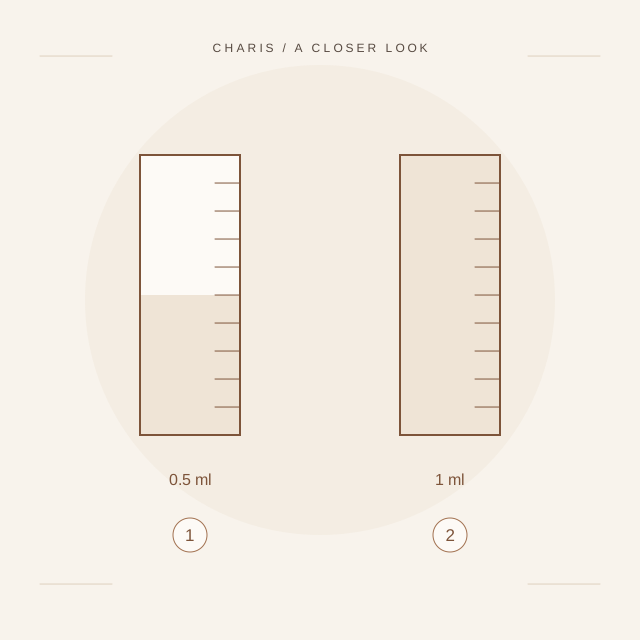
A closer look
Volume is a measurement, not a promised look
0.5 ml
Half the volume of 1 ml. The measurement does not specify where it should be placed.
1 ml
Twice 0.5 ml, but not a prediction of twice the visible change.
Individual assessment
Starting anatomy, previous filler and the treatment plan determine whether any volume is appropriate.
Relative liquid volumes, not life-size containers or dosing advice. No amount guarantees a particular appearance.
Sources and further reading
- NHS — Dermal fillers
- British Association of Dermatologists — patient information
- Nursing & Midwifery Council — search the register
- Aesthetic Complications Expert Group
This page is general information, not personal medical advice. Every treatment needs an individual assessment, and what is right for someone else may not be right for you.

About the author
Ashleigh Trickett
Registered Nurse & Aesthetic Practitioner
Registered Nurse with a BSc in Nursing and a PGCert in Critical Care (Manchester Metropolitan University, 2025). Ten years in the NHS, four of them in critical care. Advanced facial anatomy education at the Royal College of Surgeons with BAMAN, June 2026. Member of BAMAN and the Aesthetic Complications Expert Group. BAMAN Awards 2026 finalist for Rising Star of the Year.
Treatments this relates to
- Signature Lips£220
Hyaluronic acid lip enhancement built around your existing anatomy — shape and balance before volume.
- Cheek Filler£550
Midface support to restore structure that has descended — not to build cheeks that were never there.
- Chin Filler£280
Projection and balance in the lower face — often the single most effective treatment for a profile.
- Dermal Filler DissolvingFrom £200
Removal of hyaluronic acid filler — for migration, overfilling, or a result that no longer suits you.
Common questions
- Is 0.5ml of lip filler noticeable?
- To you, yes — clearly. To a stranger, usually not as filler; they see a mouth that looks balanced. That gap is the point. 0.5ml is enough to restore shape, definition and symmetry without changing how large your lips read in your face.
- How much is 0.5ml of lip filler?
- Signature Lips is £220, using Restylane®. It is priced as a treatment rather than by the syringe, so the assessment decides the amount rather than the price deciding it. A consultation is £30, taken as a deposit and redeemed against your treatment.
- Should I have 0.5ml or 1ml for my first lip filler?
- For most people, 0.5ml. It settles more predictably, it costs you nothing in flexibility because more can be added at the two-week review, and it means the decision to go further is made on a settled result rather than a guess. Starting at 1ml removes that choice.
- Can I have 1ml in thin lips?
- Usually over two appointments rather than one. Thin tissue can only accommodate so much before the product goes upward instead of outward, which is migration. Building the same total across eight weeks costs the same and holds its shape.
- How many ml of lip filler is too much?
- There is no universal number — it depends on the tissue you started with. The practical signs of too much are a lip that keeps the same shape whether you are talking, smiling or at rest, a shelf of product above the lip border, and a lost cupid's bow. Any of those is a reason to stop adding.
- Does 1ml of filler go further in cheeks than in lips?
- It behaves differently rather than going further. Cheek tissue is deeper and barely moves, so the same volume produces a subtler visible change but lasts far longer — twelve to eighteen months against six to twelve in a lip.
Read next
Lips
How to get lip filler that looks natural
Natural is a proportion problem, not a volume problem. What actually makes lips read as done, and the specific things to ask for — and to refuse — at consultation.
Lips
Filler migration: what it is and what to do
How to tell migration from swelling, why it happens, and why the right answer is almost always to dissolve and start again rather than to add more.
Lips
Lip filler swelling: what is normal
A day-by-day account of normal swelling, what reduces it, and the difference between swelling and something that needs a phone call.
Facial harmonisation
Facial asymmetry: what can be treated, and what should be left alone
Every face is asymmetric, and most asymmetry should not be treated. The four causes, which respond to treatment and which do not, the one presentation that needs a doctor rather than an injector, and how much of the difference is realistically going to change.
Get in touch
Book a consultation
Consultations are £30, and that comes off the cost of your treatment if you go ahead. No pressure to book anything on the day — if you are not sure whether you want treatment at all, that is still a good reason to come and talk.