
Marionette lines
The lines from the mouth corners toward the jaw — why they make a resting face look unhappy, and why the answer is structural.
Marionette lines run from the corners of the mouth down toward the jawline, named after the hinged mouth of a puppet. Of all the changes people bring to a consultation, these are the ones most often described in emotional terms — people say they look cross, or tired, or sad, when they feel perfectly fine. That is worth taking seriously, because it is the actual complaint.
Why they form
Three things combine. Bone support in the lower face and along the jaw resorbs, so the framework retreats. The fat compartments of the cheek descend, and the tissue that used to sit high on the face collects lower down, either side of the chin. And the ligaments that held everything in place slacken.
There is a muscular component too: the depressor anguli oris pulls the corners of the mouth downward, and as the tissue supporting those corners weakens, its pull becomes relatively stronger and more visible.
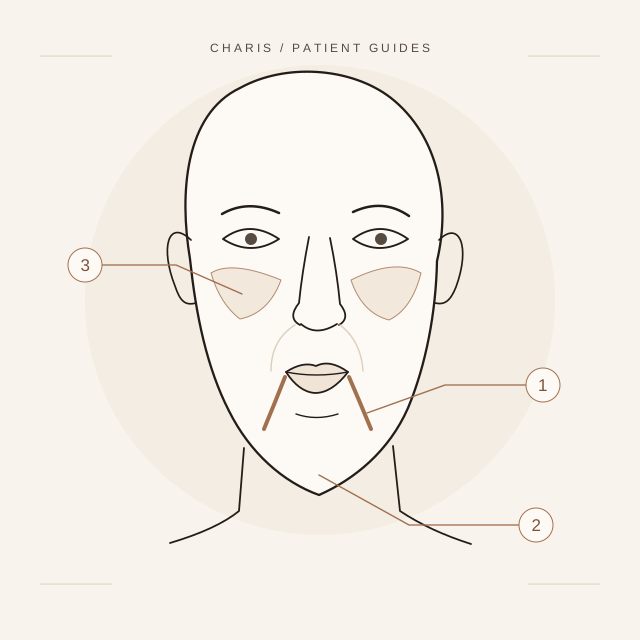
A closer look
Mouth-corner lines and their neighbours
Marionette lines
Run downward from the mouth corners. They are distinct from the folds beside the nose.
Chin and jaw
The surrounding framework contributes to the contour of the lower face.
Cheek and soft tissue
Age-related changes involve several layers. A single crease does not explain the whole face.
A map of neighbouring features, not a recommended treatment sequence.
Why they read as an expression
We are extremely good at reading mouth-corner position. A downward turn at the corners is one of the most reliable visual cues for sadness, and we read it automatically and unconsciously in other people's faces.
So a structural change that lowers the mouth corners by a few millimetres changes how strangers interpret your mood. That is why people report being asked if they are alright, and why treating this area often matters to people more than the size of the line would suggest.
How they are treated
Structurally, and usually not by filling the line. Restoring support along the jawline and at the chin rebuilds the framework the tissue slid off, and restoring midface support stops more tissue arriving from above.
With the structure rebuilt, small amounts of product can then support the mouth corners directly, lifting them a little and softening the line that runs from them.
Where the downward muscular pull is a major contributor, relaxing that muscle allows the corners to sit higher. It is a supporting move rather than the main event, and used alone it rarely achieves much.
The chin is often the answer
This surprises people. A chin that has lost projection shortens the lower third and lets everything above it crowd downward. Restoring chin projection frequently improves marionette lines more than treating the lines themselves would — and it improves the profile at the same time.
It is a good example of why I assess the whole face before treating a line. The thing that fixes your complaint is often somewhere you were not looking.
Skin quality and realistic expectations
Where the line is etched into the skin as well as being a structural fold, microneedling or skin boosters improve the etched component. Structure first, then skin.
Realistically: substantial softening and a mouth that no longer turns down at rest is achievable for most people. Complete erasure of a deep, long-standing line is not, and where skin laxity is advanced the honest answer may be that surgery would do more.
Why filling the line itself rarely works
Marionette lines run from the corner of the mouth downward, and the instinct — the clinic's as much as the patient's — is to fill the groove. It is usually the wrong move, for three reasons.
- The line is the bottom of a slope. Tissue has descended from the midface and gathered above it, and the crease is simply where the gathering stops. Filling the crease does nothing about the slope, so it flattens the shadow and leaves the heaviness.
- The area is highly mobile. Product placed superficially in a crease that folds thousands of times a day tends to become visible as a ridge, particularly while you talk.
- Adding volume low in a face that is already heavy low makes it heavier. The result reads as fuller rather than fresher, which is the opposite of the brief.
Support above and to the sides — restoring midface volume, rebuilding the jawline and chin — takes tension off the corner of the mouth and softens the line as a consequence. It is the less intuitive approach and the one that ages well.
Which order to do things in
| Step | What it addresses | Why it comes here |
|---|---|---|
| 1. Midface support | The descended volume causing the fold | Everything below it is judged differently once this is done |
| 2. Jawline and chin structure | The lost shelf the corner of the mouth sits on | Defines the frame the line runs into |
| 3. Reassess | What is genuinely left | Usually less than expected — which often saves you the next step |
| 4. A small amount in the line, if still needed | The residual crease | Now a finishing touch rather than the whole plan |
| 5. Skin quality | The etched component volume cannot reach | Runs alongside the rest, over months |
The step people want to skip to is the fourth, and doing it first is the commonest reason marionette treatment disappoints at considerable expense.
What no injectable will fix
Two things sit outside what this category can do, and being told so is worth more than being sold a plan.
Significant skin laxity — where the skin has genuinely lost elasticity rather than lost its support — cannot be corrected with volume, and adding volume to it makes it heavier. The pinch test is the quick version: skin that springs back has elasticity left to work with, skin that stays where you put it does not.
And a downturned mouth corner caused by strong muscular pull downward is a movement problem rather than a volume one. It is worth identifying, because volume placed against an active downward pull is money spent fighting a muscle.
Sources and further reading
This page is general information, not personal medical advice. Every treatment needs an individual assessment, and what is right for someone else may not be right for you.

About the author
Ashleigh Trickett
Registered Nurse & Aesthetic Practitioner
Registered Nurse with a BSc in Nursing and a PGCert in Critical Care (Manchester Metropolitan University, 2025). Ten years in the NHS, four of them in critical care. Advanced facial anatomy education at the Royal College of Surgeons with BAMAN, June 2026. Member of BAMAN and the Aesthetic Complications Expert Group. BAMAN Awards 2026 finalist for Rising Star of the Year.
Treatments this relates to
- Facial HarmonisationFrom £220
Full-face assessment and treatment planning — restoring support and balance across the face rather than treating features in isolation.
- Chin Filler£280
Projection and balance in the lower face — often the single most effective treatment for a profile.
- Jawline Filler£600
Definition along the jaw, for softening from age-related bone loss or for a naturally less defined jawline.
- Lines & Wrinkles ConsultationOn consultation
A consultation for the treatment of lines and wrinkles — assessment first, with the options and what they can realistically achieve discussed before anything is decided.
Common questions
- Will treating marionette lines make me look happier?
- It can genuinely change how your face reads at rest, because mouth-corner position is one of the strongest cues we use to read mood. Most people describe the result as looking less tired rather than looking different.
- Can filler be placed straight into the line?
- In small amounts, after structural support has been restored. Placed into the line first, it tends to make the lower face heavier without solving the cause.
- How long does it last?
- Structural work in the chin and jaw commonly lasts 12 to 18 months. Muscle relaxation, where used, lasts three to four months.
- Is chin treatment really relevant to lines by my mouth?
- Frequently, yes. A chin that has lost projection allows the lower face to crowd downward. Restoring it often improves the lines more than treating them directly.
- What if my skin is quite lax?
- Then filler along the jaw can make things heavier rather than better, and I will tell you that. Where laxity is the dominant problem, a surgical opinion is the honest recommendation.
Read next
Facial harmonisation
Nasolabial folds
The folds beside the nose are usually a midface problem. Treating them directly is why some faces end up looking heavy.
Facial harmonisation
Treating jowls without surgery
Why jowls form, which stage responds to treatment, and the point at which filler makes them worse.
Facial harmonisation
Is there such a thing as a non-surgical facelift?
What the phrase actually means, what it can and cannot do, and when the honest answer is a surgeon.
Anti-wrinkle
Lines around the mouth
Vertical lip lines — usually nothing to do with smoking, rarely fixed by one treatment, and one of the hardest areas to treat well.
Facial harmonisation
Treating a double chin
Fat, skin laxity or a recessed chin — three different causes with three different answers, and treating the wrong one makes it worse.
Facial harmonisation
Hollow cheeks: why they happen, and what actually fills them
Cheeks lose fat before the rest of the face does. What causes hollowing, which treatments genuinely restore it, and the one mistake that makes a hollow face look heavier rather than fuller.
Get in touch
Book a consultation
Consultations are £30, and that comes off the cost of your treatment if you go ahead. No pressure to book anything on the day — if you are not sure whether you want treatment at all, that is still a good reason to come and talk.