Is there such a thing as a non-surgical facelift?
What the phrase actually means, what it can and cannot do, and when the honest answer is a surgeon.
“Non-surgical facelift” is a marketing phrase rather than a procedure, and it is worth unpacking before you spend money against it. There is no injectable that lifts skin the way surgery does. What there is — and it is genuinely useful — is a way of restoring support that has been lost, so tissue sits closer to where it used to.
What is actually being sold
Usually a full-face plan: structural filler restoring midface, chin and jawline support, anti-wrinkle treatment where movement is contributing, and skin-quality treatment underneath all of it. Done well, that reads as looking rested and better supported.
It is a real result and for many people it is enough. What it is not is a lift. Nothing is cut, nothing is repositioned surgically, and no skin is removed.
Where the line is
The deciding factor is skin laxity. Where underlying support has been lost but the skin still has reasonable elasticity, restoring that support does a great deal. Where the skin itself has become genuinely lax and is hanging, filling underneath makes the face heavier rather than lifted — and heavier is the look most people are trying to avoid.
I will tell you which of those you are. If the honest answer is that a surgical consultation would serve you better, I will say so. That costs me the booking and it is still the right answer.
A realistic plan
Assessment of the whole face, in thirds. A staged plan — usually structure first, skin quality alongside it — delivered over months rather than in one appointment, with a review at each stage before moving on.
Staging matters more here than anywhere else: a full-face plan delivered in a single sitting is how people end up looking changed rather than rested.
The five things sold under the phrase, compared
The phrase covers at least five unrelated treatments, and clinics rarely say which they mean. They address different problems, they are not substitutes for one another, and only one of them lifts anything.
| What is offered | What it actually addresses | What it cannot do |
|---|---|---|
| Structural filler | Lost volume and bone support — restores the scaffold | Tighten loose skin |
| Thread lifts | Modest repositioning of soft tissue | Replace lost volume; results are shorter-lived than marketed |
| Energy-based tightening | Mild to moderate skin laxity, by heating the dermis | Move descended tissue, or replace volume |
| Regenerative injectables | Skin quality — firmness, hydration, texture | Change facial shape or lift anything |
| A surgical facelift | Repositioning tissue and removing excess skin | — it is the only thing on this list that genuinely lifts |
A well-planned combination of the first four can produce a face that reads as fresher and better supported. What none of them does is what a facelift does, and a clinic implying otherwise is describing a different procedure from the one you will receive.
Which of the three problems do you actually have?
If the problem is deflation
Cheeks that have flattened, temples that have hollowed, a jawline that has lost its edge — this is the group non-surgical treatment serves genuinely well, because the tissue has not gone anywhere, the support beneath it has. Rebuild the support and the face lifts as a consequence.
If the problem is descent
Tissue that has moved downward and gathered — heavy jowls, deep folds with loose skin above them. Non-surgical treatment can soften how this reads and cannot reverse it. Realistic expectations here are the difference between a good outcome and a disappointing one at the same price.
If the problem is laxity
Skin that has genuinely lost elasticity. This is where injectables stop helping and can make things worse by adding weight. Energy-based treatment does something; surgery does considerably more; and being told which category you are in is the most valuable part of a consultation.
A closer look
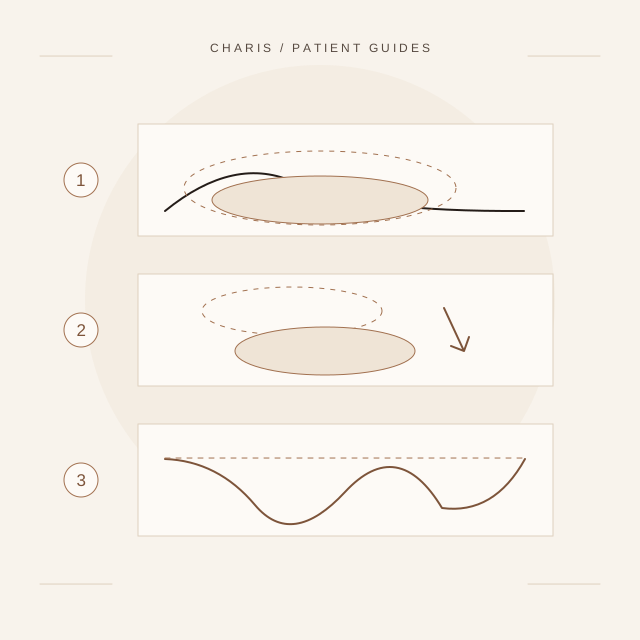
Three changes, assessed separately
Deflation
A reduction in volume changes the support beneath the skin.
Descent
Soft tissue changes position. Adding volume does not surgically reposition it.
Laxity
The skin becomes looser. Injectables cannot remove excess skin.
Conceptual diagrams, not measured anatomy. These changes often coexist and need individual assessment.
Sources and further reading
This page is general information, not personal medical advice. Every treatment needs an individual assessment, and what is right for someone else may not be right for you.

About the author
Ashleigh Trickett
Registered Nurse & Aesthetic Practitioner
Registered Nurse with a BSc in Nursing and a PGCert in Critical Care (Manchester Metropolitan University, 2025). Ten years in the NHS, four of them in critical care. Advanced facial anatomy education at the Royal College of Surgeons with BAMAN, June 2026. Member of BAMAN and the Aesthetic Complications Expert Group. BAMAN Awards 2026 finalist for Rising Star of the Year.
Treatments this relates to
- Facial HarmonisationFrom £220
Full-face assessment and treatment planning — restoring support and balance across the face rather than treating features in isolation.
- Cheek Filler£550
Midface support to restore structure that has descended — not to build cheeks that were never there.
- Jawline Filler£600
Definition along the jaw, for softening from age-related bone loss or for a naturally less defined jawline.
- Skin BoostersFrom £200
The category explained — what a skin booster is, how the options differ, and how to work out which one you actually need.
Common questions
- How long does a non-surgical facelift last?
- The structural component typically 12 to 18 months, with skin-quality treatment on its own maintenance cycle. It is an ongoing plan rather than a one-off.
- Is it cheaper than surgery?
- Per appointment, yes. Across five or ten years of maintenance the gap narrows considerably, and it is worth doing that arithmetic honestly before you start.
- Will it get rid of loose skin?
- No. That is the one thing this approach cannot do, and it is the point at which a surgical opinion is the right answer.
Read next
Facial harmonisation
Treating jowls without surgery
Why jowls form, which stage responds to treatment, and the point at which filler makes them worse.
Facial harmonisation
Nasolabial folds
The folds beside the nose are usually a midface problem. Treating them directly is why some faces end up looking heavy.
Regenerative & skin quality
Skin booster or filler — which do you need?
One changes the quality of the skin, the other changes the shape of the face. They are not alternatives, and picking the wrong one is the most common reason a treatment disappoints.
Facial harmonisation
Marionette lines
The lines from the mouth corners toward the jaw — why they make a resting face look unhappy, and why the answer is structural.
Facial harmonisation
Treating a double chin
Fat, skin laxity or a recessed chin — three different causes with three different answers, and treating the wrong one makes it worse.
Facial harmonisation
Facial asymmetry: what can be treated, and what should be left alone
Every face is asymmetric, and most asymmetry should not be treated. The four causes, which respond to treatment and which do not, the one presentation that needs a doctor rather than an injector, and how much of the difference is realistically going to change.
Get in touch
Book a consultation
Consultations are £30, and that comes off the cost of your treatment if you go ahead. No pressure to book anything on the day — if you are not sure whether you want treatment at all, that is still a good reason to come and talk.