Hollow cheeks: why they happen, and what actually fills them
Cheeks lose fat before the rest of the face does. What causes hollowing, which treatments genuinely restore it, and the one mistake that makes a hollow face look heavier rather than fuller.
Hollow cheeks are a volume problem, not a skin problem, and that distinction decides everything that follows. The cheek sits on a set of fat compartments layered over bone; when those compartments shrink or descend, light stops catching the front of the face and starts pooling under the cheekbone. Skin treatments cannot reach that, and nor can anything applied to the surface — what changes it is restoring the support underneath.
Why cheeks hollow, and which cause is yours
Four things produce the same shadow, and they respond very differently. Working out which is dominant is most of what an assessment is for.
| Cause | How to tell | What restores it |
|---|---|---|
| Rapid or significant weight loss | The hollowing arrived over months, alongside weight coming off elsewhere | Structural filler to replace the lost support; often the most rewarding group to treat |
| Age-related fat pad loss | Gradual over years, usually with flattening across the midface | The same, staged over more than one appointment |
| Bone change | The whole midface reads as less projected, not just softer | Deep placement on bone, which is a different plane and a different product |
| Naturally low fat in that compartment | Present since your twenties; parents look similar | Nothing needs fixing — this is face shape, and it photographs well |
The last row is not a throwaway. A naturally sculpted face is not a deflated one, and filling it because a photograph caught it badly is the commonest way to lose the thing people liked about their own bone structure.
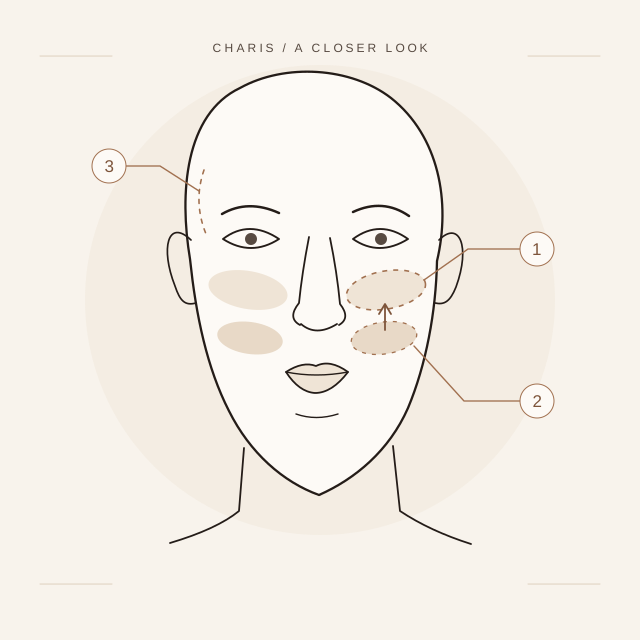
A closer look
The shadow and the support are in different places
Where the support sits
On and above the cheekbone, deep to the tissue. This is the area that holds the front of the face forward.
Where the shadow is
Below the cheekbone. It is where the hollow is seen, which is not the same as where the volume was lost.
The temple
A hollow above the cheekbone is easy to overlook and is often part of what makes a face read gaunt.
Schematic surface landmarks, drawn to separate where a hollow is seen from where support is lost. No injection sites, depths or amounts are shown.
If this followed weight loss
The face very often goes first. Facial fat compartments are metabolically active and comparatively small, so they respond to a calorie deficit sooner and more visibly than the areas most people were actually trying to change. Losing weight steadily and being pleased about it while disliking your own face in photographs is an extremely common combination, and it is not vanity — the change is real and it happened faster than anywhere else.
What the face actually lost
Volume, mostly, and support with it. As the deep fat pads under the cheek reduce, the tissue above them has less to sit on, so it settles downward. That is why weight loss can deepen a nasolabial fold and soften a jawline at the same time as hollowing a cheek: one loss, three visible consequences.
Skin elasticity is the second half. Skin that has been stretched and then emptied does not always retract, and how much it does is largely down to age, genetics and how quickly the weight came off. That part is not a volume problem and filler does not address it.
Whether to wait
If the weight is still moving, it is usually worth waiting until it is stable — roughly three to six months at a steady weight. Filler placed into a face that is still changing is filler placed against a moving target, and the plan you would make today is not the one you would make at the end.
The exception is someone significantly distressed by the change, where treating the midface conservatively and reviewing as things settle is reasonable. That is a conversation, not a rule.
What nobody should promise you
That you will look exactly as you did before. Some of what changed is skin quality and skin laxity, and no injectable reverses those. What a well-planned course of structural support does is restore the scaffold, which lifts the shadow and returns the shape — and for most people that is the part they actually missed.
What restores the volume, and what cannot
| Treatment | What it does here | Realistic contribution |
|---|---|---|
| Structural filler, midface | Replaces support on and above the bone so the cheek sits forward again | The bulk of the result |
| Filler at the temple | Softens the hollow above the cheekbone that makes a face read gaunt | Significant where the temple is involved, and it often is |
| Regenerative injectables | Improves the quality and firmness of the skin over the restored shape | Real, but it is the finish rather than the fix |
| Skin boosters and bio-remodelling | Hydration and firmness across the area | Complementary; changes no shape |
| Skin tightening | Addresses laxity where skin has not retracted | The right answer for a different problem |
| Filler into the hollow itself, superficially | Fills the shadow directly | Usually the wrong move — see below |
What a sensible plan looks like
This is a volume rebuild rather than a single appointment, and staging it is what keeps it looking like your face.
- Assessment on a stable weight, in daylight, looking at the whole face rather than the cheek you came about.
- Midface support first. Almost everything else — the fold, the jawline, the tired look under the eye — is judged differently once this is done, and a good deal of it needs less than you expected.
- Review at two weeks, then decide what is genuinely left. This is where people are surprised by how little remains outstanding.
- Temple, tear trough or jawline only if the reassessment still calls for them.
- Skin quality alongside, over months, because the restored shape sits under skin that also changed.
Doing it in one sitting is possible and is how faces end up looking treated. The staging is not caution for its own sake; it is what lets each step be judged before the next is bought.
Sources and further reading
- NHS — Dermal fillers
- NHS — Losing weight
- British Association of Dermatologists — patient information
- Aesthetic Complications Expert Group
This page is general information, not personal medical advice. Every treatment needs an individual assessment, and what is right for someone else may not be right for you.

About the author
Ashleigh Trickett
Registered Nurse & Aesthetic Practitioner
Registered Nurse with a BSc in Nursing and a PGCert in Critical Care (Manchester Metropolitan University, 2025). Ten years in the NHS, four of them in critical care. Advanced facial anatomy education at the Royal College of Surgeons with BAMAN, June 2026. Member of BAMAN and the Aesthetic Complications Expert Group. BAMAN Awards 2026 finalist for Rising Star of the Year.
Treatments this relates to
- Cheek Filler£550
Midface support to restore structure that has descended — not to build cheeks that were never there.
- Facial HarmonisationFrom £220
Full-face assessment and treatment planning — restoring support and balance across the face rather than treating features in isolation.
- PolynucleotidesFrom £195
Regenerative injectable treatment that works on skin quality — hydration, elasticity and firmness — rather than adding volume.
- Skin BoostersFrom £200
The category explained — what a skin booster is, how the options differ, and how to work out which one you actually need.
Common questions
- Will filler fix my face after weight loss?
- It restores the volume and the support that were lost, which is usually most of what changed. What it does not do is tighten skin that has lost elasticity — that is a separate problem needing a different treatment, and an honest assessment will tell you how much of each you are dealing with.
- How long should I wait after losing weight?
- Ideally until your weight has been stable for around three to six months. Treating a face that is still changing means planning against a moving target, and the plan would be different by the end of it.
- How much filler do hollow cheeks need?
- It depends on how much support has gone and on your own anatomy, and you are given the exact figure at assessment before anything is booked. It is usually staged over more than one appointment rather than done all at once — adding at a review is straightforward, and removing is not.
- Will it make my face look fat?
- Not when the support is placed where the structure was lost. Faces look heavy when volume is added low and superficially into the hollow itself rather than rebuilt higher and deeper, which is why the placement matters more than the amount.
- Are hollow cheeks always a problem?
- No. Plenty of people have naturally low fat in that compartment, have had it since their twenties, and it is simply their face shape. If it has always looked that way and nothing has changed, there is nothing to correct.
Read next
Facial harmonisation
Nasolabial folds
The folds beside the nose are usually a midface problem. Treating them directly is why some faces end up looking heavy.
Facial harmonisation
Treating jowls without surgery
Why jowls form, which stage responds to treatment, and the point at which filler makes them worse.
Facial harmonisation
Is there such a thing as a non-surgical facelift?
What the phrase actually means, what it can and cannot do, and when the honest answer is a surgeon.
Regenerative & skin quality
Skin booster or filler — which do you need?
One changes the quality of the skin, the other changes the shape of the face. They are not alternatives, and picking the wrong one is the most common reason a treatment disappoints.
Facial harmonisation
Marionette lines
The lines from the mouth corners toward the jaw — why they make a resting face look unhappy, and why the answer is structural.
Get in touch
Book a consultation
Consultations are £30, and that comes off the cost of your treatment if you go ahead. No pressure to book anything on the day — if you are not sure whether you want treatment at all, that is still a good reason to come and talk.