
Treating jowls without surgery
Why jowls form, which stage responds to treatment, and the point at which filler makes them worse.
Jowls are the softening along the jawline where tissue that used to sit over the cheek slides forward and down. They are one of the changes people find most ageing, and one of the most commonly mistreated — because the instinct is to fill them, and filling them is usually wrong.
Why they form
Three things happen at once. The jaw bone resorbs, so the shelf the tissue sat on retreats. The ligaments holding the cheek fat in place slacken, letting it slide forward. And the skin loses elasticity, so it no longer holds the shape.
The jowl is the end result, some distance from where the change started. Treating it directly is treating the symptom.
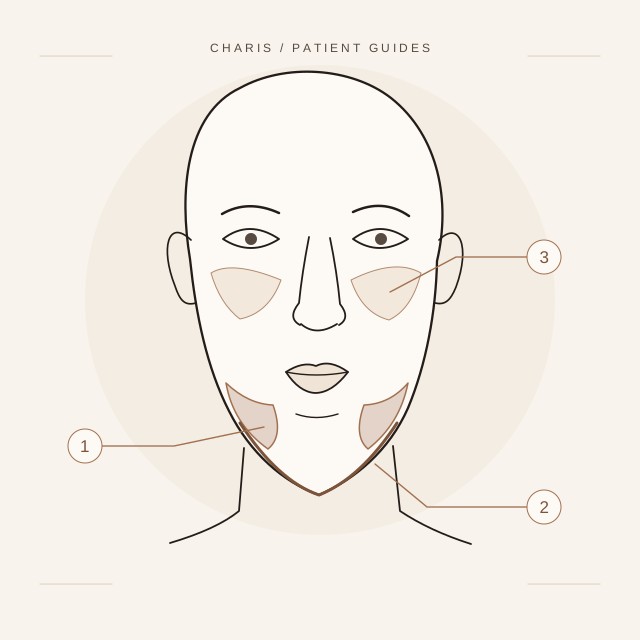
A closer look
The jawline is part of a larger structure
Jowl region
Soft tissue can gather beside the chin and interrupt the jawline.
Jaw framework
Bone remodelling contributes to changes in lower-face support.
Soft tissue above
Fat compartments, supporting tissues and skin also change. Their contribution differs between people.
Simplified anatomy. A diagram or home pinch test cannot determine which treatment is suitable.
What works, and when
Early jowling with good skin quality responds well: restoring midface support so the tissue is held higher, and rebuilding the jaw angle behind the jowl so there is a defined line again. Frequently the jowl softens without being touched at all.
Established jowling with significant skin laxity does not respond, and adding product makes the lower face heavier. That is the point where a surgical opinion is honest advice rather than a brush-off.
The role of skin quality
Where laxity is early, treatment that genuinely improves skin density — polynucleotides, bio-remodelling, microneedling — does more for a jawline than most people expect, and it is a better first step than filler in a borderline case.
The four causes, and what each one responds to
Jowls are the end result of four separate processes, and treatment only works when it is aimed at the one that is dominant for you. This is why two people with apparently identical jowls need completely different plans.
Scroll the table sideways →
| Cause | How to spot it | What helps | What will not |
|---|---|---|---|
| Midface volume loss | Flat or hollow cheeks; the jowl is tissue that descended from above | Structural filler restoring midface support | Filling the jowl itself |
| Bone resorption | The jaw and chin have lost definition and projection with age | Filler along the mandible and chin to rebuild the shelf | Skin treatments of any kind |
| Skin laxity | Skin that no longer springs back when pinched | Energy-based tightening, or surgery for significant laxity | Filler — it adds weight to something already descending |
| Platysmal pull | Visible vertical bands in the neck pulling downward | Relaxing the bands to release the downward pull | Volume in the jowl |
When the honest answer is surgery
There is a point past which non-surgical treatment stops being good value, and someone should tell you where it is. Significant skin laxity — where the skin has genuinely lost its elasticity rather than simply lost the support beneath it — is not correctable with injectables, and a plan that promises otherwise is spending your money to postpone the same conversation.
The useful test is the pinch: if the skin springs back, there is still elasticity to work with and structural support may do a great deal. If it stays where you put it, you are looking at laxity, and a consultation with a surgeon is a more honest use of an afternoon than a syringe.
Saying that costs a booking and it is the right answer, which is roughly the whole argument for choosing a practitioner who will say it.
Sources and further reading
This page is general information, not personal medical advice. Every treatment needs an individual assessment, and what is right for someone else may not be right for you.

About the author
Ashleigh Trickett
Registered Nurse & Aesthetic Practitioner
Registered Nurse with a BSc in Nursing and a PGCert in Critical Care (Manchester Metropolitan University, 2025). Ten years in the NHS, four of them in critical care. Advanced facial anatomy education at the Royal College of Surgeons with BAMAN, June 2026. Member of BAMAN and the Aesthetic Complications Expert Group. BAMAN Awards 2026 finalist for Rising Star of the Year.
Treatments this relates to
- Facial HarmonisationFrom £220
Full-face assessment and treatment planning — restoring support and balance across the face rather than treating features in isolation.
- Jawline Filler£600
Definition along the jaw, for softening from age-related bone loss or for a naturally less defined jawline.
- Cheek Filler£550
Midface support to restore structure that has descended — not to build cheeks that were never there.
- PolynucleotidesFrom £195
Regenerative injectable treatment that works on skin quality — hydration, elasticity and firmness — rather than adding volume.
Common questions
- Can filler get rid of jowls?
- It can improve early jowling by restoring the structure behind and above it. It cannot remove established jowls, and used in that situation it makes the lower face heavier.
- Will anti-wrinkle treatment help?
- Only marginally, and only where the muscle pulling the jawline down is a significant contributor. It is a supporting move, not the main answer.
- How do I know which stage I am at?
- Lift the skin of your cheek gently upward and outward in a mirror. If that resolves what bothers you, support is the issue and treatment can help. If the skin still looks lax when repositioned, laxity is the problem.
Read next
Facial harmonisation
Is there such a thing as a non-surgical facelift?
What the phrase actually means, what it can and cannot do, and when the honest answer is a surgeon.
Facial harmonisation
Marionette lines
The lines from the mouth corners toward the jaw — why they make a resting face look unhappy, and why the answer is structural.
Regenerative & skin quality
Skin booster or filler — which do you need?
One changes the quality of the skin, the other changes the shape of the face. They are not alternatives, and picking the wrong one is the most common reason a treatment disappoints.
Facial harmonisation
Nasolabial folds
The folds beside the nose are usually a midface problem. Treating them directly is why some faces end up looking heavy.
Facial harmonisation
Treating a double chin
Fat, skin laxity or a recessed chin — three different causes with three different answers, and treating the wrong one makes it worse.
Facial harmonisation
Hollow cheeks: why they happen, and what actually fills them
Cheeks lose fat before the rest of the face does. What causes hollowing, which treatments genuinely restore it, and the one mistake that makes a hollow face look heavier rather than fuller.
Get in touch
Book a consultation
Consultations are £30, and that comes off the cost of your treatment if you go ahead. No pressure to book anything on the day — if you are not sure whether you want treatment at all, that is still a good reason to come and talk.