
Nasolabial folds
The folds beside the nose are usually a midface problem. Treating them directly is why some faces end up looking heavy.
The nasolabial folds run from the sides of the nose to the corners of the mouth. Everyone has them — they are a normal anatomical boundary between the cheek and the upper lip, not a flaw, and a face without them entirely looks wrong. What changes with age is how deep they are, and that change usually starts somewhere other than the fold itself.
What the fold actually is
It is the junction where the cheek's fat compartments meet the tissue of the upper lip, held by a ligament. On a young face the cheek sits high and full above that junction and the fold is a soft crease. As the cheek fat descends and the bone behind it resorbs, tissue piles up against the junction from above and the crease becomes a fold.
So the depth of the fold is largely a measure of how much has come down from above, not of anything happening in the fold itself.
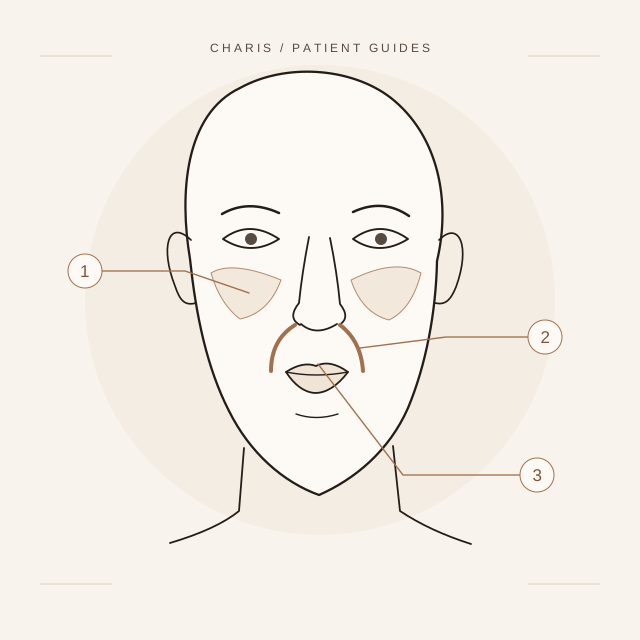
A closer look
A fold at the cheek–lip boundary
Cheek
Fat, bone and skin changes above the fold can affect how it looks.
Nasolabial fold
Runs beside the nose towards the mouth corner. It is a normal facial feature.
Upper lip
The fold separates the cheek from the upper-lip region. Smiling changes its appearance.
Surface anatomy is simplified. The illustration does not show blood vessels, injection planes or treatment sites.
Why filling the fold is usually the wrong move
If you inject product into the fold while the tissue above it is still descending, you have added weight to a heavy area. The fold may look shallower immediately, but the lower face reads as fuller and more pulled-down, and the effect tends to look worse in photographs than in a mirror.
It is also the treatment most likely to produce the look people are actively trying to avoid — the slightly swollen, slightly changed lower face that reads as work having been done.
This is one of the most common corrections I am asked about, and it is usually solved by dissolving and replanning rather than by adding more.
Restoring support instead
Placing structural support higher — over the cheekbone and in the midface, where bone and ligament support has been lost — lifts the tissue away from the fold and softens it at source. Very often that is all that is needed, and it uses less product than filling the fold would have.
It also improves several things at once: the fold, the flattening across the cheek, and often the hollow under the eye, all of which have the same underlying cause.
When treating the fold directly is appropriate
Sometimes, in small amounts, and afterwards. Where midface support has been restored and a residual crease remains — because it has been etched into the skin over decades — a very small amount of a soft product placed correctly can refine it.
The order matters. As a refinement it works. As a first move it usually does not.
If a clinic offers to treat your nasolabial folds without assessing your midface, that tells you something about how they plan treatment.
The skin component
Where the fold has become a fixed line in the skin as well as a structural fold, skin-quality treatment improves the etched part. Microneedling and skin boosters both help.
Structure first, then skin, is generally the right sequence — improving the skin over tissue that is still unsupported gives a smaller return.
What deepens a fold, and where the answer sits
Five things drive the change, they usually run together, and only one of them has its answer in the fold itself. Working out which is dominant for you is most of what a consultation is for — it decides whether the treatment goes in the cheek, in the skin, or nowhere at all.
| Contributor | What is happening | Where treatment belongs |
|---|---|---|
| Midface volume loss | The cheek deflates and its weight settles onto the fold | The cheek, not the fold |
| Bone change | Reduced support beneath the cheek and around the base of the nose | Deep structural placement |
| Skin laxity | Skin no longer holding its own weight | Skin quality treatment — or a surgical opinion where it is significant |
| Repeated movement | Smiling folds the same crease for decades | Skin quality; the fold itself is not the target |
| Weight loss | Facial fat pads reduce quickly | Structural support, usually at the cheek |
The area where anatomy matters most
Why this is a high-risk region
The facial artery and its branches run close to the nasolabial fold, and the vessels above it connect toward the blood supply of the eye. This is one of the two areas of the face where a vascular occlusion carries the most serious consequences, which is why depth, technique and knowing when not to inject matter more here than almost anywhere else.
That is a reason to ask directly what training the person holds and whether hyaluronidase is kept on site — not a reason to avoid the area, which is treated safely and routinely by people who know it well.
What good practice looks like
Aspiration or a cannula where the technique calls for it, slow placement, small volumes, and a practitioner willing to stop and reassess rather than finish the syringe. Anyone treating this area briskly is treating it as though it were the cheek.
Realistic outcomes, by starting point
| Starting point | Realistic result | Sessions |
|---|---|---|
| Mild fold, good skin quality | Substantially softened; reads as rested | One, sometimes two |
| Moderate fold with midface deflation | Noticeably softer, shadow reduced, cheek restored | Two, staged |
| Deep fold with significant laxity | Partial softening only — the fold remains | Volume alone is the wrong plan |
| Deep fold after major weight loss | Responds well to structural support | Two to three, staged |
The third row is the one that needs saying out loud at consultation. Where laxity is the dominant problem, more product produces a heavier face rather than a smoother one, and the honest conversation is about skin tightening or a surgical opinion instead.
Sources and further reading
This page is general information, not personal medical advice. Every treatment needs an individual assessment, and what is right for someone else may not be right for you.

About the author
Ashleigh Trickett
Registered Nurse & Aesthetic Practitioner
Registered Nurse with a BSc in Nursing and a PGCert in Critical Care (Manchester Metropolitan University, 2025). Ten years in the NHS, four of them in critical care. Advanced facial anatomy education at the Royal College of Surgeons with BAMAN, June 2026. Member of BAMAN and the Aesthetic Complications Expert Group. BAMAN Awards 2026 finalist for Rising Star of the Year.
Treatments this relates to
- Facial HarmonisationFrom £220
Full-face assessment and treatment planning — restoring support and balance across the face rather than treating features in isolation.
- Cheek Filler£550
Midface support to restore structure that has descended — not to build cheeks that were never there.
- Dermal Filler DissolvingFrom £200
Removal of hyaluronic acid filler — for migration, overfilling, or a result that no longer suits you.
- MicroneedlingFrom £150
Controlled micro-injury that prompts the skin to remodel — used for texture, scarring, pore size and overall quality.
Common questions
- Can nasolabial folds be removed completely?
- No, and you should not want that — the fold is normal anatomy and a face without one looks odd. Softening it so it reads as it did ten years ago is the realistic and better-looking aim.
- Why did filler make me look heavier?
- Most likely product placed into the fold rather than support restored above it. It is a common outcome and it is correctable — usually by dissolving, letting the tissue settle, and replanning.
- How much product will I need?
- Restoring midface support usually takes more than filling a fold would, but it treats several concerns at once and lasts longer. You will get a realistic figure at consultation and the plan can be staged.
- How long does it last?
- Structural midface support commonly lasts 12 to 18 months, as the area is relatively static compared with the mouth.
- Is there anything non-injectable that helps?
- Skin quality treatment improves the etched component, and sun protection slows the collagen loss that contributes. Neither replaces lost structural support.
Read next
Facial harmonisation
Marionette lines
The lines from the mouth corners toward the jaw — why they make a resting face look unhappy, and why the answer is structural.
Facial harmonisation
Treating jowls without surgery
Why jowls form, which stage responds to treatment, and the point at which filler makes them worse.
Facial harmonisation
Is there such a thing as a non-surgical facelift?
What the phrase actually means, what it can and cannot do, and when the honest answer is a surgeon.
Facial harmonisation
Hollow cheeks: why they happen, and what actually fills them
Cheeks lose fat before the rest of the face does. What causes hollowing, which treatments genuinely restore it, and the one mistake that makes a hollow face look heavier rather than fuller.
Get in touch
Book a consultation
Consultations are £30, and that comes off the cost of your treatment if you go ahead. No pressure to book anything on the day — if you are not sure whether you want treatment at all, that is still a good reason to come and talk.