From the Treatment Room · Behind the scenes
Working with Doctor Alex Parys
Pinch me!
Ashleigh Trickett, Registered Nurse & Aesthetic Practitioner · 27 October 2026
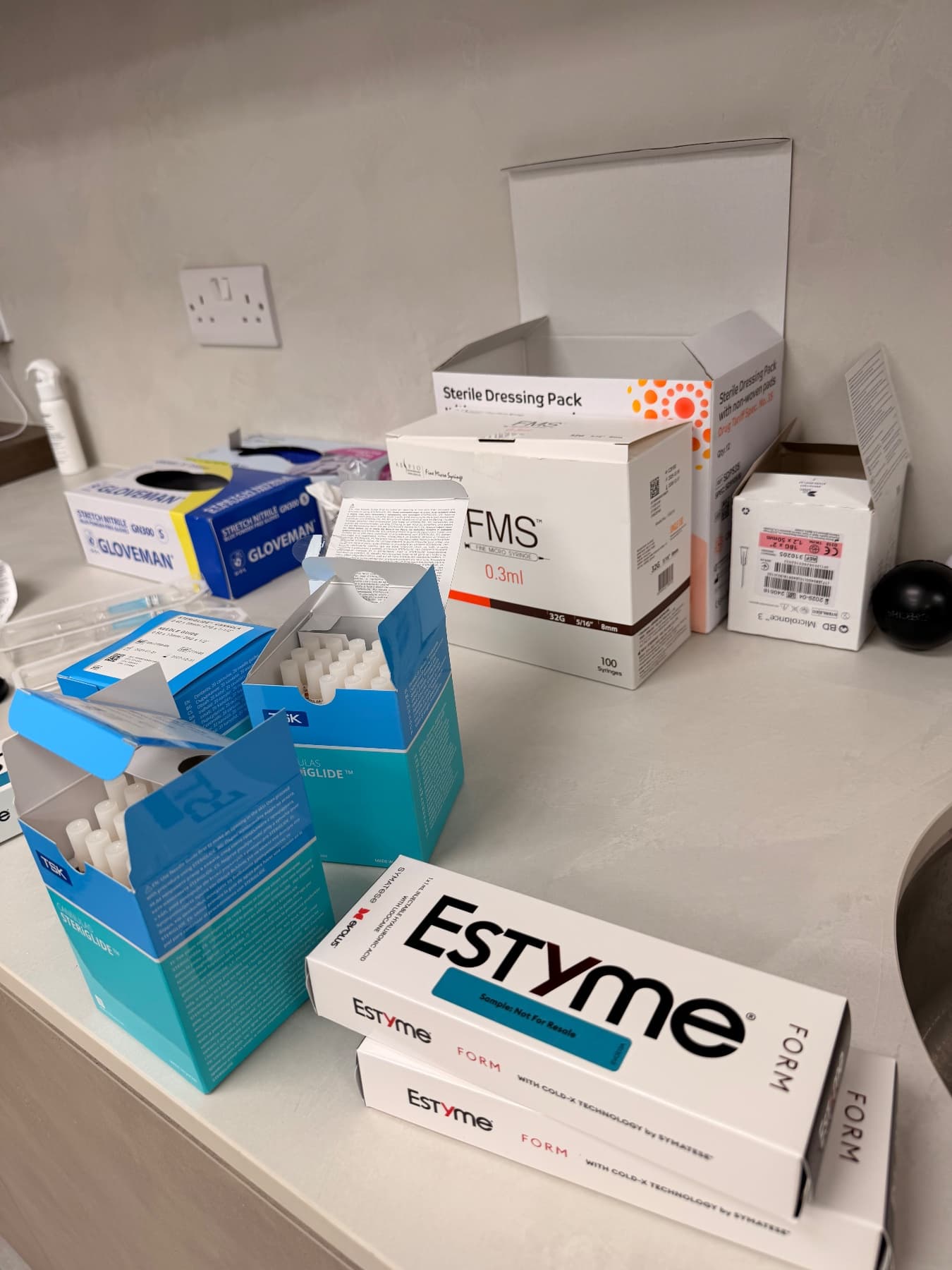
If you’ve read my previous article about dermal fillers, you’ll know I’ve been doing a lot of research into what I actually want from the products I use in clinic.
So this particular training day was so exciting for me!
I had the opportunity to spend time working alongside Dr Alex Parys at SONÜ Clinic in Hale, Altrincham.
Dr Alex is an award-winning aesthetic doctor, international educator and someone with extensive experience in facial aesthetics. Not only is he super talented but he is such a nice person too! 🥹 He also won Rising Star of The Year Award! An award I was nominated for 😱 He was also involved in the UK introduction of Estyme, a range of hyaluronic acid dermal fillers I’ve been interested in for quite some time.
So naturally, I had about a million questions. 😂
Anatomy, technique and learning from experience
We spent time discussing facial anatomy and physiology in detail, including anatomical danger zones, arterial branches, nerves and the different tissue planes we work within when injecting.
These are areas I’ve already studied extensively, particularly through my advanced anatomical and cadaveric dissection training.
And something I found really reassuring was seeing how closely my own injection techniques aligned with those Dr Alex was using.
I think when you’re constantly learning and questioning your own practice, it’s easy to focus on what you don’t know rather than recognising what you do, I’m always my biggest critic.
So being able to learn from somebody with his experience, pick up some really useful tips and see those techniques in practice was invaluable.
But what impressed me most was the results.
Such small amounts of filler, yet such beautiful, natural-looking improvements.
And that’s exactly what I’ve been looking for.
So what makes Estyme different?
Now this is the part I find really interesting!
Most hyaluronic acid dermal fillers are manufactured using a process called cross-linking.
Hyaluronic acid (HA) is something our bodies naturally produce, and it plays an important role in tissue hydration.
But naturally occurring HA breaks down relatively quickly, so manufacturers chemically cross-link it to create a gel that can provide longer-lasting support within the tissues.
Traditional manufacturing processes commonly use heat, which can affect the structure of the HA chains.
Estyme uses something called Cold-X technology.
Rather than relying on conventional higher-temperature cross-linking, this technology uses near-freezing temperatures, designed to preserve more of the original HA chain structure.
And this is what initially caught my attention.
The idea is that by preserving the HA structure, we can create fillers with properties that allow them to integrate into the tissues and behave naturally during facial movement, whilst still providing the support we need.
I don’t want somebody to look lovely when they’re sitting still but have a result that looks unnatural when they smile or talk.
Our faces are constantly moving, and I want the products I use to work with that movement.
Of course, manufacturing technology alone doesn’t guarantee a better result. Product selection, anatomy, injection technique and individual tissue characteristics all matter.
But I find the science behind this technology genuinely exciting.
What about safety and longevity?
Another thing that stood out to me was Estyme’s certification under the European Medical Device Regulation (MDR).
This means the range has undergone assessment against stringent European requirements for medical device safety, quality and performance.
And that’s important to me.
It doesn’t mean complications are impossible or that Estyme is automatically safer than every other filler, but regulatory standards and the evidence supporting a product are things I take seriously when deciding what to introduce into my clinic.
I’m also particularly interested in longevity.
Not simply how long a filler makes somebody look fuller, but how it behaves within the tissues over time.
How well does it maintain its intended effect? How does it respond to movement? What happens as it gradually breaks down?
And importantly, what do we know about the product that might still be present when somebody returns for future treatment?
We still need longer-term evidence to understand whether Estyme offers advantages in degradation, migration or other complications compared with established fillers.
But these are exactly the questions I’m interested in.
Why using less matters to me
One of the biggest things I took away from yesterday was seeing how much could be achieved with relatively small amounts of product.
I’ve said before that I don’t think repeatedly adding more and more filler is a sustainable approach to aesthetic medicine.
And I stand by that.
I’m interested in achieving the right amount of correction, in the right anatomical plane, using the most appropriate product for that individual.
Not simply injecting more because we can.
Seeing the results Dr Alex achieved reinforced something I’ve been thinking for a long time.
It’s not about how much filler we use. It’s about what we can achieve with it.
And whilst using less product doesn’t automatically eliminate complications, avoiding unnecessary volume is something I believe is important when planning treatments over the long term.
What this means for Charis
This has been such an exciting research journey for me.
I’ve spent time looking into different fillers, their physical properties, how they’re manufactured and the evidence behind them.
And I didn’t want to introduce Estyme simply because it was new or because I’d seen some impressive results online.
I wanted to see it being used, understand the techniques, ask questions and learn from somebody with extensive experience.
This training really reinforced why this is the direction I want to take Charis.
Natural results, considered product selection, smaller volumes where appropriate and a focus on long-term patient outcomes.
I’m not interested in chasing trends or continually adding volume to people’s faces.
I want to understand the products I’m using, why I’m choosing them and what that means for my patients, not just immediately after treatment but in the years to come.
And that’s why I’m so excited about bringing Estyme into my practice.
Ashleigh x
Mentioned in this note
- Cheek Filler
Midface support to restore structure that has descended — not to build cheeks that were never there.
- Chin Filler
Projection and balance in the lower face — often the single most effective treatment for a profile.
- Dermal Filler Dissolving
Filler dissolving, including lip filler dissolving — removal of hyaluronic acid filler for migration, overfilling, or a result that no longer suits you.
- Marionette Lines
Softening the lines that run down from the corners of the mouth — by restoring the support around them, not only filling the crease.
- Signature Lips
Hyaluronic acid lip enhancement built around your existing anatomy — shape and balance before volume.
- Tear Trough Treatment
Treatment of the under-eye hollow — where correct assessment matters more than any product choice.
- Jawline Filler
Definition along the jaw, for softening from age-related bone loss or for a naturally less defined jawline.
- Facial Harmonisation
Full-face assessment and treatment planning — restoring support and balance across the face rather than treating features in isolation.
Read next
More in from the treatment room. This is a note from clinic, not personal medical advice. What applies to you is decided at assessment — the guides carry the fuller explanations, and the consultation is where anything is actually decided.
Get in touch
Book a consultation
Consultations are £30, and that comes off the cost of your treatment if you go ahead. No pressure to book anything on the day — if you are not sure whether you want treatment at all, that is still a good reason to come and talk.