From the Treatment Room · Behind the scenes
Qualified on Paper, Competent in Practice?
The Reality of Aesthetic Training - My Own Experience.
Ashleigh Trickett, Registered Nurse & Aesthetic Practitioner · 28 October 2026
The reason I want to become involved in raising standards within aesthetic medicine, and why I feel so passionately about it, comes from my own experience of entering the industry.
When I first decided to train in aesthetics, I paid £4,000 for a course that would supposedly leave me suitably qualified to administer dermal fillers, anti-wrinkle, skin boosters and polynucleotides, as well as perform micro-needling treatments.
The course was one week long.
One week to learn all of that.
As a critical care nurse, I was already very aware of my own limitations. The thought of injecting people’s faces genuinely frightened me. Not because I lacked clinical confidence, but because I understood the responsibility involved and knew there had to be an enormous amount to learn.
I asked whether I could complete the course over almost two months instead, allowing myself more time to absorb the information and understand what I was about to learn.
I was given PDF workbooks. I read through them, made notes and studied the material, but I couldn’t shake the feeling that there had to be more to it than this.
I already had an extensive understanding of aseptic non-touch technique (ANTT). In my role in intensive care, I’m an ANTT assessor. I assess doctors, nurses, consultants and physiotherapists, ensuring that the principles of aseptic practice and infection prevention are being followed.
So naturally, I began applying those same principles to my aesthetic practice.
I thought, if I can apply the standards of ANTT and infection control that I use every day in ICU, surely that can only improve my patients’ safety and, ultimately, the quality of my practice?
But there was something else that really struck me during my initial training.
Injection points.
I remember being told something along the lines of, “Use these points and you’ll never drop a brow or cause a ptosis.”
And I remember thinking, but surely everyone’s anatomy is different?
I’ve worked in intensive care for years. I’ve seen inside patients’ abdomens, limbs, lungs and necks. I’ve seen patients whose anatomy was completely different from what you’d expect.
I’ve even cared for patients whose heart was on the opposite side of their chest. It’s called dextrocardia.
And, by the way, that’s a pretty important thing to recognise when a patient arrests! Depending on the circumstances, recognising unusual anatomy can influence decisions about defibrillation pad placement, alongside established resuscitation guidance.
The point is, not every patient’s anatomy is identical.
Similar? Yes.
But identical to the diagrams in a textbook? Absolutely not.
We aren’t textbooks. We’re human beings.
So I wasn’t satisfied with being told to stick to certain injection points and everything would be fine.
My ICU background has taught me to think about every eventuality. Even when something is rare, it can still happen. And when it does happen, you need to recognise it, understand it and know what to do.
These are people’s lives we’re talking about.
So I started researching.
I discovered Dr Tim Pearce and began working through every piece of free anatomy and physiology education I could get my hands on.
I bought facial anatomy textbooks. I studied and memorised facial arteries, explored anatomical foramina and learned the pathways of facial nerves.
And I loved it.
This is my bread and butter. It’s my passion.
When I completed my postgraduate certificate in Critical Care Nursing, I memorised the cranial nerves. I could explain the propagation of an action potential, the anion gap consept, the clotting cascade and the pharmacological mechanisms of drugs that interrupt different stages of that cascade.
You’re probably wondering why any of that is relevant to aesthetic medicine.
Well, to me, aesthetic medicine is another specialty that demands the same depth of scientific understanding I needed when studying critical care.
Take the anion gap, for example. In critical care, we’re looking at the relationship between measured cations and anions, including bicarbonate, to help us interpret acid-base disturbances.
In aesthetic medicine, we’re also dealing with chemistry, electrical charges, molecular interactions and formulation characteristics. Prescription only medicine formulations, hyaluronic acid structures and polynucleotide products each have their own chemistry that deserves to be understood. They aren’t the same concepts as the clinical anion gap, but my background gave me a foundation for exploring them.
I wanted to understand what I was putting into people’s faces, how it worked, why it behaved the way it did and what could potentially go wrong.
Thank God for my background, honestly.
I went on to spend thousands more on what was advertised as advanced training.
And some of those experiences left me even more frustrated.
I’d attend a full day of training, sometimes treating 12–14 patients back to back. I’d assess each patient, explain my injection technique, mark out danger zones, palpate relevant anatomical landmarks and accessible vessels, discuss potential anatomical variations and explain my rationale for choosing particular approaches.
I’d explain what I was doing, why I was doing it and what I was trying to avoid.
And I’d be told, “I can’t teach you anything. You know exactly what you’re doing.”
Sometimes the trainer would simply sit back and watch me work.
I even had trainers ask me to do their own filler at the end of the day!
Now, I understand that might sound like a compliment.
But I hadn’t paid thousands of pounds for compliments.
I didn’t want certificates. I wanted knowledge.
I wanted somebody to challenge my thinking, question my rationale, show me something I hadn’t considered and help me become a better practitioner.
I wanted to leave those courses with more knowledge, more understanding and, importantly, more of the right questions to ask.
Because surely that’s what advanced education should do?
It shouldn’t just confirm what you already know.
It should show you what you don’t.
Around this time, I came across Dr Tim Pearce discussing full-face assessments, and it really resonated with me.
I began researching the concept further, because it reminded me so much of how I approach patients in critical care.
When I arrive in ICU in the morning, I might already know some of the patient’s background, but I don’t simply walk in and start carrying out interventions.
I assess.
I gather information throughout the morning to understand where that patient is in their critical illness, what their most pressing problems are, what concerns need escalating and what the priorities should be.
I work with the consultant and multidisciplinary team to develop a plan.
I’ve also worked shifts in A&E, where the importance of thorough assessment becomes even more obvious.
A patient might present with breathlessness and tell you they have no medical history.
But as you’re taking their history, asking about their lifestyle, observing their physical presentation and examining them, you notice lower-limb oedema.
They tell you they don’t have any medical conditions, but it turns out they’re somebody who simply never goes to the doctors.
Now, if you know, you know.
You start thinking about what might be going on beneath the surface. You don’t just accept the first piece of information you’re given and stop there.
You ask questions.
You gather information.
You use your knowledge and clinical reasoning to consider the possibilities.
And I realised that this was exactly how I wanted to approach aesthetic medicine.
I didn’t want someone to walk into my clinic, point at their lips and say, “I want filler,” and for me to simply inject them.
I wanted to know them.
I wanted to establish rapport, take a full medical history, understand their lifestyle, their expectations, their previous experiences and what had brought them to me.
I wanted to look beyond the information they initially volunteered and ask the questions that might reveal something important.
Was this patient actually a suitable candidate for the treatment they were requesting?
Would another approach be more appropriate?
Were there contraindications or concerns that needed exploring?
And sometimes, was the right decision to explain that there was nothing I could safely or appropriately offer?
Just because somebody wants a treatment doesn’t mean they should have it.
Then there was follow-up.
Something that has frustrated me throughout my nursing career is seeing what can happen when follow-up and reassessment aren’t given enough attention.
Think about your grandad going to the GP with high blood pressure.
He’s prescribed an antihypertensive, perhaps ramipril. He also has emphysema and develops a persistent cough. He goes back to the doctor, his medication is changed, and then there’s no meaningful follow-up.
Two years later, he’s feeling light-headed and experiencing presyncope.
His blood pressure is checked over several weeks, and his systolic readings are frequently below 100.
Now, that doesn’t automatically tell us the cause of his symptoms, but surely it raises questions that need investigating?
For me, that illustrates why reassessment matters.
You don’t just prescribe something, perform a procedure or deliver a treatment and assume that because the patient has left the room, your responsibility is finished.
I wanted my aesthetic practice to be different.
I wanted to be known for safe aesthetic medicine.
I wanted to change the narrative around the experiences I’d personally had as someone receiving filler and other aesthetic treatments.
Because, honestly, some of my own experiences had been awful.
I remember having numbing cream slapped onto my face while sitting in a waiting room with four other people.
Twenty minutes later, I’d be called through.
No meaningful consultation.
No proper discussion about my facial anatomy, my expectations or whether what I was asking for was actually appropriate.
Just putting filler wherever I’d requested it.
Then I’d leave with awful swelling, bruising and results I was disappointed with.
And this happened repeatedly.
Eventually, I gave up.
When I decided to branch out into aesthetic medicine as another area of clinical practice, I thought I could offer something different.
But I was absolutely devastated by some of what I encountered when I entered the industry.
I remember attending an aesthetics event, nearly £1000 where demonstrations that, in my view, showed little consideration for individual anatomy and poor ANTT.
There seemed to be so much emphasis on different ways to inject, rather than the clinical reasoning and safety principles underpinning those techniques.
I was so uncomfortable that I paid £80 for a taxi home.
And that put me off for life! 😂
But I couldn’t stop thinking that there had to be more to this industry.
There just had to be.
I wanted to show patients that they could come into an aesthetic clinic and feel safe, listened to and properly cared for.
That they could receive good treatment, appropriate follow-up and the same professional consideration they’d expect when attending a medical clinic for wound care or another outpatient procedure.
Why should aesthetic medicine be treated as though it sits outside the standards we expect from healthcare?
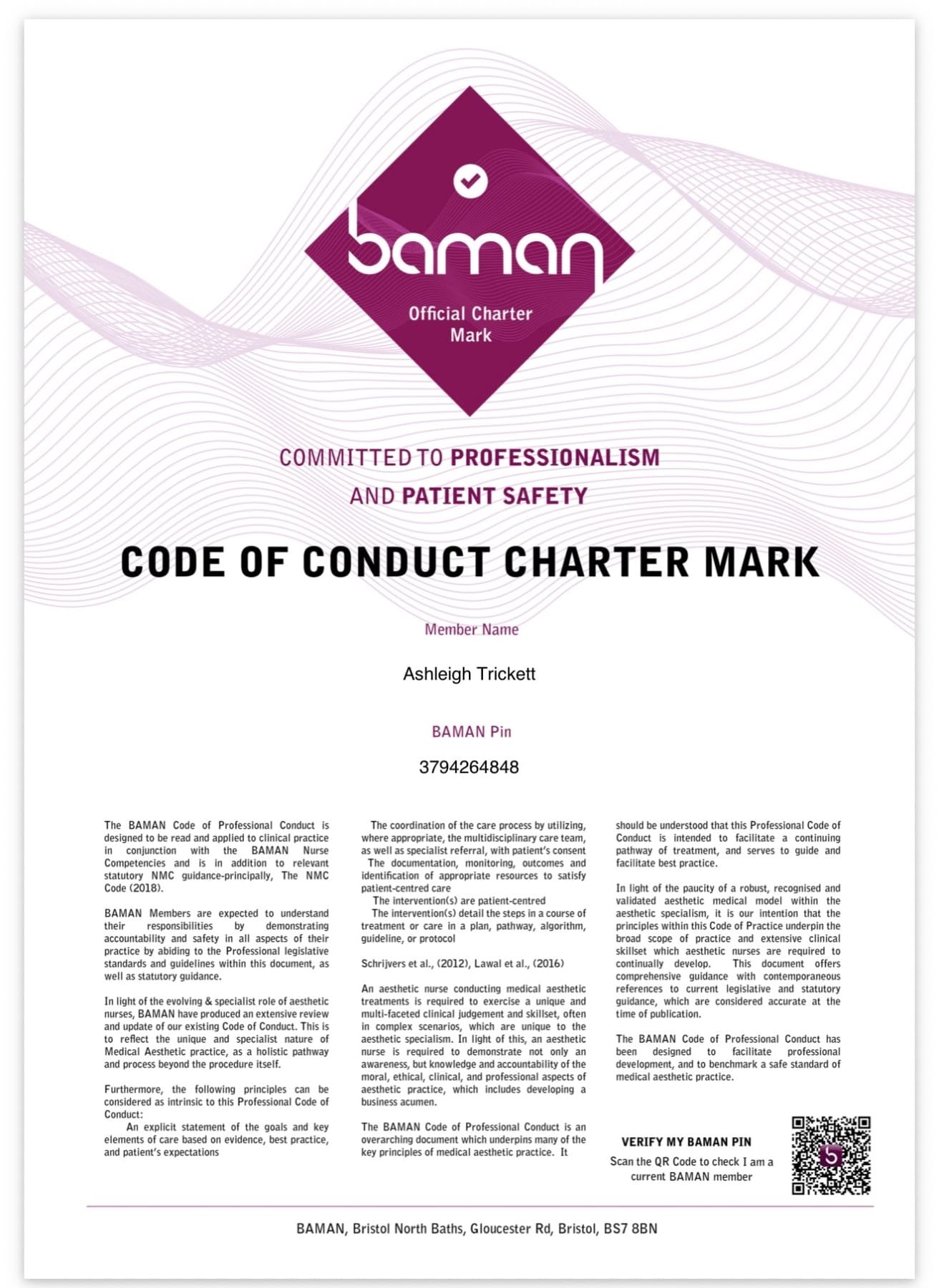
Then I discovered BAMAN.
The British Association of Medical Aesthetic Nurses.
I came across an event they were holding at the Royal College of Surgeons of Edinburgh.
More money for training, yes!
But this time, something felt different.
I started reading about the organisation, its advocacy for nurses working in medical aesthetics and its commitment to developing professional frameworks, governance and better standards.
And I remember thinking:
This is it. I’ve found my people.
I joined immediately.
I booked the event and took myself, completely alone, to the Royal College of Surgeons in Edinburgh
Mentioned in this note
- Bio-Spicule Therapy
A needle-free resurfacing treatment using microscopic marine sponge spicules to open micro-channels in the skin, driving a controlled renewal over the following week.
- Celora Vita™
A skin booster built on nine amino acids alongside hyaluronic acid — delivering the building blocks skin uses to make collagen and elastin, rather than only stimulating it.
- Cheek Filler
Midface support to restore structure that has descended — not to build cheeks that were never there.
- Chin Filler
Projection and balance in the lower face — often the single most effective treatment for a profile.
- Chemical Peels
A resurfacing treatment that accelerates cell turnover — used for pigmentation, congestion, texture and dullness.
- Dermal Filler Dissolving
Filler dissolving, including lip filler dissolving — removal of hyaluronic acid filler for migration, overfilling, or a result that no longer suits you.
- Fat Dissolving Injections
Injectable treatment for small, localised pockets of fat that have not responded to diet and exercise.
- Facial Harmonisation
Full-face assessment and treatment planning — restoring support and balance across the face rather than treating features in isolation.
- Lines & Wrinkles Consultation
A consultation for the treatment of lines and wrinkles — assessment first, with the options and what they can realistically achieve discussed before anything is decided.
- Jawline Filler
Definition along the jaw, for softening from age-related bone loss or for a naturally less defined jawline.
- Marionette Lines
Softening the lines that run down from the corners of the mouth — by restoring the support around them, not only filling the crease.
- Microneedling
Controlled micro-injury that prompts the skin to remodel — used for texture, scarring, pore size and overall quality.
- Non-Surgical Rhinoplasty
Filler used to refine the profile of the nose — camouflaging a dorsal hump, lifting the tip, improving symmetry.
- Polynucleotides
Regenerative injectable treatment that works on skin quality — hydration, elasticity and firmness — rather than adding volume.
- PRP for Hair Loss
Platelet-rich plasma injected into the scalp to support follicle health in early-stage thinning.
- PRP & PRF Facial
Your own platelet-rich plasma, used to prompt skin repair. Sometimes called a vampire or liquid gold facial.
- Purasomes HSC50+ Hair & Scalp Complex
Purasomes HSC50+, an exosome-based scalp treatment for early thinning — the newer alternative to PRP, and the honest position on what the evidence currently supports.
- Signature Lips
Hyaluronic acid lip enhancement built around your existing anatomy — shape and balance before volume.
- Skin Boosters
The category explained — what a skin booster is, how the options differ, and how to work out which one you actually need.
- Sunekos
An amino acid and hyaluronic acid injectable that supports the skin's extracellular matrix — used where skin has lost density.
- Teoxane BabyGLOW
A skin booster that improves hydration, elasticity and firmness across larger areas — face, neck and hands — without adding volume.
- Tear Trough Treatment
Treatment of the under-eye hollow — where correct assessment matters more than any product choice.
Read next
Note
There’s So Much More To Aesthetics Than Just Injecting
Charis aesthetics isn’t just aesthetics, my clinic is my passion!
Advice
Regenerative Aesthetics
Why I’m so interested in treating skin at a cellular level. Not just chasing lines and folds
Note
The Anatomy Lesson I Was NOT Prepared For
Cadaveric Dissection
More in from the treatment room. This is a note from clinic, not personal medical advice. What applies to you is decided at assessment — the guides carry the fuller explanations, and the consultation is where anything is actually decided.
Get in touch
Book a consultation
Consultations are £30, and that comes off the cost of your treatment if you go ahead. No pressure to book anything on the day — if you are not sure whether you want treatment at all, that is still a good reason to come and talk.